Introduction
The art and antiquities market relies heavily upon connoisseurship, reputation, scholarship, and trust. Like any high-value market built upon specialized knowledge requiring cross-disciplinary expertise, it is also vulnerable to incomplete documentation, inherited assumptions, commercial incentives, conflicts of interest, and inadequate due diligence.
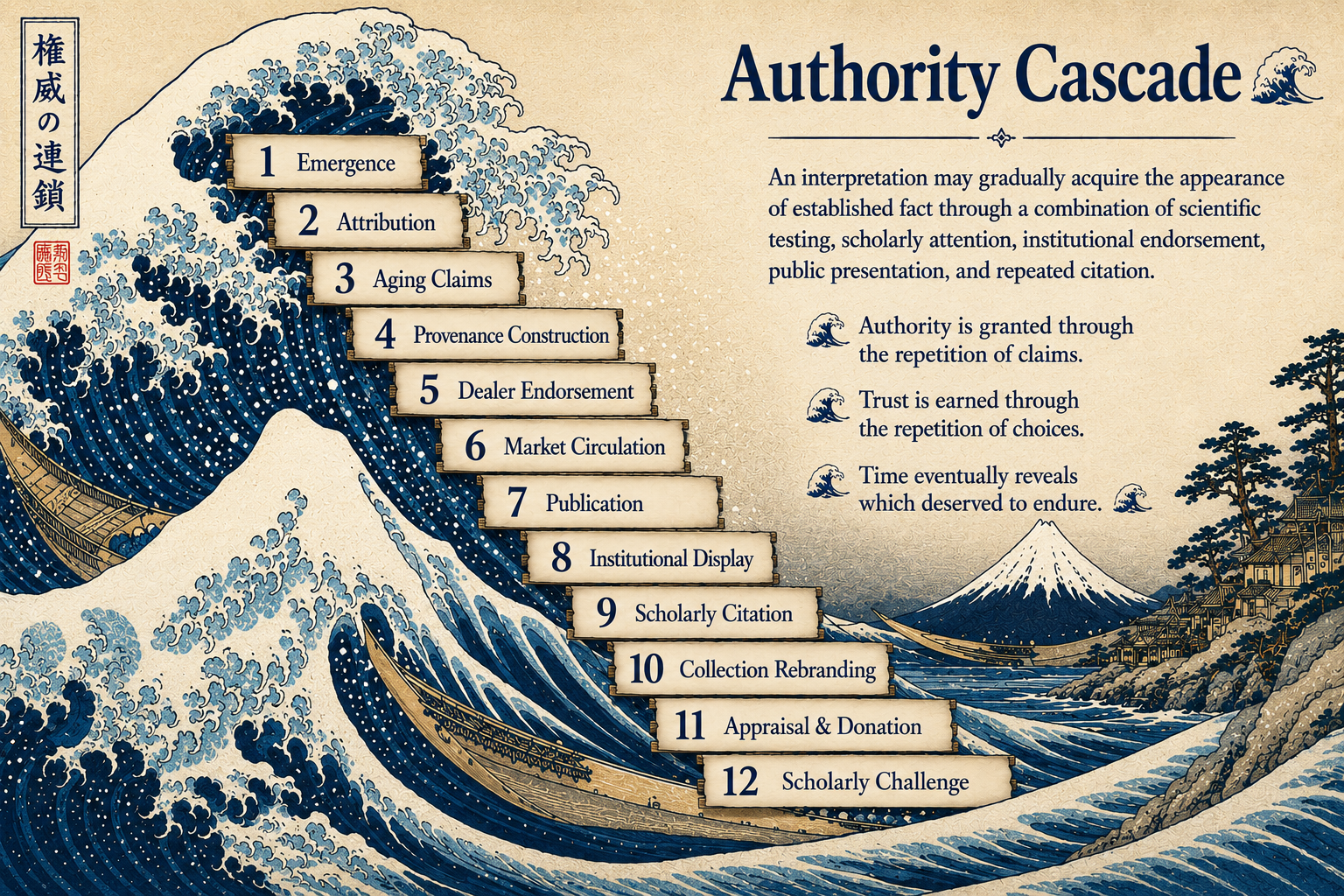
Authority Cascades typically begin with incomplete evidence, informed opinion, and provisional conclusions that gradually become accepted as established fact through repetition rather than through independent verification.
Scientific testing reports are frequently treated as authentication reports, even though most analytical techniques evaluate only specific samples, materials, properties, or characteristics that may contribute to—but do not establish—an object's authenticity.
That distinction matters.
The purpose of scholarship is not merely to repeat conclusions—it is to continually examine whether those conclusions remain proportionate to the evidence supporting them.
Structural Vulnerabilities
The Tribal Art and other antiquities markets illustrate these challenges particularly well because several characteristics naturally increase uncertainty:
- Provenance gaps are common rather than exceptional.
- Early collecting histories are frequently incomplete.
- Stylistic attribution often fills evidentiary gaps.
- Publication, exhibition history, and institutional ownership substantially influence market confidence.
- Pre-1970 ownership frequently receives disproportionate evidentiary weight because of cultural property considerations.
These conditions naturally increase uncertainty and elevate the importance of independent verification.
They simply create an environment in which interpretations can gradually accumulate authority through repetition.
The Authority Cascade as a Systems Model
The Authority Cascade is a systems model describing how confidence may progressively accumulate within scholarly, institutional, and commercial environments. It does not know the intentions of individual participants. Instead, it examines the cumulative effects of repeated reliance upon earlier conclusions. Honest scholarship, incomplete evidence, commercial incentives, institutional priorities, confirmation bias, inadequate due diligence, and deliberate deception may all contribute to the same outcome: confidence that gradually outpaces independently verified evidence.
Its purpose is not to assign blame, but to encourage investigators to periodically return to the primary evidence and ask whether the accumulated authority remains justified.
When Repetition Replaces Evidence
One of the most persistent misconceptions in the art market is that repeated claims gradually become stronger evidence.
Repetition changes perception. It does not change the evidence. Only independent verification can strengthen the evidentiary foundation.
Two Types of Error
Systematic errors are consistent, repeatable inaccuracies that influence conclusions while leaving the underlying investigative framework intact.
Foundational errors arise when the underlying assumptions, methodology, or evidentiary framework are themselves flawed. Because every subsequent conclusion depends upon those foundations, foundational errors may propagate throughout an entire body of scholarship, institutional practice, and market understanding.
The Authority Cascade frequently illustrates how foundational errors, once established, may be systematically reinforced through repetition.
A New Era of Verification
The art and antiquities market is entering a period in which long-standing assumptions, undocumented opinions, and inherited authority will increasingly be tested against expanding scientific capabilities, digitized historical records, artificial intelligence, improved provenance research, and growing public expectations for transparency.
The environment surrounding authentication has fundamentally changed. Practices once sustained primarily by reputation, convention, or limited access to information will increasingly be expected to withstand independent verification.
The same advances that now expose unsupported assumptions also provide an opportunity to strengthen the evidentiary foundations of museums, collections, scholarship, and the art market.
Due Diligence in the Age of AI
Emerging AI capabilities can now generate plausible provenance narratives, fabricate supporting documentation and correspondence, alter or create convincing photographs, simulate historical records, and assist in producing increasingly sophisticated false or misleading evidence. At the same time, AI also provides investigators with powerful new capabilities for research, comparative analysis, document examination, image analysis, anomaly detection, and the identification of inconsistencies that previously would have been impractical to detect.
These developments fundamentally change what constitutes reasonable professional due diligence. Independent verification, forensic examination, transparent investigative methodology, and cross-disciplinary expertise are becoming increasingly essential as both authentic and fabricated evidence grow more sophisticated.
The continued evolution of professional standards will affect every participant in the art and cultural property ecosystem, including collectors, dealers, galleries, auction houses, museums, appraisers practicing under USPAP, conservators, provenance researchers, scientific testing laboratories, financial institutions, governmental agencies, attorneys, insurers, expert witnesses, and the IRS Art Advisory Panel. These topics will be explored further in a forthcoming paper on the future of evidence‑based authentication and investigation.
Toward a Methodology of Independent Verification
For collectors, dealers, galleries, auction houses, museums, appraisers, and other professionals working with art and cultural property, the Authority Cascade is not merely a framework for suspicion—it is a model of professional risk management and due diligence.
The greatest risk within mature authentication ecosystems is not always deliberate deception. It is the gradual replacement of independent verification with inherited confidence.
Its purpose is to encourage investigators to periodically return to the underlying evidence and ask simple questions:
- What evidence actually supports this conclusion?
- Which elements have been independently verified?
- Which assumptions have simply been repeated?
- Has the authority surrounding the object grown faster than the evidentiary record?
- What additional investigation would materially strengthen—or weaken—the current interpretation?
Those questions do not diminish scholarship.
They strengthen it.
Conclusion
Authority and evidence are closely related, but they are not synonymous. Authority can grow through publication, institutional endorsement, market acceptance, appraisal, donation, and repeated citation. Evidence grows only through careful observation, transparent methodology, rigorous testing, and independent verification.
The healthiest scholarship continually reconnects authority to its evidentiary foundations. In an era of better scientific tools, broader digital access, improved provenance research, and increasing public scrutiny, that reconnection is no longer merely aspirational. It is becoming a necessary component of responsible stewardship.