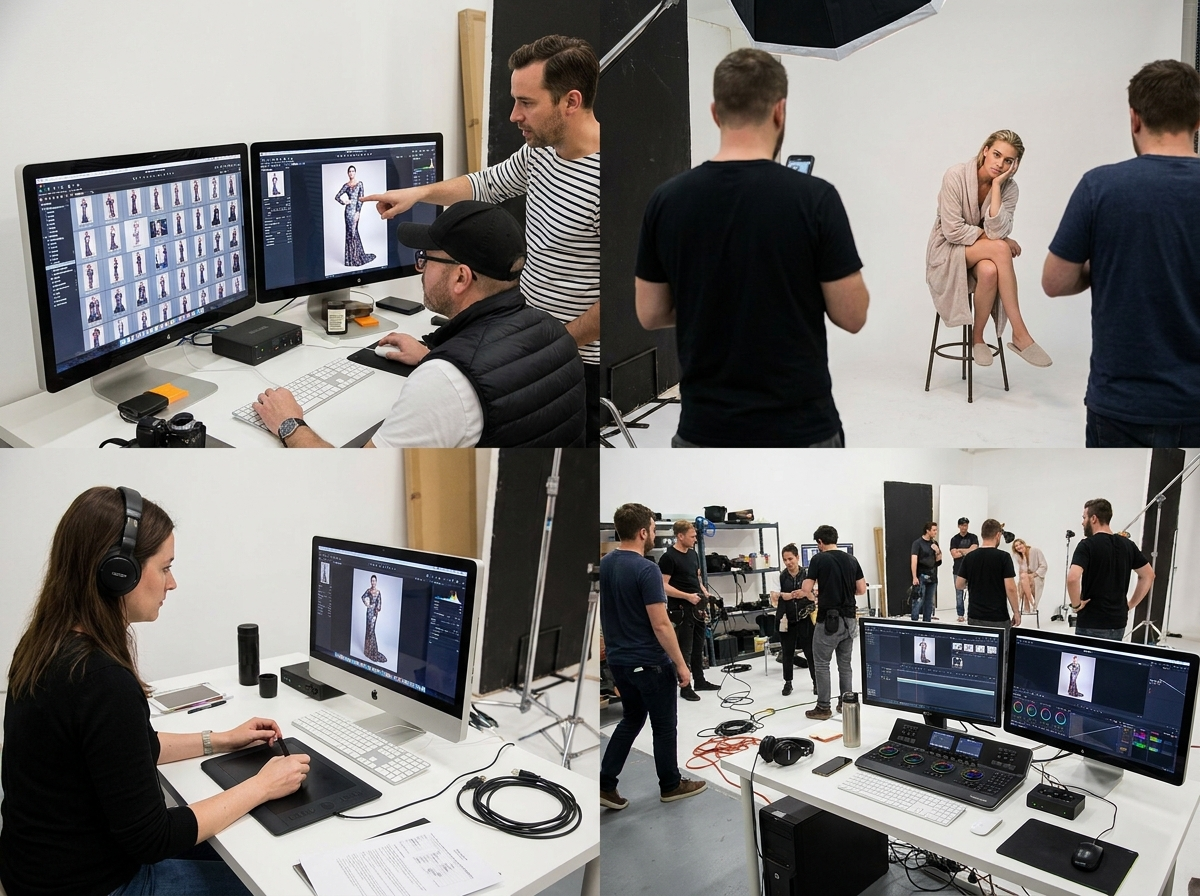
Every brand that has sat through a photography quote has done the same arithmetic. Take the invoice, divide by the number of photos, and see whether the result feels reasonable.
It is the right instinct. Product imagery is a per-unit cost of doing business, and per-unit costs should be measured per unit.
The problem is what people divide by. Almost everyone divides by the number of images produced. The number that matters is the number of images actually used.
Those two numbers are nowhere near each other.
01 - The denominator Frames shot and frames used are different numbers
Here is what a shoot actually produces. A photographer works a garment for about two hours and comes away with roughly three hundred frames. Of those, around twenty survive selection. The other two hundred and eighty are discarded before anyone outside the room ever sees them.
That is not a sign of a bad shoot. That is a normal shoot. We walked through the full sequence in an earlier piece on how product photos are actually made, and the ratio holds across almost every professional production.
So when a studio says the day produced three hundred images, the honest reading is that the day produced twenty. Everything you paid for was spent finding those twenty.
You are not buying photographs. You are buying the search for the photographs that work. The discarded frames are not waste; they are the process. But they still have to be paid for, and they belong in the denominator.
Once you accept that, the arithmetic changes character. It stops being a question about price lists and becomes a question about yield.
02 - What the day actually buys Every line on the invoice is priced by the day, not by the photo
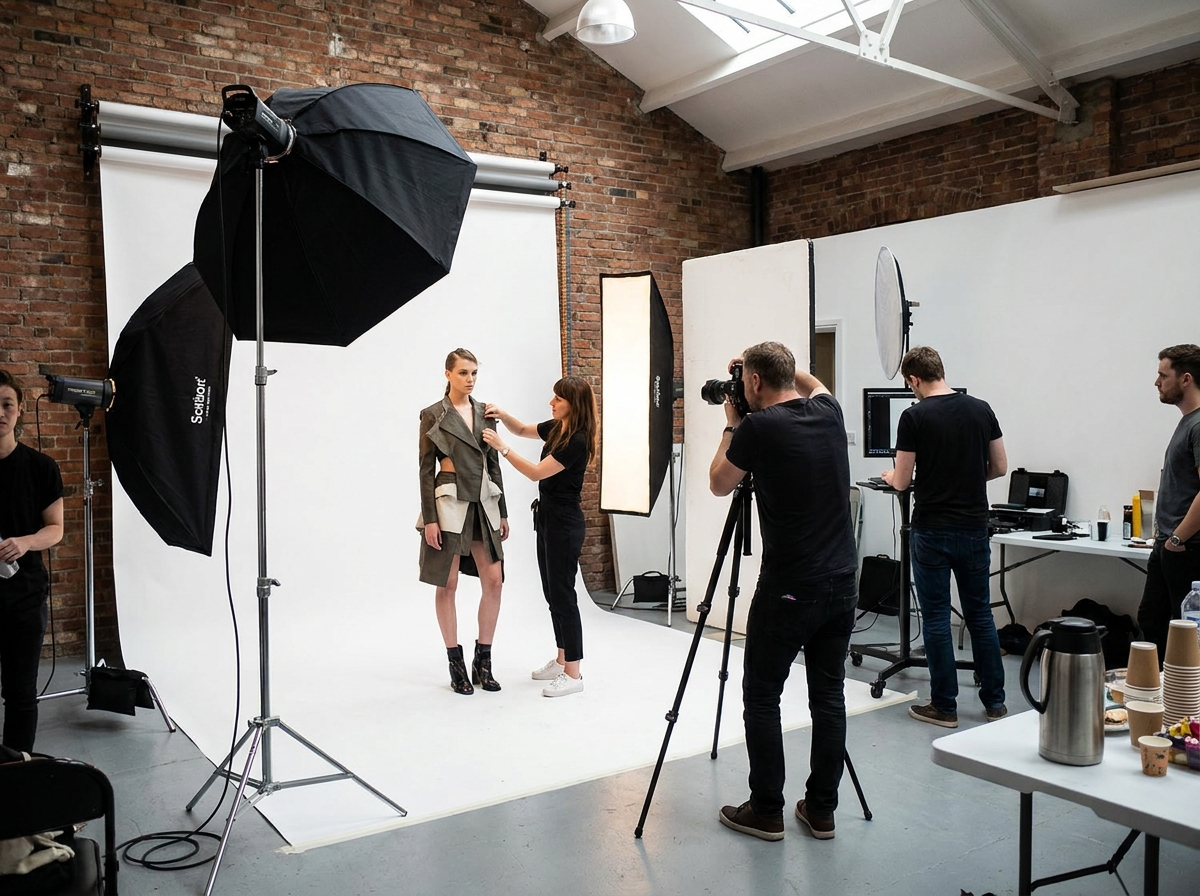
Look at what a shoot day is made of. The model is booked for the day. The agency takes its commission on that booking. Hair and makeup are booked for the day. The studio is rented by the day. The photographer, if not bundled, is engaged for the day. Retouching is the one line billed per image, and it applies to nearly every commercial fashion photo that ships.
Not one of those lines is priced by output. You commit the full cost before anyone knows how the day will go. We itemized the actual ranges in the guide to booking Korean model agencies and in the breakdown of how product photos are made, so we will not repeat them here. The structural point matters more than the figures.
The invoice is fixed. The yield is not. That asymmetry is the entire story. A day that produces a generous set of keepers and a day that produces a thin one cost exactly the same. Which means your real cost per image is not set by what you negotiated. It is set by how the day went.
And that is the optimistic case, where nothing goes wrong.
Things go wrong.
03 - The multipliers Three things that sit on top, and none of them are billed
Three factors decide how far your real cost drifts from the quoted one. None of them appear on any invoice, and all three compound.
-
Yield Every discarded frame is paid for at full price
Halve the number of keepers a day produces and you have doubled your cost per usable image. Nothing about the invoice changed. This is the most sensitive variable in the entire calculation and the one nobody tracks. Most brands cannot tell you their keeper rate from last season without going back through the files.
-
Rework A reshoot does not add cost, it multiplies it
When a shoot comes back wrong, you do not pay a correction fee. You pay for another day: model, studio, crew, and the coordination around all of it. A single reshoot doubles the cost of everything that day was supposed to cover. And reshoots are not rare, because you find out whether the shoot worked only after everyone has gone home.
-
Waiting Time on the shelf is a cost per image too
Between the product being ready and the photos being ready, the item is not selling. Casting, scheduling, shooting, selecting, retouching, delivering: this runs in weeks, not days, and that is when the calendar cooperates. For a seasonal item, the weeks lost at the front of its window are the weeks it would have sold best. That loss is real, it scales with every SKU, and it never appears in any per-image quote.
Stack those three together and the honest cost of a published image is far above what the quote implied. Not because studios overcharge, but because the model has a low yield and a long cycle time built into it structurally. You are paying full price for the search, and paying again every time the search has to restart.
04 - The same math, applied to AI A low sticker price does not survive a low keeper rate
Everything above is an argument against conventional shoots, which is a convenient argument for us to make. So let us turn the same lens on our own category, where it is considerably less flattering.
Generic AI image tools quote a per-image price that looks unbeatable. If the denominator were the number of images generated, the conversation would be over before it started.
But the denominator is the number you can actually put on a product page. And that is where these tools tend to fall apart for fashion specifically. The output is recognizably synthetic: skin rendered too smooth, poses held too perfectly, garment drape that does not behave like fabric, a face that reads as generated the moment a shopper looks twice. For a mood board it is fine. For a listing where someone is deciding whether to trust you with their money, it is not.
So the keeper rate collapses, and it collapses much harder than on a real shoot. Generate a large batch, publish a handful. Whatever the sticker said, the effective cost is a large multiple of it, plus something the sticker never captures at all: the hours your team spends reviewing the images that were never going to work.
| What gets quoted | What decides the real cost | |
|---|---|---|
| Conventional shoot | A day rate | Keeper rate, reshoot risk, weeks of waiting |
| Generic AI tool | A price per generation | How many outputs survive a shopper's second look |
| What you should compare | Neither | Cost per image you actually published |
This is why realism is not an aesthetic preference. Realism is the denominator. An image that looks synthetic is not a cheaper image; it is a discarded frame that you paid to generate and paid again to review.
05 - What actually moves the number Yield and cycle time, not list price
If the real cost is governed by keeper rate and waiting time, then those are the two things worth optimizing. This is what StyleRoom was built around.
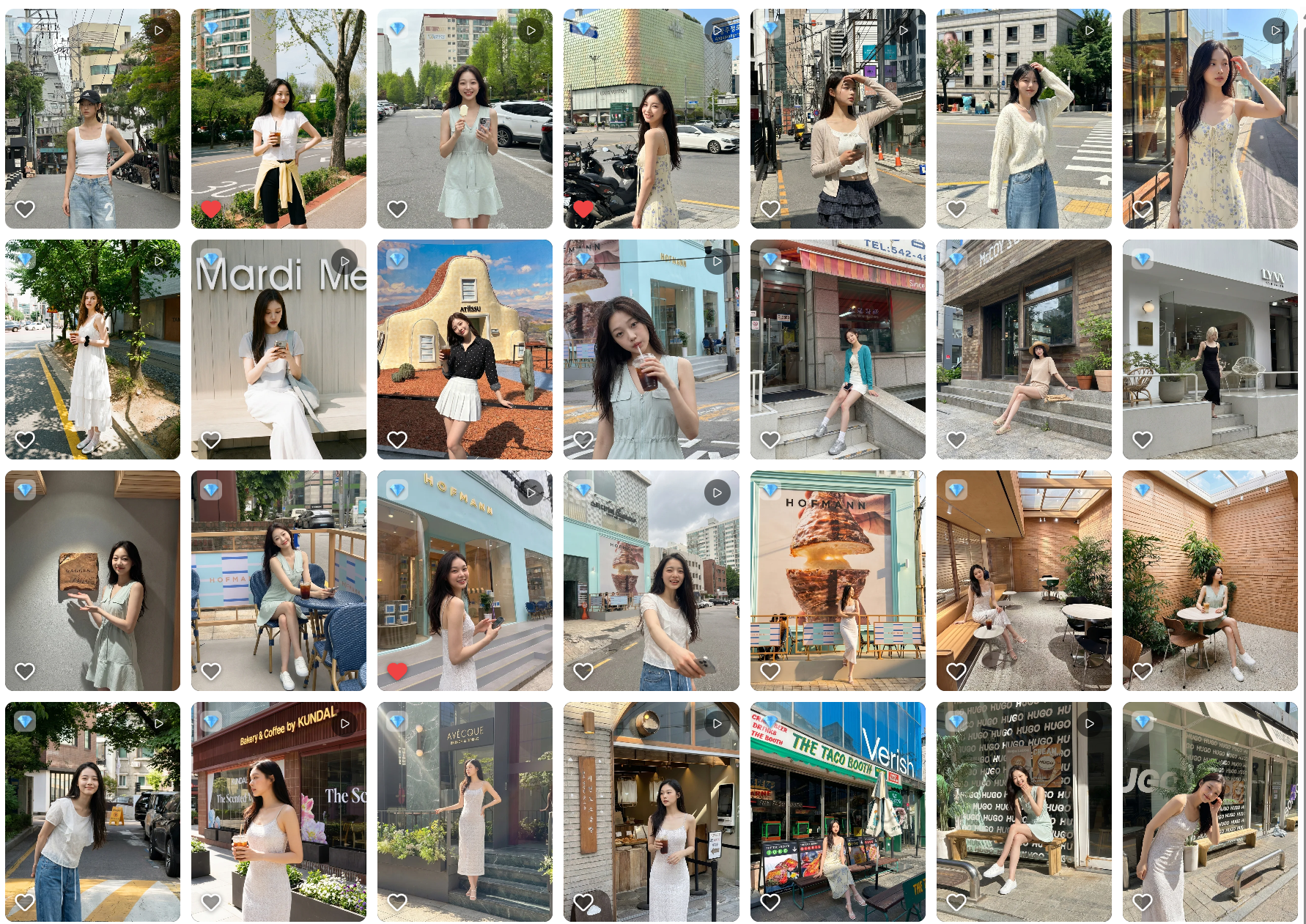
General-purpose models learn from the whole internet, which is why their output reads as generic. StyleRoom is trained specifically on Korean fashion commerce imagery, so the results carry the color temperature, the slightly relaxed posture, and the unperformed expression that shoppers on Musinsa and Ably read as an ordinary photo of a person.
The practical consequence is not that the images are prettier. It is that a much higher share of them are publishable, which is the variable that actually sets your cost per image. We went deeper on why training data determines this in a separate piece on visual trust.
There is no casting, no scheduling, no studio booking, and no waiting for a retoucher's queue. You upload the garment and have images the same session. A product that arrives on Monday can be listed on Monday.
This also changes what a mistake costs. When a shot does not work, you regenerate it in minutes rather than rebooking a day. The reshoot multiplier, which is one of the largest hidden terms in the conventional calculation, effectively disappears.
Most of what lowers a keeper rate is not the total failure. It is the shot that is ninety percent there, wrong in one small way: a fabric texture that reads flat, a silhouette that sits oddly, a detail that needs a touch of retouching. On a shoot, and with most AI tools, that image gets discarded and the cost rolls onto the survivors.
You can edit those details directly instead of regenerating from scratch. A near-miss becomes a keeper rather than a write-off, which is the same thing as saying your denominator goes up without your spend moving at all.
06 - Do this yourself Six steps to your real number
None of this is worth much as a general argument. It is worth something as a number you have actually run, and the answer is specific enough to your operation that nobody can hand it to you. Take your last quarter and work through this. It takes about twenty minutes.
- Add up everything you spent on product imagery last quarter, including retouching, freelancers, and the reshoots.
- Count the images you actually published. Not the ones delivered to you. The ones that went live.
- Divide. That is your real cost per image, and it is probably the first time you have seen it.
- Now count how many images were delivered but never used, and work out what that share cost you.
- For your three best-selling seasonal items, estimate the days between the product being ready and the listing going live. Multiply by daily revenue for that item.
- Add step five to step one and divide again. That number is what your imagery actually costs.
Brands who run this exercise are usually surprised by how far the honest figure sits from the one they had been quoting internally. The gap is not overcharging. It is the frames nobody counted and the weeks nobody billed for.
The useful thing about this calculation is that it makes tools comparable on the same axis. Once you know your cost per published image, any option can be evaluated by a single question: does it raise the keeper rate, does it shorten the wait, or neither?
That is the question worth bringing to any vendor, including us.
Product imagery built for the two variables that set your real cost
Trained on Korean fashion commerce imagery so a high share of output is publishable, and fast enough that a garment arriving today can be listed today. Upload a garment, choose the model, background, and pose, and see where your own keeper rate lands.
Try it on one garment
The fastest way to find your real number is to run a batch and count what you would publish.