group
Note
This is a beta release of group. Points, curves, helix and label do not currently work with group. The size attribute of group exists but is meaningless. Currently it is possible to have only one group object. group is currently available only in Web Vpython.
A group is a collection of objects. Moving or rotating a group affects all objects in the group. However, objects belonging to a group retain their identities and can be rotated, resized, colored etc. individually. (In contrast, objects used to create a compound lose their individual identities once compounded. Compound is less expensive computationally than group.)
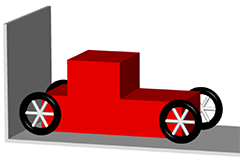
For example, using a group you can create a car whose wheels turn as the entire group moves, as in this example program .
To create a group:
First create the group
Then add objects to the group by specifying the name of the group as the group attribute of each object. Positions of objects in a group are relative to the pos of the group.
- mygroup = group(pos=vec(1,-1,3) )
- Parameters:
pos (vector) – Position of group. Default <0,0,0>. This is not necessarily the center of the collection of objects, nor is it necessarily at one end.
axis (vector) – Default <1,0,0>. Modifying axis changes the orientation of all objects in the group.
color (vector) – Modifying the color of a group changes the color of every object belonging to the group; the original color of a constituent object is lost. Initially the color of a group is set to white although the constituent objects retain their own colors. Assigning any value to color permanently changes the color of all objects in the group.
visible (boolean) – If False, object is not displayed. Default: True
canvas (object) – Default is scene.
make_trail (boolean) – If True, object leaves a trail when moved.
up (vector) – A vector perpendicular to the axis.
mygroup = group(pos=vec(0,0,0))
p1 = pyramid(group=mygroup, pos=vec(1,0,0), color=color.red)
p2 = pyramid(group=mygroup, pos=vec(1,2,0), color=color.yellow)
scene.pause()
mygroup.pos=vec(-3,0,0)
scene.pause()
mygroup.rotate(angle=pi/2, axis=vec(0,0,1))
Methods of group
- mygroup.group_to_world(myvec)
Converts a location relative to the group position to a position in world coordinates.
- mygroup.world_to_group(myvec)
Converts a location in world coordinates to a position relative to the pos of a group.
- mygroup.rotate(axis=vec(0, 0, 1), angle=pi / 2)
Same as rotation for 3D objects.