Chapter 1 : Accounting Introduction
Topics covered in this snack-sized chapter:
Accounting identifies, records, and communicates relevant, reliable and comparable information about an organization’s business activities.
Accounting is the universal language of business and finance.
Accounting helps to communicate financial information about a business to shareholders.
| Type
| Details
|
| Financial Accounting
| It includes reporting of the financial position and performance of a firm through financial statements issued to the external users on a periodic basis.
It includes:
- Revenues, Earnings, Assets and liabilities
- Profit and loss statement and balance sheet
|
| Management Accounting
| It includes:
- Costing, Budgeting, Net Present Value
|
Assets – assets represent value of ownership
that can be converted into cash
(although cash itself is also considered an asset)
- Examples: Cash, accounts receivable, inventory, notes receivable, prepaid expenses, land, buildings, equipment, furniture, and fixtures.
Liabilities - Obligations that an organization owes to someone else.
- Examples: Notes Payable, Accounts Payable, Accrued Liabilities, Long-Term Liabilities (bonds).
Expenses - The cost of doing business necessary to produce revenue.
Revenue - Income that a company receives from its normal business activities.
Owners’ Equity - The amount remaining after the value of all liabilities is subtracted from the value of all assets.
- Examples: Common stock, retained earnings, revenues, and expenses.
Assets: an asset is something that puts money in your pocket.
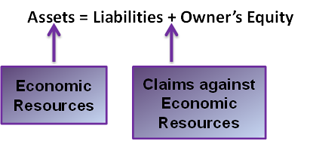
An asset is an economic resource. Anything tangible or intangible that is capable of being owned or controlled to produce value and that is held to have positive economic value
is considered an asset.
Liquid Assets: An asset that can be converted into cash quickly and with minimal impact to the price received.
- Examples: Cash, cash receivables and securities.
Current Assets: A current asset is either cash or an asset that can be sold.
- Examples: Inventories and supplies, can be turned into cash.
Fixed Assets: Assets that are purchased for long-term use and are not likely to be converted quickly into cash.
- Examples: Buildings, equipment, and natural resources
Land: Fixed, but never depreciated.
Intangible Assets: Properties other than the physical assets of a business that helps to create operating profit.
- Examples: Patents, trademarks, and copyrights.
Liability: An obligation to pay debts.
Current Liabilities: A debt to be paid with cash or with goods and services within one year or within the entity's operating cycle if the cycle is longer than a year.
- Examples: Accounts Payable and credit card debt
Long Term Liabilities: Liabilities with a future benefit over one year, such as notes payable that mature longer than one year.
Unearned Revenues: Payment received before a good is sold or a service is provided.
Bonds: A fixed interest financial asset issued by governments, companies, banks, public utilities and other large entities.
Decrease in owners’ equity during the period by using up an asset or a portion of an asset.
Can create additional liabilities.
Income an organization has earned.
An increase in owners’ equity during the period by performing a service or selling an asset.
Owners’ ownership (equity) in the business, or the amount of the business assets owned by the business owners.
An individual or company's net worth.
Used in determining an individual's or company's creditworthiness, and can be used in determining the value of a business when its owner or shareholders want to sell.
This is calculated by taking the value of all assets and subtracting the value of all liabilities.
- Owners’ Equity = Assets - Liabilities
The portion of your assets that you can legally claim.
In the GAAP framework, there must be a continuous equilibrium between assets on one side and the total of liabilities and equity on other side.
This is represented by the fundamental equation of accounting:
- Assets = Liabilities + Owners’ Equity
The recording of every transaction must keep this equation in balance, for which double entry book-keeping is employed.
| Assets (owns)
| What the business owns
|
| Liabilities (owes)
| What the business owes
|
| Owners’ Equity (worth)
| What is the worth of the business
|