Chapter 2 : History of Human Flight
Topics covered in this snack-sized chapter:
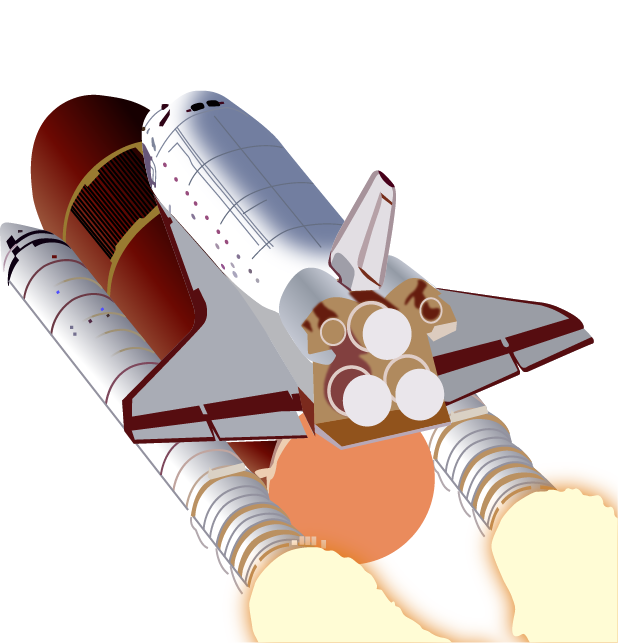
Flight beyond the Earth's atmosphere is known as the Space Flight.
Space flight can occur, with or without, humans on the board.
- U.S. Space shuttle program, is an example of human spaceflight.
- Satellites in orbit around Earth, such as communication satellites is an example of unmanned spaceflight.
Commercial use of space flight includes:
- Satellite Telecommunications
Non-commercial use of spaceflight includes:
- Earth observation satellites
Some spacecraft remains in space indefinitely, some disintegrate during atmospheric re-entry, and others reach a planetary or lunar surface for landing or impact.
Spaceflight with humans.
This makes it unlike robotic space probes or remotely-controlled satellites.
Sometimes called manned spaceflight.
First human spaceflight took place on April 12, 1961, when cosmonaut Yuri Gagarin made one orbit around the Earth.
Spacecraft reaches space and then returns to the atmosphere after following a (primarily) ballistic trajectory.
Does not complete one orbital revolution.
Spacecraft is placed on a trajectory where it could remain in space for at least one orbit.
To remain in orbit at this altitude requires an orbital speed of ~7.8 km/s.
Orbital spaceflight from Earth has only been achieved by launch vehicles that use rocket engines for propulsion.
Interplanetary Spaceflight
Also referred as interplanetary travel.
Travel between planets within a single planetary system.
In practice, spaceflights of this type are confined to travel between the planets of the Solar System.
Unmanned or manned travel between stars.
Tremendously more difficult than interplanetary travel.
Representing a very considerable technological and economic challenge unlikely to be met in the near future.
Intergalactic Spaceflight
Involves spaceflight between galaxies.
Considered much more technologically demanding than even interstellar travel.
Space flights work according to Newton's Third Law.
- Every action has equal and opposite reaction.
Space crafts can be carried to outer space by a rocket.
Rockets fire mass out at high speed and acquire velocity in the opposite direction.
- They do not need something to push against.
- They move because they are expelling exhaust gases at high speeds.
- The space flight is pushing mass away, and the mass is pushing back.
Rockets expel mass by burning fuel.
- A rocket carries oxygen in some form with it for burning fuel.
An orbit is a regular, repeating path that one object in space takes around another one.
An object in an orbit is called a satellite.
- A satellite can be natural, like the Moon.
- It can also be man-made, like the Space Shuttle or the ISS.
Satellites travel elliptical paths with the center of the Earth at one focus.
Inertia causes object to continue moving in a straight line.
Gravity pulls object to Earth.
Balance between the two is orbit.
Outer Space is everything beyond 100 kilometers (62 mi) above the Earth's surface.
In order to reach outer space from the surface of earth, a spacecraft is required to have a minimum velocity Delta-v
- Delta-v is lower than escape velocity (minimum velocity needed to escape a gravitational field)
- Delta-v is typically provided by the thrust of a rocket engine.
 (literally "change in velocity"), is a scalar which takes units of speed that measures the amount of "effort" needed to carry out an orbital maneuver, that is, to change from one trajectory to another.
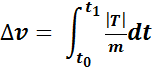
 is the instantaneous thrust
 is the instantaneous mass
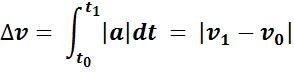
In the absence of external forces, and when thrust is applied in a constant direction this simplifies to:
Escape velocity is the speed at which the kinetic energy plus the gravitational potential energy of an object is zero.
The minimum velocity an object must have in order to escape the gravitational field of a planet and enter into orbit.
- It depends on the mass of the planet.
- Each planet has a different escape velocity.
Consider a projectile of mass  , leaving the surface of a planet with escape velocity
  , has a kinetic energy
  given by:
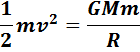
 is the mass of the object
 mass of the earth
 is the gravitational constant
 is the radius of the earth
 is the escape velocity
It simplifies to:
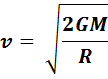
Or
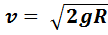
- Where,
 is acceleration of gravity on the planet's surface
For Earth:
The radius is,
is, 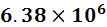 meters
The mass  is,
is, 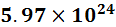 kilograms
Gravitational constant , is:
, is:

The escape velocity of Earth is 11.2 kilometers per second from the surface of the earth.
A launch pad is a fixed structure designed to dispatch airborne vehicles.
Generally consists of a launch tower and flame trench.
Surrounded by equipment used to erect, fuel, and maintain launch vehicles.
The service structure provides an access platform to inspect the launch vehicle prior to launch.
Spaceport is equipped with launch complexes and launch pads, for vertical rocket launches.
Spaceports are situated well away from human habitation for noise and safety reasons.
Once in space, the motion of a spacecraft is covered by the area of science called Astrodynamics.
Astrodynamics is the term used to describe the application of Newtonian mechanics to man-made objects in space, such as rockets and spacecraft.