Topics covered in this snack-sized chapter:
Aerospace engineering is the primary branch of engineering concerned with the design, construction, and science of aircraft and spacecraft.
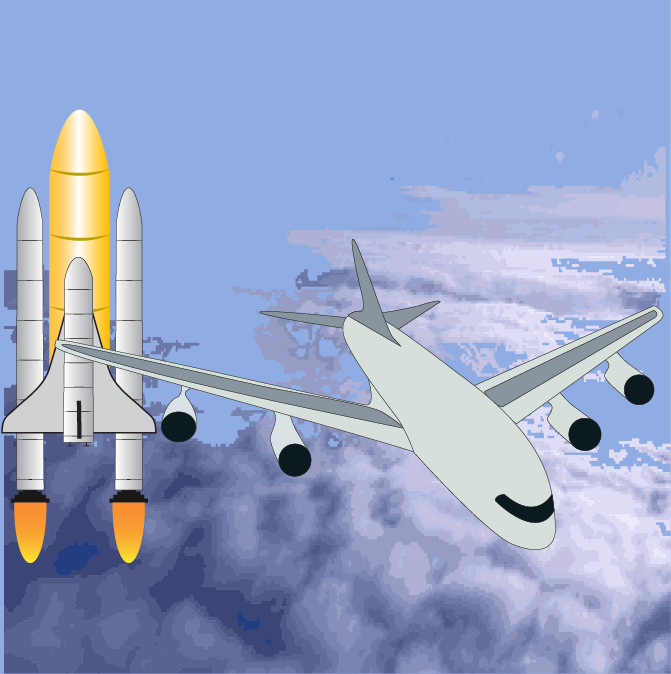
It is divided into two major and overlapping branches:
- Astronautical engineering
Aeronautical engineering:
Aeronautical engineering focuses on aircrafts.
Astronautical engineering:
Astronautical engineering is the theory and practice of navigation beyond the Earth's atmosphere.
In other words, it is the science and technology of space flight/ spacecraft.
Many aerospace engineers focus on only one kind of aerospace product, such as airplanes, helicopters or rockets, and use CAD and robotics to build them.
They are typically experts in aerodynamics, thermodynamics, or celestial mechanics.
The former deals with craft that stay within Earth's atmosphere, and the latter with craft that operates outside it.
Aerospace engineers design, test, and supervise the manufacture of aircraft, spacecraft, and missiles.
Those who work with aircraft are called aeronautical engineers, and those working specifically with spacecraft are astronautical engineers.
Aerospace engineers develop new technologies for use in aviation, defense systems, and space exploration, often specializing in areas such as structural design, guidance, navigation and control, instrumentation and communication, and production methods.
They also may specialize in a particular type of aerospace product, such as commercial aircraft, military fighter jets, helicopters, spacecraft, or missiles and rockets, and may become experts in aerodynamics, thermodynamics, celestial mechanics, propulsion, acoustics, or guidance and control systems.
Aerodynamics is the study of air as well as various gases in motion.
It concerns the forces that these gaseous fluids, and particularly air, exert on bodies moving through it.
Without the science of aerodynamics, modern flight would be impossible.
Avionics is a portmanteau of "aviation" and "electronics".
It comprises electronic systems for use on aircraft, artificial satellites and spacecraft, comprising communications, navigation and the display and management of multiple systems.
It also includes the hundreds of systems that are fitted to aircraft to meet individual roles; these can be as simple as a search light for a police helicopter or as complicated as the tactical system for an Airborne Early Warning platform.
In material science we study the characteristics and property of materials, its structure and shapes.
Propulsion is the science of the engine. It is a means of creating force leading to movement.
| Job
| Definition of Job
|
| An aerospace engineer can be an aircraft mechanic.
| This job consists of fixing and repairing damaged and broken aircrafts and spacecrafts.
|
| Another thing they could do is be an aeronautical and aerospace test pilot.
| Their job is to fly and test planes and plane prototypes.
|