Chapter 2 : Principles of Soil Science
Topics covered in this snack-sized chapter:
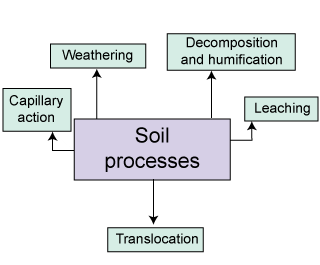
Soil Processes
- This refers to the breakdown and decomposition of rocks and minerals by factors including air, water, sun and frost.
- Physical weathering involves continual breakdown of rocks into smaller and smaller particles.
- Chemical weathering involves alteration of the chemical composition of rock minerals.
- Decomposition is the breakdown of plant derived material into its simpler organic constituents. This is accomplished by enzymes, earthworms, mites and other organisms.
- Humification is the breakdown of plant remains leading to the formation of different types of humus. It is probably the most important biological process taking place in soils.
- Where evaporation exceeds precipitation, moisture moves upwards within the soil profile by capillary action. It is therefore in the reverse direction to leaching.
- Wherever rainfall exceeds evaporation and there is free downward movement of water through the soil pore system, soluble minerals are leached or removed from the soil profile.
- Continual leaching tends to impoverish the upper mineral horizons by removal of basic cations (cations are ions having a positive electrical charge e.g. Ca2+).
- Leaching is most active in sandy soils with high porosity and is least in fine-textured soils such as clays which have restricted pore spaces.
- The movement of material in solution or suspension from one horizon to another is referred to as translocation.
- Generally soil color is determined by the amount of organic matter and the state of the iron.
- Soil color is also related to soil drainage, with free draining, well AERATED soils (with pore space dominated by oxygen) having rich brown colors.
- In contrast, poorly draining soils, often referred to as gleys, develop under Anaerobic conditions (the pore space dominated by water) and have grey or blue-grey colors.
- Soils with periodic waterlogging are imperfectly drained and are often highly mottled with blotches of contrasting color. Mottles are often rusty in color and are due to iron concentration.
- Such colors are the result of oxidation-reduction, iron is the main substance affected by these processes. If the iron is released in an anaerobic environment, then it stays in the reduced state giving it the grey blue color of water logged soils.
- Soil texture is a term used to describe the distribution of the different sizes of mineral particles in a soil.
- Textures range from clay, sand, and silt at the extremes, to a loam which has all three sized fractions present .The main influence of texture is on permeability which generally decreases with decreasing particle size.
- The clumping of the soil textural components of sand, silt and clay forms aggregates and the further association of those aggregates into larger units forms soil structures called peds.
- These peds evolve into units which may have various shapes, sizes and degrees of development.
- Size
- Surface Area
- Surface Charge
- Cation/Anion Exchange
- Crystalline silicate clays (Phylosilicates) -tetrahedral and octahedral crystal sheets.
- Non-crystalline silicate clays (Andisols) –Dominatelyamorphous clays (allophane and imogolite).
- Iron and aluminum oxides (Oxisols)- Dominatelygibbsite (Al-oxide) and goethite (Fe-oxide).
- Organic (humus) colloids (Histosols)- Non-crystalline colloids dominated by long C-chain molecules.
 cores of soil from the ground (core aeration).
- Particle Density (PD) - weight per unit volume of individual soil particles (Mg/m 3 = g/cm3 ), calculated as PD = Ws / Vs
- Bulk Density (BD) - weight of soil per unit volume in its natural state (Mg/m3 = g/cm3 ), calculated as
- BD = Ws / (Vs + Vp ),
- Where
- Ws = Weight of soil solids
- Vs = Volume of soil solids
- Vp = Volume of soil pores
- The cycling of nutrients.
- Formation and stabilization of the pore structure.
- The spread and vitality of pathogens
- The biodiversity of this rich biological community.
- Macrofauna – Moles, Prairie dogs, earthworms, millipeds .
- Mesofauna – Springtails and Mites.
- Microfauna – Nematodes and single-celled protozoans.
- Flora – Plants Roots.
- Microorganisms – Fungi, Bacteria, and Actinomycetes.
- Mass flow
- Diffusion
- Root interception