Chapter 1 : Numbers and Integers
Topics covered in this snack-sized chapter:
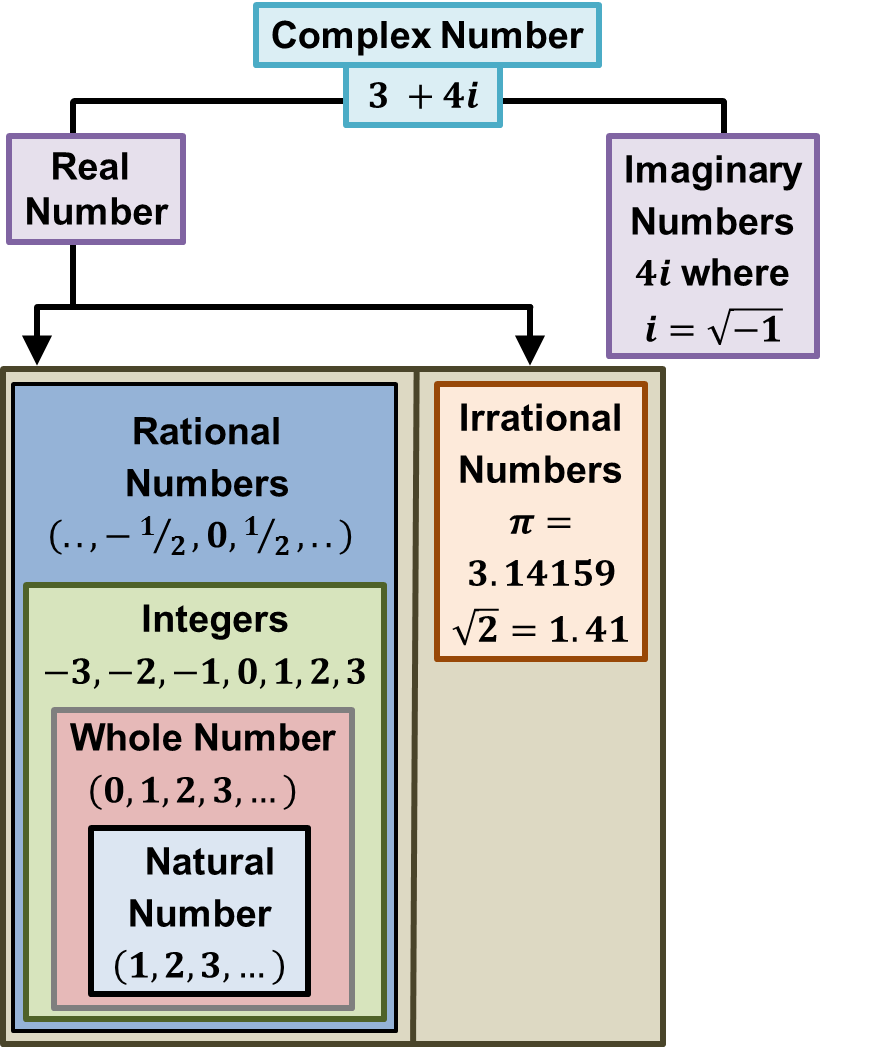
Fig: Number System
| Natural Numbers
| The natural numbers are the counting numbers.
Example: 1, 2, 3, 4, 5
|
| Whole Numbers
| The whole numbers are the counting numbers and 0.
Example: 0, 1, 2, 3, 4, 5
|
| Integers
| Integers include counting numbers, zero and negative numbers.
Example: -3, -2, -1, 0, 1, 2, 3
|
| Rational Number
| A rational number is a number that can be expressed as a fraction or ratio. The numerator and the denominator of the fraction are both integers.
Example: 2/3
|
| Irrational Numbers
| Numbers that cannot be written as fractions.
Example: √2
|
| Prime Numbers
| A prime number is a natural number that has exactly two (distinct) natural number divisors, which are 1 and the number itself.
Example: 2, 3, 5, 7, 11, 13
|
| Complex Numbers
| Complex numbers consist of imaginary number, where
i = √(-1).
Example: We can write



|
| Composite
Number
| Any number other than 1, which is not a prime number.
Example: 4, 6, 8, 9, 10, etc.
|
| Multiples
| If a number is divisible exactly by a second number, then the first number is said to be a multiple of the second number.
Example: 15 is a multiple of 5
|
| Factors
| If one number divides a second number exactly, then the first number is said to be a factor of the second number.
Example: 5 is a factor of 15
|
| Even Numbers
| Numbers divisible by 2 are called even numbers.
Example: 2, 4, 6, 8
|
| Odd
Numbers
| Numbers which are NOT divisible by 2 are called odd numbers.
Example: 1, 3, 5, 7
|
| Roman
Numerals
| Roman numerals are a numeral system of ancient Rome based on letters of the alphabet, which are combined to signify the sum of their values.
| Symbol
| Number
|
| I
| 1
|
| II
| 2
|
| III
| 3
|
| IV
| 4
|
| V
| 5
|
| VI
| 6
|
| VII
| 7
|
| VIII
| 8
|
| IX
| 9
|
| X
| 10
|
| XX
| 20
|
| XXV
| 25
|
| XXX
| 30
|
| XL
| 40
|
| L
| 50
|
|
An integer is a whole number (not a fractional number) that can be positive, negative, or zero.
Integers can be represented on number line.
Whole numbers, which are greater than zero, are called positive integers. These numbers are to the right of zero on the number line.
Whole numbers, which are less than zero, are called negative integers. These numbers are to the left of zero on the number line.
The integer zero is neutral. It is neither positive nor negative.
The sign of an integer is either positive (+) or negative (-), except zero, which has no sign.
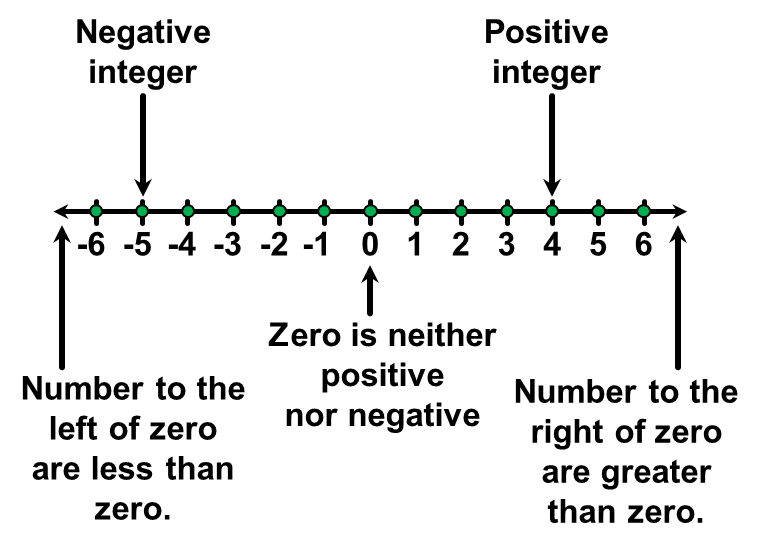
The number line is a line labeled with the integers in increasing order from left to right, that extends in both directions:

For any two different places on the number line, the integer on the right is greater than the integer on the left
Examples:
The absolute of a number is the distance the number is from 0 on the number line. The symbol for absolute value is two vertical bars on either side of the number.

Rules of Signs for Addition and Subtraction:
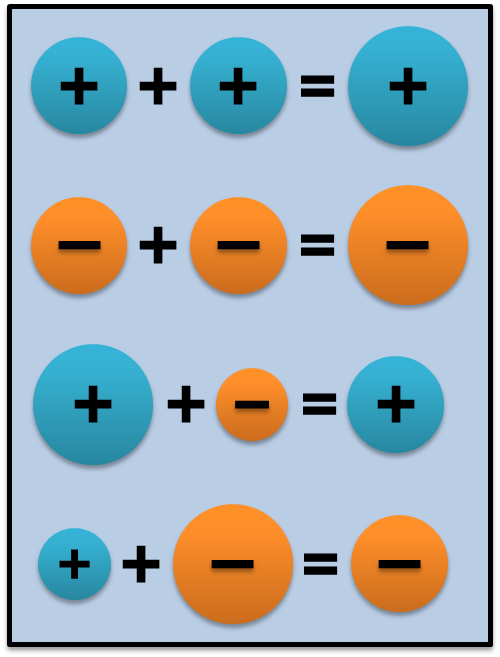
Figure: Visual Representation of Addition of Positive and Negative Numbers
When adding two numbers with like signs:
- Add the absolute value of the two numbers and use the sign of the original numbers for the result.
Add (-5) and (-10)
|-5|=5
|-10|=10
5+10=15
The answer is –15.
When adding two numbers with unlike signs
- Subtract the absolute value of the number with the smallest absolute value from the absolute value of the number with the largest absolute value and use the sign corresponding to the number with the largest absolute value.
Add (-5) and (10)
|-5|=5
|10|=10
10-5=5
The answer is 5.
Properties of Addition and Subtraction of Integers arrow_upward
Closure property under addition:
- Integers are closed under addition. For any two integers a and b, a + b
is an integer.
Closure property under subtraction:
- Integers are closed under subtraction. If a and b are two integers then a – b is also an integer.
Commutative property under addition:
- Addition is commutative for integers. For any two integers a and b, we can say a + b = b + a.
Commutative property under subtraction:
- Subtraction is not commutative for integers.
Associative property under addition:
- Addition is associative for integers. For any three integers a, b and c, we can say that, a + (b + c) = (a + b) + c
Associative property under subtraction:
- Associative property does not exist for subtraction.
Zero is an additive identity for integers. For any integer a,
a + 0 = a = 0 + a.
Multiplication of Positive and Negative Integers:
We multiply a positive integer and a negative integer as whole numbers and put a minus sign (–) before the product.
Example: (-4) × 8 = -32
Multiplication of two Negative Integers:
We multiply the two negative integers as whole numbers and put the positive sign before the product.
Example: (-14) × (-8) = 112
Product of three or more Integers:
If the number of negative integers in a product is even, then the product is a positive integer.
If the number of negative integers in a product is odd, then the product is a negative integer.
Integers are closed under multiplication, i.e. for any two integers, a and b, ab is an integer.
Multiplication is commutative for integers. For any two integers, a and b, ab = ba
1 is the multiplicative identity for integers. In general for any integer a, we have, a × 1 = a = 1 × a.
Multiplication is associative for integers. For any three integers a, b and c, we can say that, (a × b) × c = a × (b × c).
For any integers a, b and c we can say that, a × (b + c) = a × b + a × c.
Division of Negative Integer by Positive Integer:
We divide a negative integer by a positive integer as whole numbers and then put a minus sign (–) before the quotient.
Example: (-48) ÷ 6 = -8
Division of Positive Integer by Negative Integer:
We divide a positive integer by a negative integer as whole numbers and then put a minus sign (–) before the quotient.
Example: 72 ÷ (–8) = –9
Division of Negative Integer by Negative Integer:
We divide a negative integer by a negative integer as whole numbers and then put a positive sign (+). That is, we get a positive integer.
Example: (-32) ÷ (–8) = 4
Closure property under division:
Integers are NOT closed under division, i.e. for any two integers, a and b, a/b may not be an integer.
Commutative property under division:
Division is NOT commutative for integers. For any two integers, a and b, a/b may not be an integer.
Associative property under division:
Division is NOT associative for integers.
Any integer divided by 1 gives the same integer. For any integer, a ÷ 1 = a

