Chapter 2 : Types of Chemical Groups
Topics covered in this snack-sized chapter:
Two or more atoms bound together as a single unit and forming part of a molecule.
List the types of chemical groups here:
Hydrophobic – “water hating”.
Literally, a Hydrophobe means something with a fear of water.
A hydrophobic molecule is repelled by water and is usually neutral (no charge).
Hydrophobic molecules often cluster together when dropped in water, just as oil does.
Hydrophobic molecules are also called lipophilic because they get dissolved in oils and other lipids.
They tend to be electrically neutral and nonpolar and work
better with neutral and
nonpolar solvents.
Hydrophobic molecules include:
Hydrophobic solvents are used:
- To clean up oil slicks and manage oil spills.
In a hydrophobic interaction, although it seems that the hydrophobic molecules are rejecting water, what's actually happening is that water is rejecting the hydrophobic molecules in favor of bonding to itself.
Water bonds easily with polar molecules, and since water itself is polar, it will prefer water molecules (polar) to oil molecules (nonpolar).
- Hydrophobic molecules then tend to cluster together.

Figure: Water drops on the hydrophobic surface of a plant leaf
Hydrophilic molecules are “water loving” or “water friendly”.
A hydrophilic molecule is one that is typically charge-polarized and capable of hydrogen bonding, enabling it to dissolve more readily in water than in oil or other hydrophobic solvents.
Hydrophilic substances are attracted to, and dissolve well within water.
Hydrophilic is typically used to describe a property of a molecule, and refers to the likelihood of its bonding with the hydrogen molecule in water.
A hydrophilic molecule is not just soluble in water but also in other polar solvents.
- It will dissolve less readily in oils and other hydrophobic solvents.
- Hydrophilic molecules are charge-polarized so that one end is positive and the other negative.
In addition to hydrophilic molecules, there are also super hydrophilic molecules which have special applications.
- An example is titanium dioxide; water dropped onto titanium dioxide has almost no contact angle.
Uses of Super Hydrophilic Materials
Super hydrophilic materials act as excellent glass defoggers and enable oil spots to be washed away with water.
These substances are being used today in:
Building coatings
Super hydrophilic substances may be used in the future:
- To create metastable structures
- To enable water to clean substances that was previously almost impossible to clean with water.
These applications are still in the earliest stages.Hydrophilic coatings of rubber can increase the power of plugs to stop water escaping to cause leaks.
The water is attracted to the coating and less available for seeping through gaps.
This is the basis for water-stop and sealant products.
Other uses of hydrophilic substances are:
- Waterproofing outside materials (example horse blankets)
- Surface treatment of wet wipes and Nappies
- Scientific testing for proteins.
Amphiphile is a term describing a chemical compound possessing both hydrophilic (water-loving, polar) and lipophilic (fat-loving) properties.
- Hydrophilic and hydrophobic molecules are also known as polar molecules and nonpolar molecules, respectively.
Such a compound is called amphiphilic or amphipathic.
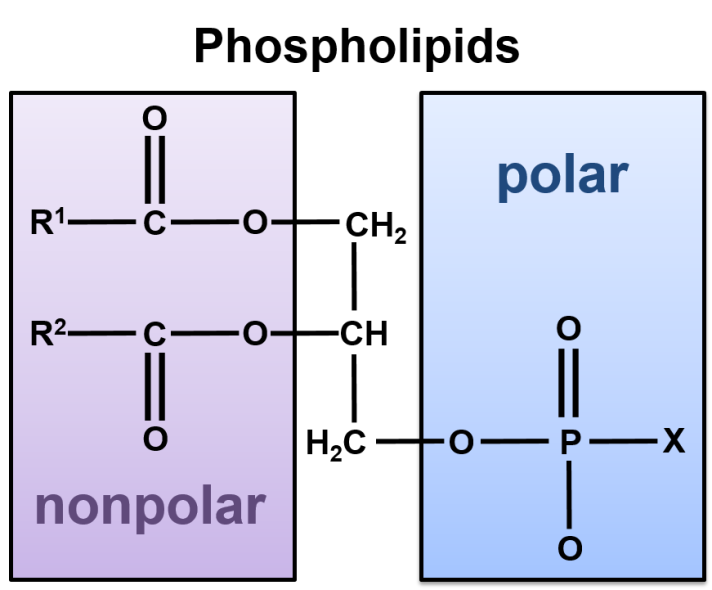
Figure: Phospholipids have amphipathic character
This forms the basis for a number of areas of research in chemistry and biochemistry, notably that of lipid polymorphism.
Organic compounds containing hydrophilic groups
at both ends of a sufficiently long hydrophobic hydrocarbon chain are called bolaamphiphilics.
- Common amphiphilic substances are soaps and detergents.
Substances that accumulate at water surfaces and change the surface properties are called surfactants.
Alkali metal salts of fatty acids are more soluble in water than the acids themselves, and the amphiphilic character of these substances also make them strong surfactants.
The most common examples of such compounds are soaps and detergents.
The use of such compounds as cleaning agents is facilitated by their surfactant character, which lowers the surface tension of water, allowing it to penetrate and wet a variety of materials.