Chapter 2 : Chemistry of Life
Topics covered in this snack-sized chapter:
Both living and non-living things are made up of matter.
Chemistry is the study of the interactions of matter.
Anything that has mass and volume is called matter, such as:
- Atoms, rocks, car, people, etc.
- It includes living and non-living things, and things that are made up of elements.
All matter exists in any of the four states solid, liquid, gas, or plasma.
- Plasma is found in stars.

All matter is made up of atoms.
An atom is the smallest element of matter. It cannot be divided by chemical reaction and still has the same properties of the matter it comprises.
All atoms have a nucleus made up of protons and neutrons located in the center of the atom.
Electrons circulate the nucleus of the atom.
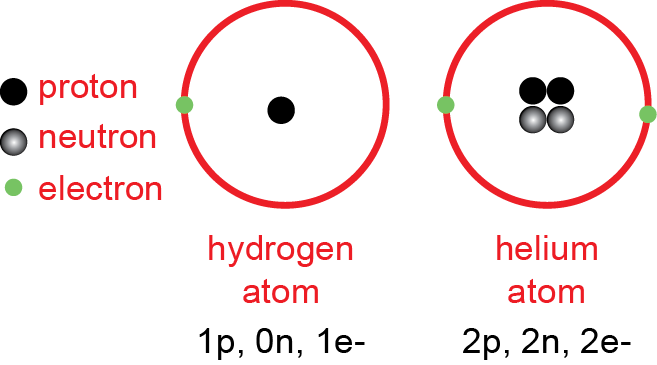

An element consists of atoms of the same kind.
An element has a certain number of protons, which is called its atomic number
- Every atom that has 1 proton is hydrogen.
- Every atom that has 6 protons is carbon.
There are 92 naturally occurring elements.
Atoms combine to form compounds.
When atoms of two (or more) elements form bonds together, the new combination is called a compound.
Ionic bond: weak; involves the transfer of electrons.
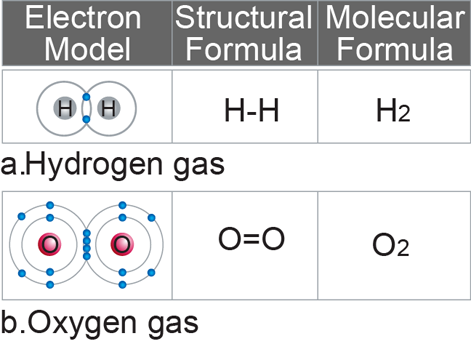
Covalent bond: strong; atoms share electrons.
Hydrogen bond: weakest individually; but strong collectively.
An ion is a charged atom (+ or -); ionic bonds are weak (formed by the attraction between a positively charged atom and a negatively charged atom).
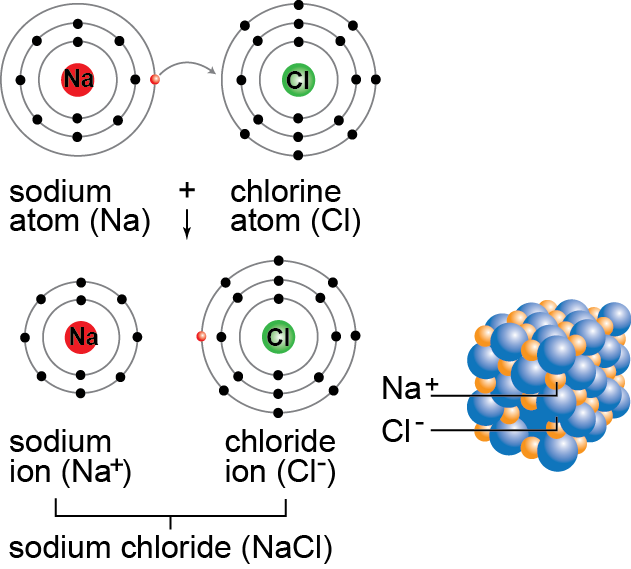
Covalent bonds are strong:
- 2 atoms literally share an electron.
The terms polar and nonpolar bonds usually refer to covalent bonds.
- Nonpolar: both atoms share equally.
- Polar: one atom has a stronger pull on the electron.
Examples: O2
, H2
, CH4
.
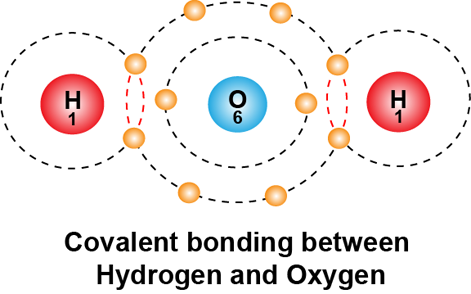
The polarity in a water molecule causes the hydrogen atoms of one water molecule to be attracted to the oxygen atoms of another water molecule.
Water structure:
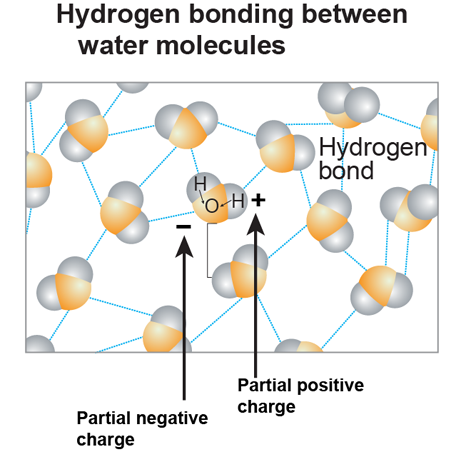
To understand life, one must understand water.
Living things are made up of 70%+ water.
Water has unique properties based on its polarity.
Oxygen is more electronegative than hydrogen, which results in the unequal sharing of electrons.
Six properties that make water special:
| High Heat Capacity
| Heats up and cools down slower than most liquids.
Holds heat longer than most.
Keeps body temperature stable.
Keeps environmental temperature stable.
|
| High Heat of Vaporization
| Heat is the amount of energy associated with the movement of atoms and molecules in matter.
Evaporation requires a lot of energy.
Body heat is used as energy to evaporate water.
This is important for an organism’s ability to moderate its temperature.
|
| Solvent Properties
| Universal solvent.
Molecules dissolve in water, which allows them to move around and interact more.
Water facilitates most chemical reactions.
|
| Cohesive and Adhesive Nature
| Water molecules move freely, but stick together (hydrogen bonds).
Great for transporting nutrients in plants, and facilitating circulation in animals.
|
| High Surface Tension
| Water molecules tend to “stick” to each other.
Effect of hydrogen bonds.
|
| Water is less dense as a Solid than as a Liquid
| Bodies of water freeze from the top down.
Ice floats.
Allows life to exist below a sheet of ice.
Density increases as temperature decreases.
|
The term pH refers to the amount of free hydrogen ions in water and is measured on a scale from 0 to 14.
7 is considered as neutral.
<7 is acidic; chemicals that donate H+ are acids.
>7 is basic; chemicals that accept H+ are bases.
A pH of 5 is 10 times more acidic than a pH of 6.