Chapter 1 : Introduction to Botany
Topics covered in this snack-sized chapter:
The branch of biological science which focuses on the study of plants and plant life

The word botany is derived from the Greek word "botanikos," meaning "of herbs.”
Plants are an essential component of all ecosystems, and botany contributes significantly to the basic understanding of essential processes that affect ecosystems and natural environments.
Plants are essential to the lives of humans, providing all food either directly or indirectly as well as breathable oxygen.
Botany is the scientific study of plants:
- How are they related to each other?
- How do people make use of plants?
Botany is considered to be one of the oldest sciences, as it began with the effort of early humans to identify edible, poisonous, and medicinal plants.
The study covers plants, algae, and fungi.
- Also includes following areas:
The word “plant” encompasses a wide range of living organisms, all of which belong to the kingdom plantae that:
- Produce food from sunlight and inorganic matter through the process of photosynthesis
- Have rigid cell walls containing cellulose
Characteristics of plants
Are as follows:
- Eukaryotic (true nucleus) organisms
- Plants are unable to move on their own, mostly being rooted in one place
- They synthesize their own food by the process of photosynthesis
- Their cells have cell walls composed mainly of cellulose
- Their cells contain chlorophyll which enables plants to convert energy from the sun into food
- Their cells usually have large vacuoles
- Plants store their food as starch
Botany can be defined as the science of plants.
The methodology of botany is that of science. Essentially, it is a method of obtaining and applying facts towards solving problems and/or sating human curiosity regarding plants.
Has four steps:
Any enquiry must begin with direct or indirect observation.
Observations may also arise from a previous scientific investigation.
Hand lenses, binoculars, microscopes etc. are some of the tools used in observing plants.
The next step in the scientific method is to formulate questions based on the observations.
In order to answer a question scientifically, the scientist must be able to measure or observe the phenomenon in question.
Formal statement that is designed to provide a potential explanation for something that has been observed
A hypothesis is a potential answer to a question.
The possible answer to a question, from known facts and observations, involves a guess or prediction.
After a question has been proposed and a hypothesis or multiple hypotheses have been generated, an experiment is performed to test the hypothesis.
A set of manipulations or specific observations
Necessary to determine whether or not a prediction is correct
Can be divided into two groups:
Composed of:
- Cells: the basic structural and physiological units of plants
- Tissues: organized groups of similar cells that work together to perform a specific function
Composed of:
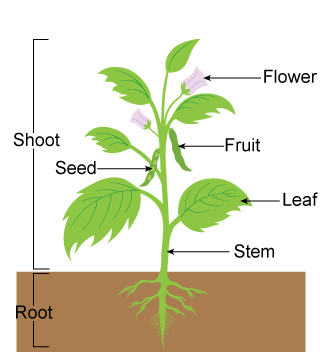
- Roots: typically originate from the lower portion of a plant, responsible for anchoring the plant to the ground and extracting water and minerals from the soil
- Stems: structures which support buds and leaves and serve as conduits for carrying water, minerals, and sugars
- Leaves: their principal function is to absorb the sunlight needed to manufacture plant sugars through a process called photosynthesis
- Flowers: responsible for one important function: reproduction
- Fruits: consist of fertilized, mature ovules (seeds), plus the ovary wall
- Seeds: contain all of the genetic information needed to develop into an entire plant
The cell is one of the most basic and smallest units of life.
A living cell is a complex, multi-functional unit.
Cells are made mostly of macromolecules, which define the physics and chemistry of a cell.
All cells contain four major types of macromolecules:
The basic building blocks for carbohydrates are sugars.
The main chemical components of the primary plant cell wall include cellulose, a complex carbohydrate made up of several thousand glucose molecules linked end to end.
Fatty acids and their derivatives are very important because they contribute to the structure of the membranes.
Lipids also act as food reserve and provide energy via oxidation.
The polymers of nucleotides, consisting of nitrogenous bases, phosphates, and pentose sugars
There are two types of nucleic acid:
- Deoxy-ribose nucleic acid (DNA)
- Ribose nucleic acid (RNA)
The most important organic components of cells, for they act as both structural and functional molecules
The most abundant molecule in cells, accounting for 70% or more of total cell mass
The interactions between water and the other constituents of cells are of central importance in biological chemistry.
Organic and inorganic molecules
Many inorganic metals are the integral part of some organic molecules and act as co-factor in enzymatic activities.
Many organic factors are also important for the metabolism of cells because many of the vitamins act as coenzymes, required for enzymatic activities.