Chapter 1 : Ratio and Proportion
Topics covered in this snack-sized chapter:
A ratio is a comparison of two numbers.
- The ratio of two quantities of the same kind and units is a fraction that shows how many times the one quantity is of the other.
- The ratio of two numbers a and b (b ≠ 0) is a ÷ b or, a/b and is denoted by a : b.
- In the ratio a : b, the quantities a and b are called the terms of the ratio.
In the ratio a : b, a is the antecedent and b is the consequent.
- We may separate the two numbers in the ratio with a colon {:}.
| Example 1
| Write the ratio of 8 and 12.
|
| Example 2
| John has 3 red marbles and 4 blue marbles. What is the ratio of blue marbles to all marbles in the bag?
Note that the total is 3 + 4 = 7 and there are 4 blue marbles.
The ratio of blue marbles to all marbles is 4 : 7 or 4/7.
|
| Step 1
| Obtain the given ratios.
|
| Step 2
| Express each one of them in the form of a fraction in the simplest form.
|
| Step 3
| Find the L.C.M. of the denominator of the fractions obtained in step 2.
|
| Step 4
| Obtain the first fraction and its denominator.
Divide the L.C.M. obtained in step 3 by the denominator to get a number x (say).
Now, multiply the numerator and denominator of the fraction by x.
Apply the same procedure to the other fractions.
Now, the denominators of all fractions will be same.
|
| Step 5
| Compare the numerator of the fractions obtained in step 4.
The fraction having larger numerator will be larger than the other.
|
Compare the ratio 7 : 16 and 4 : 9.
Writing the given ratios as fractions we have, 7 : 16 = 7/16 and, 4 : 9 = 4/9.
Now, L.C.M. of 16 and 9 is 144.
Making the denominator of each fraction equal to 144, we have
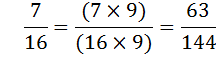
and
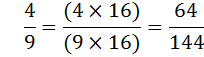
Clearly, 63 < 64.
So, 63/144 < 64/144  7/16 < 4/9.
Rate is a comparison of measurements that have different units, like cents and grams.
Example: To walk 10 kilometers in two hours is to walk at the rate of 5 km/h.
A Unit Rate is a rate with a denominator of 1.
Example: A man earns $2 per hour.
A proportion is a statement that two given ratios are equal.
Example: 3/4 = 6/8.
A proportion is an equation with a ratio on each side.
A proportion has four terms.
Example: In the proportion 2/5 = 4/10.
The first term is 2, the second term is 5 the third term is 4, and the fourth term is 10.
The first and fourth terms are called the extremes.
- Here 2 & 10 are extremes.
The second and third terms are called the means.
A proportion is said to be true if the two ratios are equal.
To determine whether a proportion is true, cross multiply the numerator of one fraction by the denominator of the other.
Example: 2/3 = 7/12
On cross multiplying,
12 × 2 = 24 and
7 × 3 = 21.
Since 24 is larger than 21, the fractions are not equal and this proportion is not true.
Example: 1/2 = 2/4
On cross multiplying,
1 × 4 = 4 and
2 × 2 = 4
As both the products are equal this means that the proportion is true.
Example:

12x = 24
x = 2
Two quantities, A and B, are in direct proportion if by whatever factors A changes, B changes by the same factor.
Formula

Here the symbol  implies proportionality and quantity A is k times quantity B.
Graph:

Note that the slope of the line will be k (proportionality constant).
Price of 1 gallon of gas = $2.
Price of 10 gallons of gas = $20.
Note that as gallons increases by a factor of 10 so does the price.
Hence, the price of gas and gallons of gas are in direct proportion.
The weight of 1 gallon of milk is given as 2 lbs. What will be the weight of 5 gallons of milk?
The weight and volume are directly proportional.
Hence, the weight of 5 gallons of milk will be equal to 10 lbs (2 × 5).
Two quantities, A and B, are in inverse proportion if by whatever factor A changes, B changes by the reciprocal (or multiplicative inverse) of that factor.
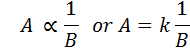
Here the symbol implies proportionality and quantity A is  times the quantity
  .
.
The speed of a car is inversely proportional to the time taken to travel a given distance.
Consider the following data for a group of people traveling in a space ship.
Given that there is enough food for 100 days if there are 10 people.
What happens as the number of people increases?
| # of people
| # of days for which food will last in a space ship
|
| 10
| 100
|
| 20
| 50
|
| 40
| 25
|
| 80
| 12.5
|
| 160
| 6.25
|
If you plot the data above on a graph, you will see the following:
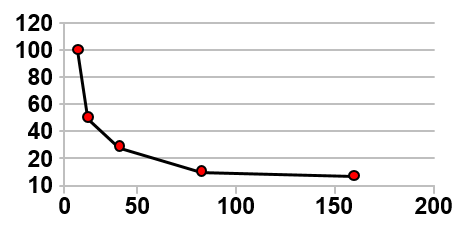
(Days on y axis and people on x axis)
- As the number of people increases, the number of days for which food will last in a space ship decreases.