Chapter 2 : Derivatives and Differentiation
Topics covered in this snack-sized chapter:
Differentiation is a method to compute the rate at which a dependent output y changes with respect to the change in the independent input x.
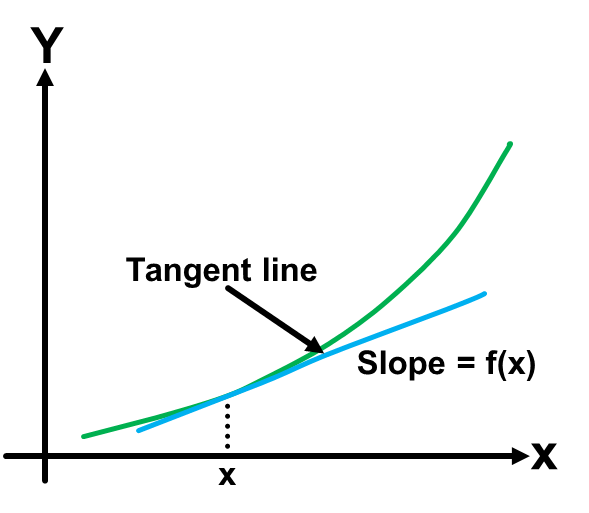
This rate of change is called the Derivative of y with respect to x.
If x and y are real numbers, and if the graph of y is plotted against x, the derivative measures the slope of this graph at each point.
If y is a linear function of x, it means that the graph of y against x is a straight line.
In this case, y = f(x) = mx + b for real numbers m and b.
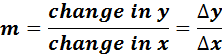
The slope m is given by:
- Where the symbol
 is an abbreviation for “change in.”
Let f be a real valued function.
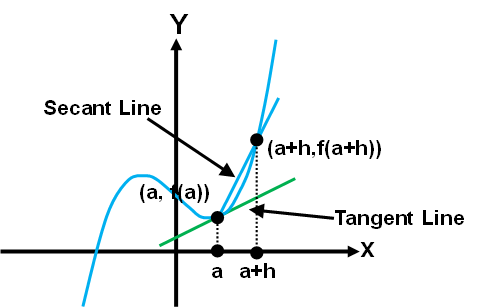
The tangent line to the graph of the function f at a real number a was the unique line through the point (a, f(a))
The derivative of y with respect to x at a is, geometrically, the slope of the tangent line to the graph of f at a the slope of the tangent line is very close to the slope of the line through (a, f(a)) and a nearby point on the graph, (a + h, f(a + h)).
These lines are called Secant lines.
A value of h close to zero gives a good approximation to the slope of the tangent line.
The slope m of the secant line is:
- This expression is Newton's difference quotient.
The derivative is the value of the difference quotient as the secant lines approach the tangent line.
Derivative of the function f at a is the limit of the difference quotient as h approaches zero.
- If the limit exists, then f is differentiable at a.

The squaring function f(x) = x2
is differentiable at x = 3, and its derivative there is 6.
This result is established by calculating the limit as h approaches zero of the difference quotient of f(3).

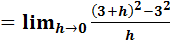
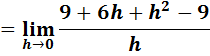
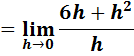
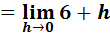
Then we calculate the limit by letting  go to zero.
6 + 0 = 6
The last expression shows that the difference quotient equals 6 + h when h ≠ 0.
The slope of the graph of the squaring function at the point (3, 9) is 6, and so its derivative at x = 3 is f'(3) = 6.
If y = f(x) is differentiable at a, then f must also be continuous at a.
Let f be a differentiable function, and let f'(x) be its derivative.
The derivative of f'(x) is written f''(x) and is called the Second derivative of f.
The derivative of a second derivative, if it exists, is written f'''(x) and is called the Third derivative of f.
These repeated derivatives are called Higher-order derivatives.
A function that has k successive derivatives is called k times differentiable.
A function that has infinitely many derivatives is called infinitely differentiable.
A point where the second derivative of a function changes its sign is called an Inflection point.
At an inflection point, a function switches from being a convex function to a concave function or vice versa.
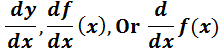
Leibniz’s Notation: Derivative of function f(x) can be denoted as:
Higher derivatives for the nth
derivative of y = f(x) (with respect to x) are expressed using the notation:
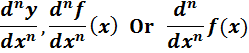
Lagrange’s Notation: Derivative of a function f(x) is denoted f'(x) or simply f'.
- The notation f'(n) for the nth
derivative of f.
Newton’s Notation: Also called the Dot notation, places a dot over the function name to represent a time derivative.
- If y = f (t), then
 and
and  denote, respectively, the first and second derivatives of y with respect to t.
Euler’s Notation: Euler’s notation uses a differential operator D, which is applied to a function f to give the first derivative Df.
- The second derivative is denoted D2
f, and the nth
derivative is denoted Dn
f.
- If y = f(x) is a dependent variable, then often the subscript x is attached to the D to clarify the independent variable x.
- Euler’s notation is then written as: