Chapter 1 : Limits, Continuity and Functions
Topics covered in this snack-sized chapter:
Calculus is the study of change.
It has two major branches:
They are related by the fundamental theorem of calculus.
In calculus, the derivative is a measure of how a function changes as its input changes.
- Derivative of function f(x) is denoted as:

Example:
- The derivative of the position of a moving object with respect to time is the object's instantaneous velocity.
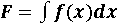
The term Integral may also refer to the antiderivative, a function F whose derivative is the given function f.
- Integral of function f(x) is denoted as:
In mathematics, the concept of a “limit” is used to describe the value that a function or sequence approaches as the input or index approaches some value.
Limits are essential to calculus and are used to define continuity, derivatives and integrals.
Let f be a function defined on some open interval that contains the number a, except possibly at a itself.
We say the limit of f(x)
as x
approaches a is L, and we write:

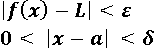
If for every number  ,there is a corresponding number
  such that:
Let f be a function defined on some open interval (b, a) [or (a, b)].
We say the left-hand or the right-hand limit of f (x) as x approaches a is L, (or the limit of f(x) as x approaches a from the left [or right] is L) and we write:
 (Left hand limit)
  (Right hand limit)
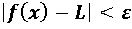
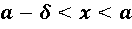
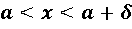
If for every number there is a corresponding number such that
If  and
and 
then we have the following:
The limit of a constant is the constant.

The limit of a power is the power of the limit.
- For any positive integer n,

The limit of a root is the root of the limit.
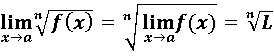
The limit of a sum or difference is the sum or difference of the limits.

The limit of a product is the product of the limits.


The limit of a quotient is the quotient of the limits.
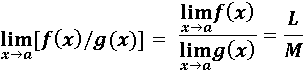
- If
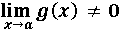
The limit of a constant times a function is the constant times the limit.

For any positive integer n,
Let f
and g be two real valued functions with the same domain such that f (x)  g (x) for all x
in the domain of definition, For some a,
if both
g (x) for all x
in the domain of definition, For some a,
if both 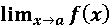 And
And 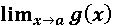 exist, then:

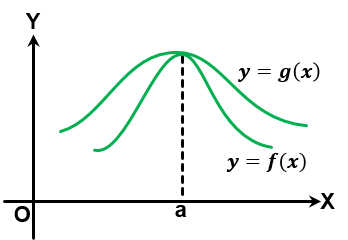
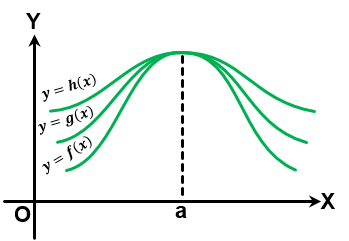
Let f,
g and h
be real functions such that  for all x
in the common domain of definition. For some real number a, if:
for all x
in the common domain of definition. For some real number a, if:
 , then

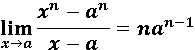
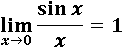
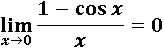
The following are two important limits.
Example: Evaluate:

Solution:
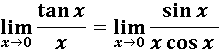
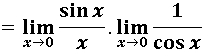
= 1.1 = 1
A function f is continuous at x = a if:
 exists (The output as a exists).
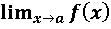 exists (The limit as
  exists)
 (The limit is the same
as the output)
A function is continuous over an interval if it is continuous at each point in that interval.
If f(x) and g(x) are continuous functions then we have the following:
The sum of continuous functions is continuous.
- f(x) + g(x) is also continuous.
The difference of continuous functions is continuous.
- f(x) – g(x) is also continuous.
The product of continuous functions is continuous.
- f(x) × g(x) is also continuous.
The quotient of continuous functions is continuous at all points x where the denominator is not zero.
 is continuous if
  .
.
The functional composition of continuous functions is continuous at all points x where the composition is properly defined.
Any polynomial is continuous for all values of x.
A function relates an input to an output.
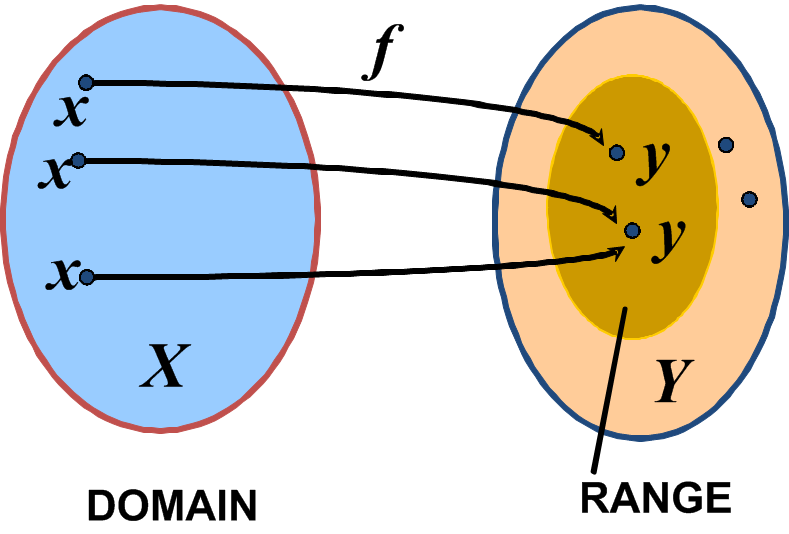
Let X and Y be two nonempty sets of real numbers.
A function from X into Y is a relation that associates with each element of X a unique element of Y.
“f(x) = …” is a classic way of writing a function.
Domain
The set of all possible input values. For function f(x), x is called the Domain of the function.
Range
The set of all images of the elements of the domain is called the Range of the function. It is the set of all possible output values.
- For each element x in X, the corresponding element y in Y is called the image of
x.
Squaring function

Constant function
Linear function
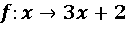
Factorial function

Any sequence can be considered as a function defined on a set of integers.
Example:
- Sequence 2, 5, 8, 11, 14,… is a function defined:
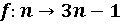
A function y = f(x), the variable x is called the Independent Variable.
Because it can be assigned any of the permissible numbers from the domain.
The independent variable is also called the Argument of the function.
The variable y is called the dependent variable because its value depends on x.
This is a function that returns a true (1) or false (0) value instead of a numeric value. It uses principal logical relations “and”, “or”, “not”, “if…then” etc.
Example:

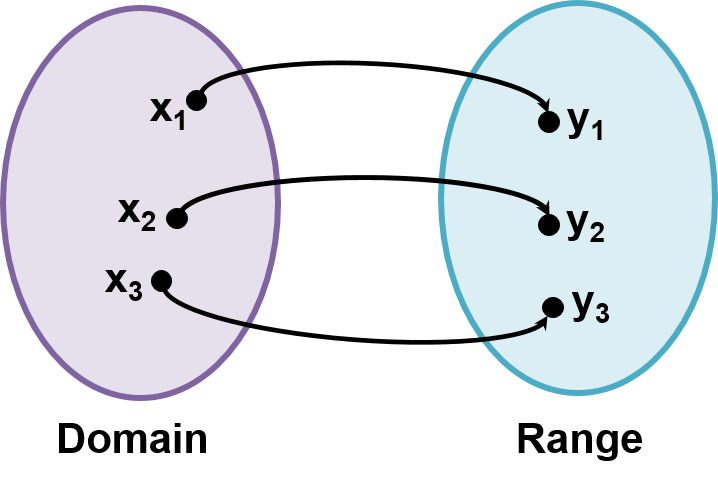
A one-to-one or injective function f from set X to set Y is a function such that each x in X is related to a different y in Y.
F is one-to-one or injective if for all elements  . If
. If  then
then . No
. No  in the range is the image of more than one
  in the domain.
- As shown in figure that, for every element of
 there is exactly one value of
 .
.
Example:
- f: R →R is defined by f(n) = 2n + 3,
- g: R → R is defined by f(x) = x2
,
- Then f is one-to-one function, and g is not.
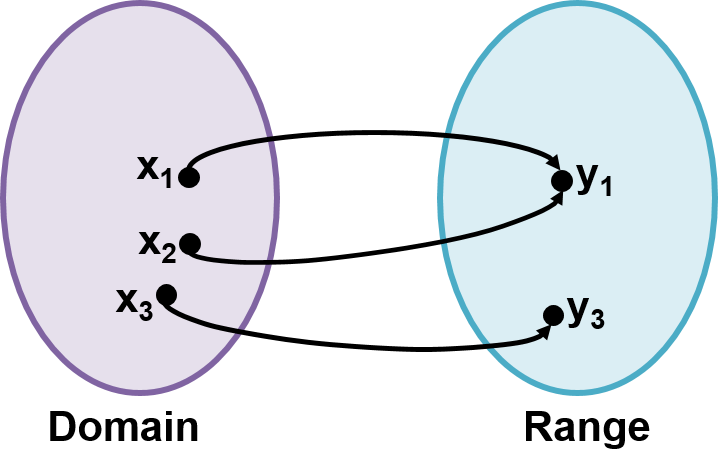
A function f: X →Y is said to be onto or surjective if for every y in Y, there is an x in X, such that f(x) = y. All the elements in the Y are used.
If two or more different elements in the domain corresponds to the same element in the range.
Examples:
- We define f: R → R by f(n) = n2
- 2
- g: R → R by f(n) = 3n - 4
- Then, g is onto, and f is not.
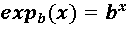
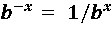
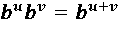
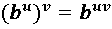
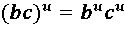
The Exponential Function with base b is the following function from R to R+
.

The logarithmic function with base b 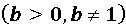 is the following function from R+
to R.
is the following function from R+
to R.
-
 = the exponent to which b must raise to obtain x.
Symbolically,

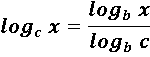
Properties


A one-to-one correspondence or bisection from a set X to a set Y is a function  that is both one-to-one and onto.
Examples:
Linear functions:
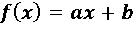
- When
 .
.
Exponential functions:

- When
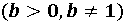 .
.
Logarithmic functions:
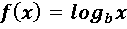
- When .
Suppose  is a one-to-one correspondence.
Then there is a function 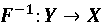 ,
,
defined as follows:
- F-1
(y) = The unique element x in X such that F(x) = y.
The function F-1
is called the Inverse Function for F.
Example:
- The logarithmic function with base
 is the inverse of the exponential function with base b.
