Chapter 2 : Atomic Theory


Atomic Theory arrow_upward


  • Matter is made up of atoms.
  • Atoms cannot be subdivided, created, or destroyed in ordinary chemical reactions.
    • These changes can occur in nuclear reactions.
  • All atoms of a given element are identical in mass and properties.
  • Compounds are formed by a combination of two or more different kinds of atoms.
  • A chemical reaction is a rearrangement of atoms.

  • Plum Pudding Model arrow_upward


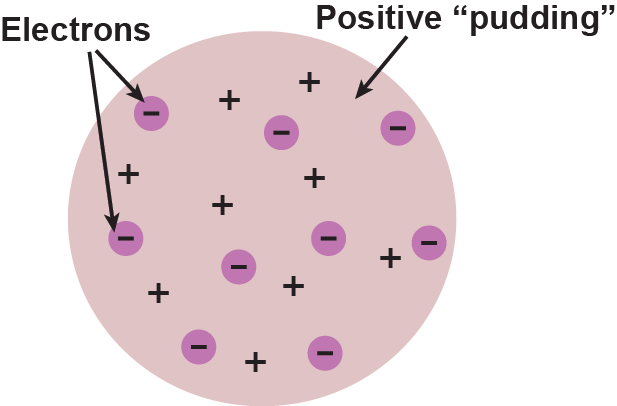
  • Thomson discovered electrons (negatively charged particles) in 1897.
  • Thomson believed that the electrons were like plums embedded in a positively charged “pudding,” thus it was called the “plum pudding” model.
  • It was assumed that the mass of the atom was uniformly distributed over the atom.
  • Rutherford’s Nuclear Model of an Atom arrow_upward


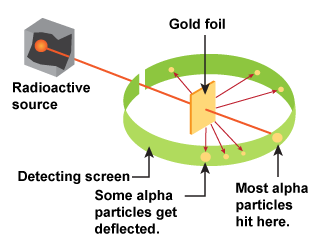
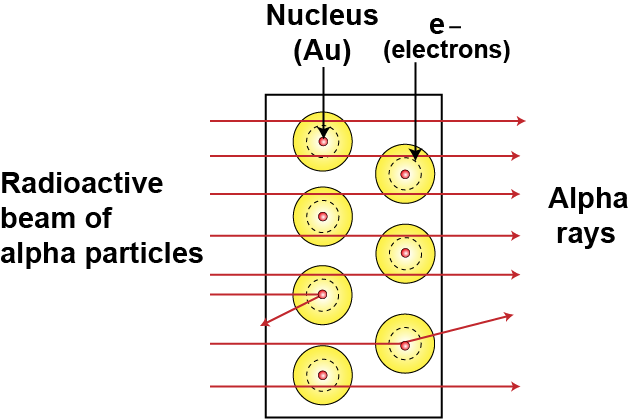
  • Rutherford bombarded a very thin gold foil with a stream of high energy alpha particles from a radioactive source and observed the following:
    • Most of the alpha particles passed through the gold foil un-deflected.
    • Small fractions were deflected by a small angle.
    • Very few bounced back (greatly deflected).

    Conclusion

  • The nucleus is small, dense and positively charged.

  • Nucleus arrow_upward


  • The positive charge and mass of the atom is densely concentrated in the center of the atom called nucleus.
  • Electrons and the nucleus are held together by electro static forces of attraction.

  • Atomic Structure arrow_upward


    Particle

    Charge

    Mass #

    Location

    Electron

    -1

    0

    Electron Cloud

    Particle

    Charge

    Mass #

    Location

    Proton

    +1

    1

    Nucleus

    Particle

    Charge

    Mass #

    Location

    Neutron

    0

    1

    Nucleus


    Electrons arrow_upward


  • Electrons are negatively-charged particles that form a cloud around the nucleus of an atom.
  • Each electron has a charge of -1.
  • Electrons can behave both as a particle as well as a wave.
  • They are one of the lightest particles with a known mass.
  • They are called fundamental particles as they cannot be further sub-divided into smaller particles.

  • Protons arrow_upward


  • Protons are small, positively charged particles that carry a charge of +1.
  • Their mass is 1840 times the mass of an electron.
  • The number of protons determines the total quantity of positive charge in the atom.
  • Most atoms are electrically neutral, meaning that they have an equal number of protons and electrons.

  • Neutrons arrow_upward


  • Neutrons are almost the same size as protons, but their mass is slightly greater.
  • Without neutrons, the repulsion among the positively-charged protons would cause the nucleus to fly apart.
  • Protons and neutrons are made up of other smaller particles called quarks.

  • Quarks arrow_upward


  • Quarks are fundamental particles that cannot be broken down further.
  • They have electric charges that are fractions of the fundamental charge.
  • There are six known quarks.
  • Neutrons and protons are made up of up quarks and down quarks.
  • An up quark has a charge of +2/3 and down quark has a charge of -1/3.
  • Proton = 2 up quark + 1 down quark
  •  = 2/3 + 2/3 - 1/3 = +1
  • Neutron = 1 up quark + 2 down quark
  •    = 2/3 – 1/3 - 1/3 = 0

  • Atomic Number (Z) arrow_upward


  • Each element has a unique number of protons, which is called the atomic number and is denoted by “Z.”
  • Atomic Number = (Number of p+ )


    Element

    # of protons

    Atomic # (Z)

  • Carbon
  • 6
  • 6
  • Element

    # of protons

    Atomic # (Z)

  • Gold
  • 79
  • 79


  • Mass Number (A) arrow_upward


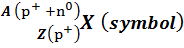
  • The total number of protons and neutrons in the atom is the mass number or atomic mass of the atom, denoted by “A.”
  • Mass Number =   (p+    + n0 )

  • Nuclide
  • Oxygen: 18
  • P+
  • 8
  • n0
  • 10
  • e-
  • 8


  • Atomic Mass Unit arrow_upward


  • The mass of atomic particles is measured in atomic mass units.
  • It is the basis for figuring out the mass of all other atoms.
  • It is 1/12th of the mass of a carbon-12 atom.
  • 1 amu = 1.66 x 10⁻²⁷ kg

  • Particle

    Mass (in amu)

  • Proton
  • 1
  • Neutron
  • 1
  • Electron
  • 1/2000 (almost 0)


  • Nuclide Notation arrow_upward


    Example:


    Isotopes arrow_upward


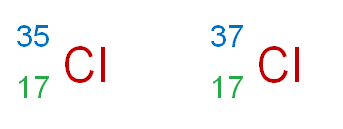
  • Atoms with the same atomic number but variable number of neutrons are called isotopes.
  • Most elements exist as a mixture of isotopes.
  • Example

  • Chlorine has two isotopes

  • Isotope

    # of Protons

    # of Neutrons

  • Cl - 35
  • 17
  • 18
  • Isotope

    # of Protons

    # of Neutrons

  • Cl - 37
  • 17
  • 20


  • Isobars arrow_upward


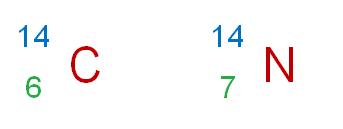
  • Atoms with the same mass number but different atomic number are called isobars.

  • Isobar

    # of Protons

    # of Neutrons

  • C - 14
  • 6
  • 8
  • Isobar

    # of Protons

    # of Neutrons

  • N - 14
  • 7
  • 7


  • The Mole arrow_upward


  • Mole, also spelled mol , in chemistry, a standard scientific unit for measuring large quantities of very small entities such as atoms, molecules, or other specified particles.
  • 1 mole = 6.02 ×10²³ atoms or molecules

  • Avogadro’s number arrow_upward


  • The number of atoms or molecules contained in one mole of a pure substance is known as Avogadro's number.
  • Avogadro’s number=6.02×10²³


    Thank You from Kimavi arrow_upward


  • Please email us at Admin@Kimavi.com and help us improve this tutorial.