Chapter 1: : Basics of Chemistry
Topics covered in this snack-sized chapter:
Chemistry is a branch of science that deals with the identification of the substances of which matter is composed.
- It also deals with the investigation of their properties and the ways in which they interact, combine, and change.
Disciplines within chemistry are traditionally grouped by the type of matter being studied.
These include the following:
Inorganic chemistry
- The study of inorganic matter.
Organic chemistry
- The study of organic (carbon-based) matter.
Biochemistry
- The study of substances found in biological organisms.
Physical chemistry
The study of chemical processes using physical concepts, such as thermodynamics and quantum mechanics.
Analytical chemistry
The analysis of material samples to gain an understanding of their chemical composition and structure.
Neurochemistry
The chemical study of the nervous system.
Below concepts are essential for the study of chemistry:
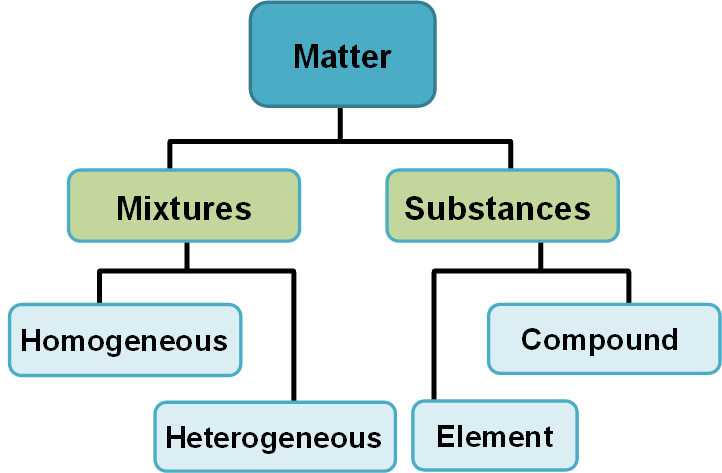
- Matter and its classification
Matter includes atoms and other particles which have mass.
Matter is anything that occupies space and has mass.
There are five main states of matter:
- Bose-Einstein condensates
Solids: A rigid shape and fixed volume.
Liquids: No fixed shape and retain a (nearly) constant volume.
Gases: No fixed shape or volume. Expand to fill the container.
Plasma: An ionized gas into which sufficient energy is provided to free electrons from atoms or molecules and to allow species, ions and electrons, to coexist.
Bose-Einstein Condensates:
- Recently discovered, which can be thought of as the opposite of plasma.
- Occurs at ultra-low temperature, close to the point that the atoms are not moving at all.
- A gaseous super fluid phase formed by atoms cooled to temperatures very near to absolute zero.
| Extensive Property
| Depends upon how much matter is being considered
|
| Intensive Property
| Does not depend upon how much matter is being considered
|
- Homogeneous mixture – Composition of substances is the same throughout.
- Heterogeneous mixture – Composition of substances is not uniform throughout.
Atom is the basic unit of matter.
Consist of a positively charged atomic nucleus at the center, which contains protons and neutrons.
Maintain a number of electrons to balance the positive charge in the nucleus.
A chemical element is a substance that is composed of a single type of atom.
Characterized by a particular number of protons in the nuclei of its atoms.
This number is known as the atomic number of the element.
- 116 elements have been identified
- 82 elements occur naturally (Example: gold)
- 34 elements have been created by scientists (Example: americium)
Substance with a particular ratio of atoms of two or more chemical elements.
This ratio determines its composition, and its particular organization.
A chemical substance is a kind of matter with a definite composition and set of properties.
A substance can often be classified as an acid or a base.
There are several theories which explain acid-base behavior.
The simplest is Arrhenius theory: An acid is a substance that produces hydronium ions (H3
O+) when it is dissolved in water, and a base is one that produces hydroxide ions (OH-) when dissolved in water.
A molecule is the smallest indivisible portion of a pure chemical substance.
It has its unique set of chemical properties.
The state in which the parameters, such as chemical composition, remain unchanged over time.
Atoms sticking together in molecules or crystals are said to be bonded with one another.
A chemical bond may be visualized as the balance between the positive charges in the nuclei and the negative charges oscillating around them.
An ion is a charged species, an atom or a molecule, that has lost or gained one or more electrons.
- Positively charged species are called cations (e.g., sodium cation Na+
).
- Negatively charged species are called anions (e.g., chloride anion Cl−
).