Chapter 2 : Civil Engineering Materials I
Topics covered in this snack-sized chapter:
Material is anything made of matter, constituted of one or more substances.
- Wood, cement, hydrogen, air and water are all examples of materials.
A material can be anything:
- A finished product in its own right.
- An unprocessed raw material.
These raw materials can be input into a new cycle of production and finishing processes to create finished materials, ready for distribution, construction, and consumption.
To understand civil engineering it is important to understand some basic civil engineering materials:
- Modern Building Materials
A stone is a small piece of rock of any shape. It does not have any definite shape and structure.
Stones are the fragmented parts of the Rocks.
Rocks may be classified into three types:
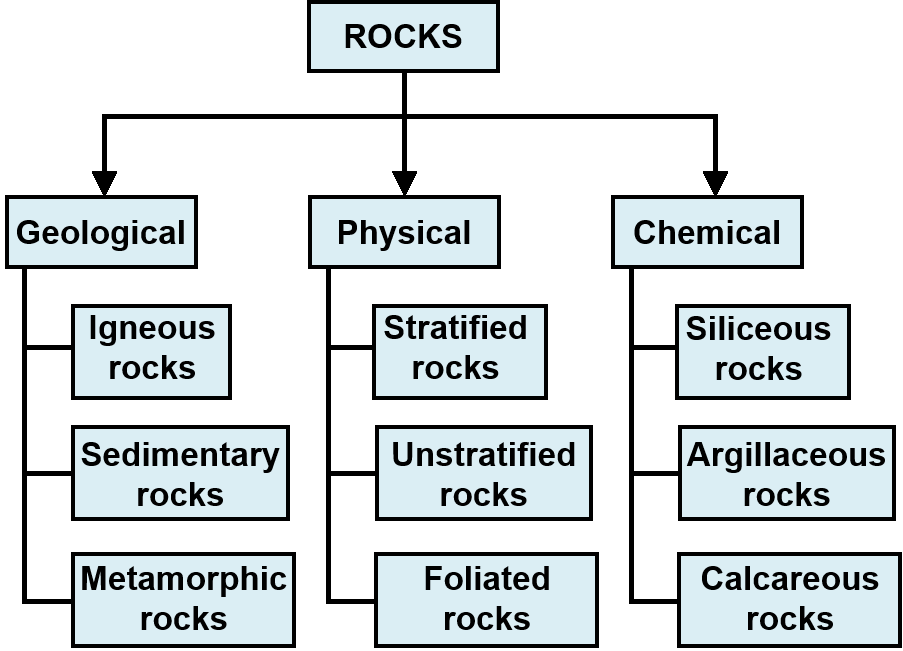
Depending on the Physical classification rocks are of three types:
- Stratified: It is the arrangement or disposition of sedimentary rocks in strata.
- These stones are found in layers one above the other.
- Example: Lime Stone and Sand Stone.
- Unstratified: The principal of this is granite, which is composed of quartz, feldspar, and mica, with the occasional addition of hornblende, and some other mineral substances.
- Example: Granite, Marble, trap etc.
- Foliated Rocks: Foliation is a geologic term that is used to describe the appearance of metamorphic rocks.
- Example: mica and chlorite, etc.
In geology, a rock is a naturally occurring solid aggregate of one or more minerals or mineraloid.
Geological rocks may be classified into three types:
- Igneous Rocks: These are formed by cooling of molten lava.
- Sedimentary Rocks: These are formed by deposition of sediments due to action of air and water.
- Metamorphic Rocks: When rocks are subjected to high pressure and temperature they are transformed to metamorphic rocks.
| Type of Rocks
| Vol. % in the Earth’s Crust
|
| Igneous
| 65%
|
| Sedimentary
| 8%
|
| Metamorphic
| 27%
|
- Siliceous Rocks: These have silica as the principal constituent.
- Argillaceous Rocks: These have clay as the principal constituent.
- Calcareous Rocks: These have carbonate of lime as the principal constituent.
After considering some of the factors we use Rocks that are given below:
- Hardness or softness of the components
- Proportion of hard and soft materials
Testing and Requirements of Stone
Below is a table showing the relationship between weights and crushing strength.
| Stone
| Weight in lb/cu. Ft
| Ultimate strength to resist crush
|
| Granite
| 165
| 13000
|
| Basalt or Trap
| 185
| 12000
|
| Limestone
| 160
| 7500
|
| Slate
| 175
| 10000
|
| Marble
| 170
| 7500
|
Bricks are artificially made rectangular blocks, made from clay.
Bricks have become the most essential building components due to their easy availability, good strength and durability.
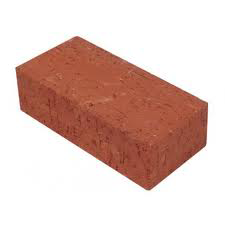
Brick
First Class Bricks:
- These bricks are table-molded and of standard shape and they are burnt in kilns.
- The surfaces and edges of the bricks are sharp, square, smooth and straight.
- These bricks are used for superior work of permanent nature.
Second Class Bricks:
- These bricks are ground-molded and they are burnt in kilns.
- The surface of these bricks is somewhat rough and shape is also slightly irregular.
- These bricks may have hair cracks and their edges may not be sharp and uniform.
- These bricks are commonly used at places where brickwork is to be provided with a coat of plaster.
Third Class Bricks:
- These bricks are ground-molded and they are burnt in clamps.
- These bricks are not hard and they have rough surfaces with irregular and distorted edges.
- These bricks give dull sound when struck together.
- They are used for unimportant and temporary structures and at places where rainfall is not heavy.
Fourth Class Bricks:
- These are over burnt with irregular shape and dark color.
- These bricks are used as aggregate for concrete in foundations, floors, roads, etc.
- Because of the fact that the over burnt bricks have a compact structure and hence they are sometimes found to be stronger than even the first class bricks.
Brick’s Size in Different Countries
| Standard
| Imperial
| Metric
|
| Australia
| 9×4.5×3 inch
| 230×110×76 mm
|
| India
| 9×4.25×2.75 inch
| 228×107×69 mm
|
| United Kingdom
| 8.5 ×4×2.5 inch
| 215×102.5×65 mm
|
| United States
| 8×4×2.25inch
| 203×102×57 mm
|
| Russia
| 10×4.75 ×2.5 inch
| 250×120×65 mm
|
Cement is used in almost all civil engineering works.
Cement is a mixture of limestone, clay, silica and gypsum.
It is a fine powder which when mixed with water sets to a hard mass as a result of hydration of the constituent compounds. It is the most commonly used construction material.
There are different varieties of cement based on different compositions according to specific end uses namely:
- Ordinary Portland Cement (OPC): OPC, popularly known as grey cement, has 95% clinker and 5% of gypsum and other materials.
- Portland Pozolona Cement (PPC): PPC has 80% clinker, 15% pozolona and 5% gypsum and accounts for 18% of the total cement consumption.
- Portland Blast Furnace Slag Cement (PBFSC): It consists of 45% clinker, 50% blast furnace slag and 5% gypsum and accounts for 10% of the total cement consumed.
- White Cement: Basically, it is OPC: clinker using fuel oil (instead of coal) and with iron oxide content below 0.4% to ensure whiteness.
- Oil Well Cement: It is made from clinker with special additives to prevent any porosity.
- Rapid Hardening Portland cement: It is similar to OPC, except that it is ground much finer, so that on casting, the compressible strength increases rapidly.
- Water Proof Cement: It is similar to OPC, with small portion of calcium stearate or non-saponifiable oil to impart waterproofing properties.
For Fire safety: Concrete provides excellent fir resistance.
- Concrete does not produce any smoke or toxic gases and does not drip molten particles, which can spread fire.
For Earthquake safety use good cement mortar: The cement mortar should be used in the ratio of 1 part of cement with 4 parts of sand.
Concrete is a construction material composed primarily of aggregate, cement and water.
It is a Composite Material.
Aggregates are 65 - 80% of volume Fine Aggregate (Sand) and Coarse Aggregate (Stone)
Water
Binder like Portland cement, Fly ash, Ground slag and Silica fume.
Workability is the ability of a fresh (plastic) concrete mix to fill the form/mold properly with the desired work (vibration) and without reducing the concrete's quality.
Workability depends on water content, aggregate (level of hydration) and can be modified by adding chemical admixtures, like super plasticizer.
Workability can be measured by the concrete slump test, a simplistic measure of the plasticity of a fresh batch of concrete following the ASTM C 143 or EN 12350-2 test standards.