Chapter 1 : Introduction
Topics covered in this snack-sized chapter:
- It also includes practical techniques for their implementation and applications. Example: Algorithms.
| Type | Details |
| Personal Computing | Economical enough for individual use. |
| Distributed Computing
| Means by which a single computer program runs on more than one computer at the same time. |
| Client/Server Computing
| Sharing of information across computer networks between servers and clients (personal computers). |
- It is the fastest medium of communication (much faster than postal mail or telegraphic communication).
- Through computers, text messages or images can reach any part of the world using internet.
- Arithmetic problems can be easily solved with a computer.
- Through video conferencing one can not only see but also talk with anybody living in any part of the world.
- Computers make it possible to receive, supply and process large volumes of data at very high speeds.
- Data Input
- Data Output
- Data Processing
- Data Transmission
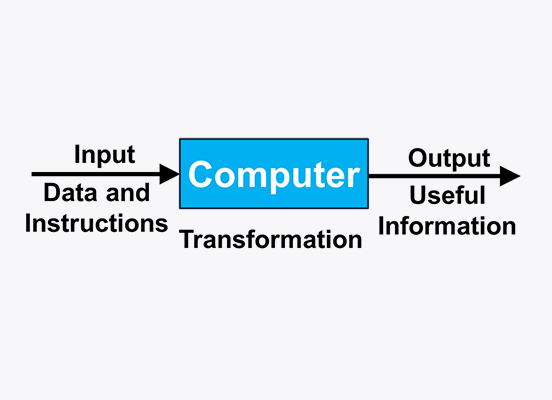
- Accepts information and stores it until the information is needed.
- Processes the information according to the instructions provided by the user.
- Ultimately returns the result to the user.
- Mobile phones
- Self Driving Cars
- Scientific calculations
- Commercial and business data processing
- Space guidance
- The educational field and many others
Personal Computer, Tablet, Smartphone:
Workstation:
- A more powerful microprocessor
- A higher-quality monitor
Minicomputer:
- Universities
- Research Organizations
- The Government Sector
Mainframe:
- Industries
- Banks
- Airlines
Supercomputer:
- Research
- Massive data-processing applications
- Nuclear and plasma physics
- Space research
Types of Digital Computers:
- PCs
- Telephone switching exchanges
- Digital voltmeters
- Frequency counters
- Calculating machines
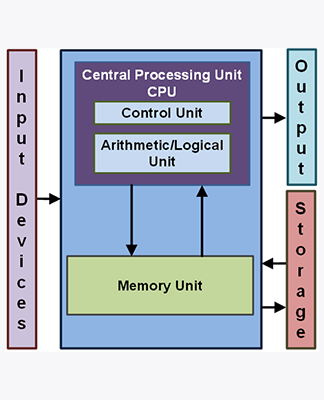
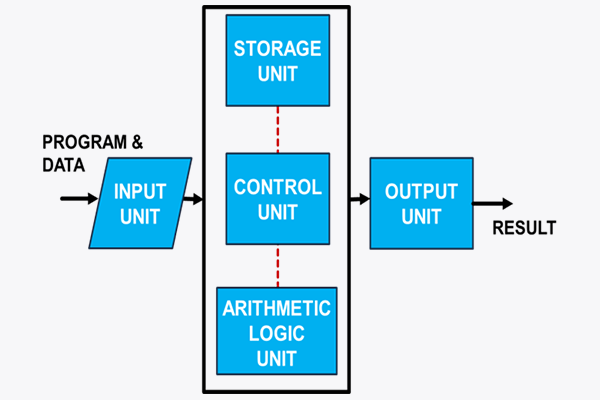
Computer Architecture
| Part | Use |
| Input | Obtains information from input devices (keyboard, mouse). |
| Output | Outputs information (screen, printer). |
| Memory | ROM (Read Only Memory) RAM (Random Access Memory) |
| Arithmetic Logic Unit | Part of the CPU (Central processing Unit) performs arithmetic calculations (addition) and logic decisions |
| Control Unit | Part of the CPU (Central Processing Unit) controls the flow of information |
- CPU, Keyboard, Mouse, Printer, Modem and Scanner, Speaker, Microphone and Camera
OS (Operating Systems):
- Windows, Linux, UNIX, Mac OS, iOS, Android
Computer Languages:
- C, C++, Java, Swift, Python, JavaScript, SQL
Computer Application Programs:
- MS Office, AutoCAD, Photoshop, Facebook, Twitter, Instagram
Examples:
- Windows, UNIX, Mac, iOS, Android
Thank You from Kimavi.Com and iEdu.io arrow_upward