Topics covered in this snack-sized chapter:
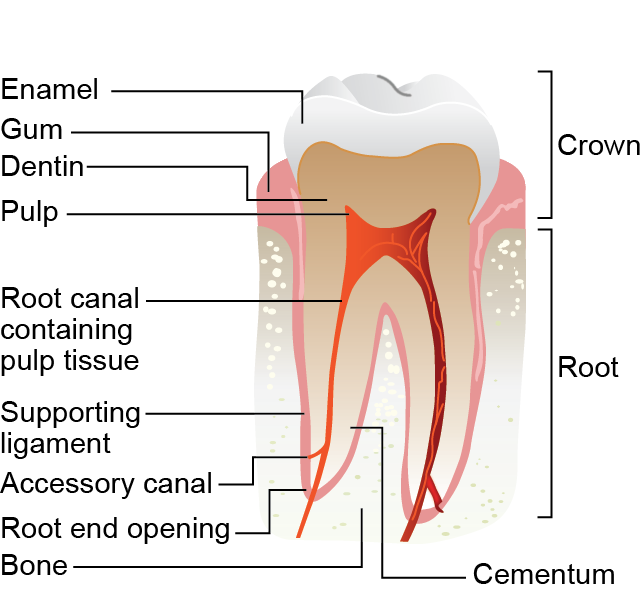
Singular: Tooth
Plural: Teeth
Teeth are calcified.
Whitish structures found in the mouth.
Used for breaking down food.
The roots of teeth are covered by gums.
Made of multiple tissues of varying density and hardness.
Most distinctive (and long-lasting) features of human beings.
Gums consist of mucous membranes
- Connected by thick fibrous tissue to the membrane surrounding the bones of the jaw.
Rich in blood vessels.
Present around the exposed portion of each tooth forming a little collar.
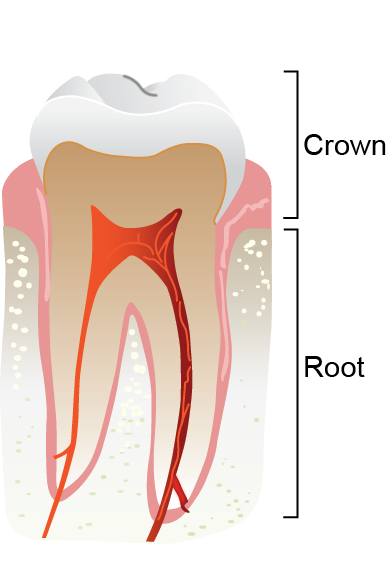
Crown:
- Part of the tooth that is above the gum.
Root:
- Part of the tooth which is below the gum and cannot be seen.
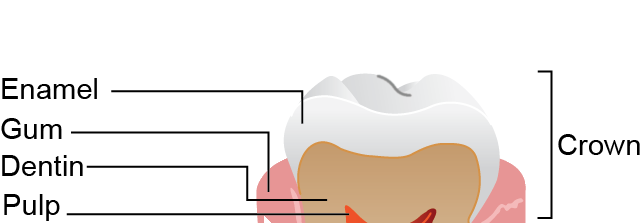
Enamel
Dentin
Cementum
Pulp
The hardest substance in the human body.
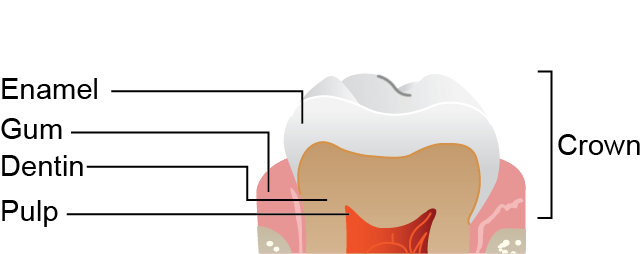
The clear outer layer of the tooth above the gum line.
- Must be supported by underlying dentin.
Most highly mineralized substance:
- Primary mineral is crystalline calcium phosphate.
- Large amount of minerals in enamel accounts not only for its strength but also for its brittleness.
Color varies from light yellow to grayish white
- Strongly affects the appearance of a tooth.
About 0.16 cm (about 0.06 in) thick.
Protects the inner layers of the teeth from harmful bacteria and changes in temperature (hot or cold).
Thickest at the cusp (about 2.5 mm) and thinnest at its border.
Does not contain collagen (found in bone) but does contain two unique classes of proteins (amelogenins and enamelins).
Does not regenerate on its own.
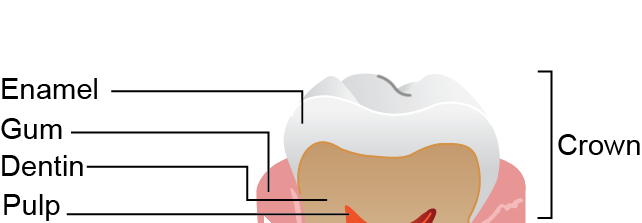
Dentin is the substance between enamel or cementum and the pulp chamber.
Secreted by the odontoblasts of the dental pulp.
Porous, yellow-hued material made of:
Softer than enamel.
Dentin has a degree of permeability which can increase the sensation of pain and the rate of tooth decay.
It decays more rapidly and is subject to severe cavities.
Acts as a protective layer and supports the crown of the tooth.
Dentin surrounds and protects the pulp or core of the tooth.
Mineralized connective tissue with an organic matrix of collagenous proteins.
Has microscopic channels, called Dentinal Tubules, which radiate outward through the dentin from the pulp cavity to the cementum or enamel.
Diameter of these tubules range from 2.5 μm near the pulp, to 1.2 μm in the mid portion.
Outer layer of the tooth that lies below the gum line.
A bonelike substance that anchors the tooth to the jawbone.
- Anchors the tooth by attaching it via the periodontal ligaments.
Specialized bony substance covering the root of a tooth.
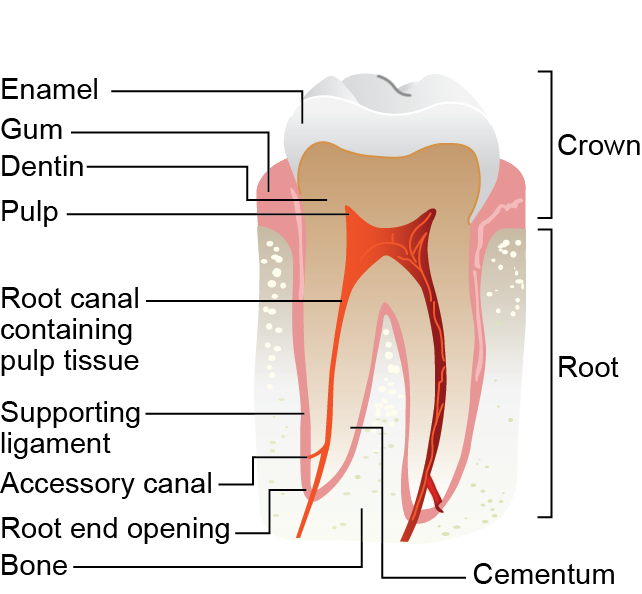
Excreted by cementoblasts cells within the root of the tooth.
Thickest at the root apex.
Coloration is yellowish.
Softer than enamel and dentin due to being less mineralized.
Consists of:
- Approximately 45% inorganic material (mainly hydroxyapatite).
- 33% organic material (mainly collagen) and 22% water.
The chemical makeup of cementum is similar to that of bone, but it lacks vascularization.
Cementum can be both cellular and acellular.
Pulp forms the core of the tooth:
- Contains blood vessels which carry oxygen and nutrients to the tooth.
- Carries nerves, which transmit pain and temperature sensations to the brain.
Dental pulp is the central part of the tooth filled with soft connective tissue.
Along the border between the dentin and the pulp are odontoblasts, which initiate the formation of dentin.
Other cells in the pulp include fibroblasts, preodontoblasts, macrophages and lymphocytes.
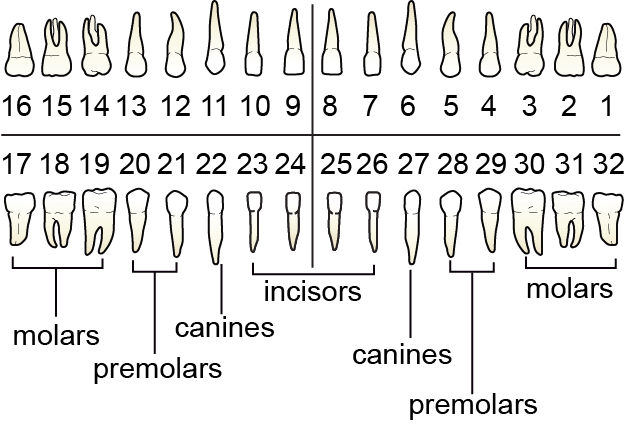
Numbering of teeth continues along the upper teeth toward the front and across to the last molar tooth back on the top left side (number 16).
The tooth numbering continues by assigning teeth numbers descending to the lower left third molar (number 17) and follows the lower (mandibular) jaw up to the tooth farthest back on the bottom right side of the mouth (number 32).
All teeth that should be there are numbered, including those teeth that have been removed for any reason or have not erupted yet (e.g. wisdom teeth).
In the original system, children's 20 primary teeth are numbered in the same order (from 1 to 20), except that a small letter "d" follows each number to indicate deciduous (primary) teeth.
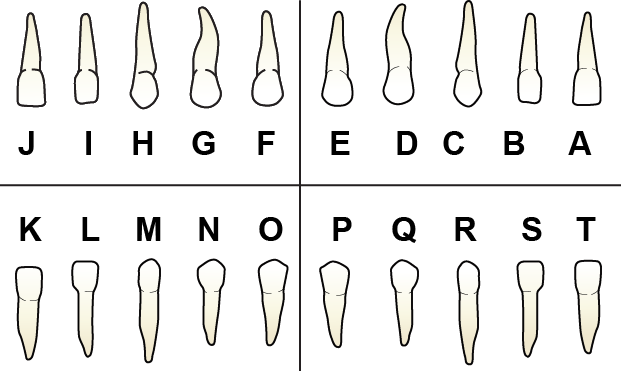
The primary teeth are designated by upper case letters A through T, with A being the patient's upper right second primary molar and T being the lower right second primary molar.