Topics covered in this snack-sized chapter:
Digital electronics represent signals by discrete bands of analog levels, rather than by a continuous range.
Signal is a function that conveys information about the behavior or attributes of some phenomenon.
There are two types of signal:
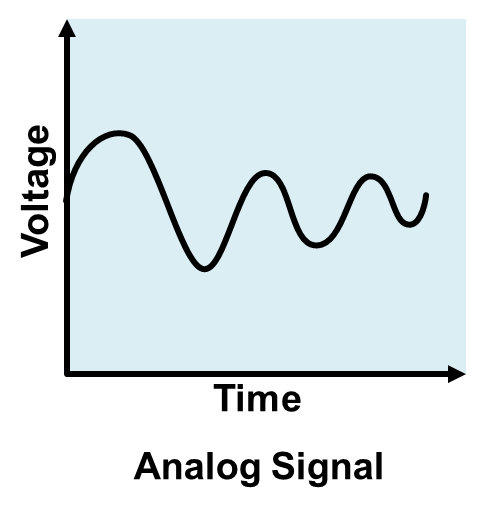
Analog signal is defined as voltage or current whose size is proportional to the quantity it represents.
Analog Signal is continuous in nature and has infinite set of possible values.
Sound, Velocity, Weight, Pressure and Temperature etc. are analog in nature.
A digital signal is a physical signal that is a representation of a sequence of discrete values (a quantified discrete-time signal).
The term digital signal can refer to either of the following:
- Any continuous-time waveform signal used in digital communication, representing a bit stream or other sequence of discrete values.
- A pulse train signal that switches between a discrete number of voltage levels or levels of light intensity, also known as a line coded signal or baseband transmission.
Digital techniques have also replaced a lot of older analog circuits such as radios, TV sets.
Digital techniques are applied in many diverse areas such as telephony, data processing, radar, navigation, military system, medical instrumentation and process control.
Digital electronics involves system in which there are only two possible states that are represented by voltage levels.
In digital system two states are used to represent numbers, symbols and characters.
In an analog system, the quantity can vary over a continuous range of values.
For example:
The amplitude of the output signal to the speaker in radio receiver can have any value between zero and its maximum limit.
Commonly used analog systems are TV Receiver, Telephone system and Magnetic tape recording.
Digital system consists of devices designed to handle physical quantities that are represented in digital form.
Digital computers, calculators, digital watches and traffic signal controller are example of digital system.
Digital systems are easy to design.
Information can be stored very easily.
Digital circuits are less affected by noise.
More digital circuitry can be fabricated on IC chips as compared to analog circuit.
Digital circuits are the foundation of digital computers and automated control system.
In digital circuits, two voltage levels represent the two binary digits, 1 and 0 and are designed to produce output voltages that fall within the prescribed 0 and 1 voltage ranges.
Figure represents a typical digital circuit with input  and output
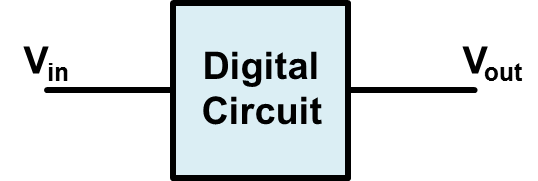
The output is shown in two different input signal waveforms.
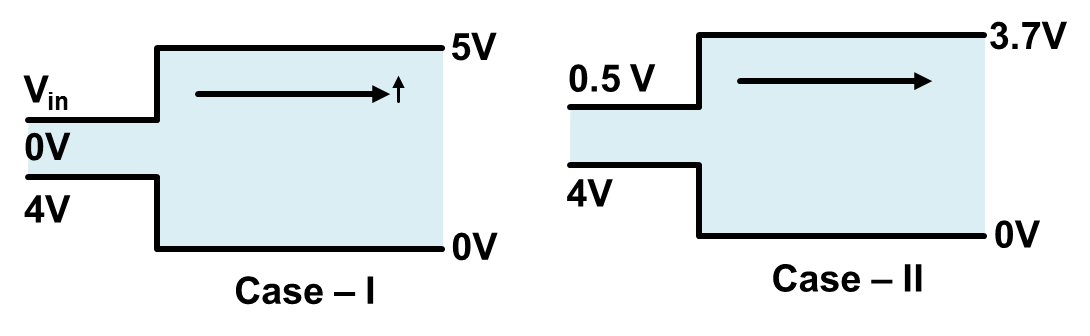
Vout
is same for both input waveforms, while they differ in their exact voltage levels.
The way in which a digital circuit responds to an input is known as the circuit’s logic.
Every digital circuit obeys a certain set of logic rules, thus digital circuits are also known as the logic circuits.
Logic circuits are generally composed of digital gates.
Combinations of gates form a circuit known as digital circuit.
All the digital circuits used in modern digital systems are integrated circuits.
Several IC fabrication technologies are used to produce digital ICs. The most common are TTL, CMOS, ECL, RTL,  etc.
etc.
Computer is a system of hardware that performs arithmetic operations and manipulates data.
In computer, each unit performs specific functions and all units function together to carry out instructions in the program.
Figure shows major parts of a digital computer:
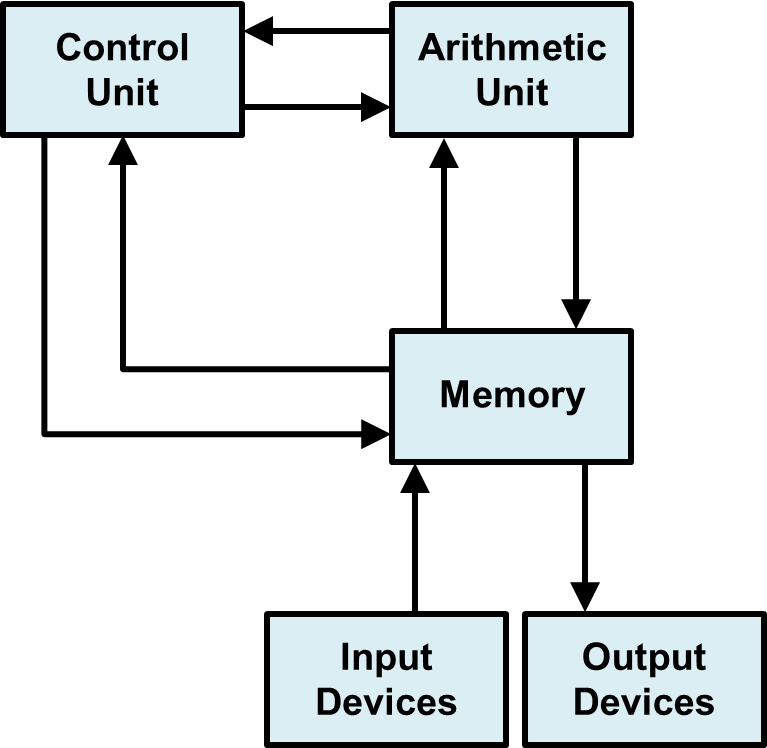
The major functions of each unit are:
Input Unit:
- This unit is used to feed information into the computer system.
Memory Unit:
- This unit stores the instruction and data received from the input unit.
- It stores the results of arithmetic operations received from the arithmetic unit.
- It also supplies information to the output unit.
Control Unit
- This unit takes instruction from the memory unit one at a time and decodes them.
Arithmetic Unit
- All arithmetic calculations and logic decisions are performed by this unit, and computation results are then stored in the memory.
Output Unit
- It takes information from the memory unit and prints out displays or shows the information to the user or operator.