Chapter 2 : Electricity and Magnetism
Topics covered in this snack-sized chapter:
Electricity is a general term encompassing a variety of phenomena resulting from the presence and flow of electric charge.
The electric field is defined as the force per unit charge that would be experienced by a stationary charge at a given location in the field.
E=F/q
- F = Electric force experienced by the particle.
- E = Electric field wherein the particle is located.
All matter is made up of atoms.
Atoms are made up of particles that carry electric charge and are called charged particles.
All atoms have a nucleus that is made up of:
- Proton: A positively charged particle.
- Neutron: An uncharged particle in the center of the atom.
- Electrons: Negatively charged particles that surround the nucleus.
- Only the electrons on the outermost orbit can participate in the electric reaction.
In normal conditions, all objects have a zero net charge.
When an object receives or gives an electron, it becomes negatively charged or positively charged respectively.
- Object + e
 Negative Charge
- Object - e Positive Charge
Each charge possesses a quantity of electric charge measured in Coulombs and denoted as Q.
Electricity is caused when two charges interact with each other. The interaction of charges causes electricity.
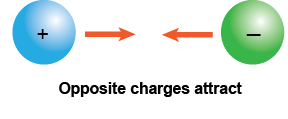
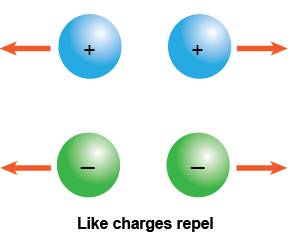
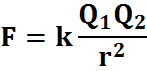
The electric force F acting on a point charge Q1
as a result of the presence of a second point charge Q2
placed at a distance of r from it is given by Coulomb's Law.
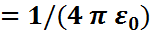
Here is Coulomb’s Constant

Ohm’s law states that the voltage (V) across a resistor is proportional to the current (I) passing through it, where the constant of proportionality is the resistance (R).
R=V/I
Here,
Conductance is the ability of a material to pass electrons.
The ratio of Current I over Voltage V gives the value of conductance G.
G=I/V
- Unit of conductance is Siemens (S).
Resistance is the ability of a material to resist the flow of electrons.
The ratio of Voltage V over Current I gives the value of resistance R.
R=V/I
- Unit of resistance is Ohm (Ω).
The relationship between Resistance and Conductance is given by:
R=1/G
Magnetism is a property of materials that respond at an atomic or subatomic level to an applied magnetic field.
A magnet that is moved in space near a second magnet experiences a magnetic field.
The strength of the magnetic field is greater where the lines are closer together and weaker where they are farther apart.
The force that a magnetic field exerts on a charge moving with a velocity  is given by:
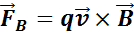
The direction is sideways and follows right hand rule.
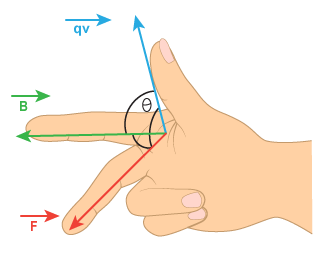
The magnitude of the force
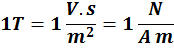
- The unit of the magnetic field
 is Tesla (T)
A magnet made from a current-bearing coil of wire, wrapped around an iron or steel core.
When a current is run through a cylindrical coil of wire, it produces a magnetic field.
The strength of the magnetic field produced by an electromagnet is proportional to the electric current in the electromagnet.
A machine that changes mechanical energy into electrical energy.
Uses moving magnets to create currents in coils of wire.
If a loop of wire is moved in a magnetic field, a voltage is induced in the wire.
The voltage is called an induced voltage and the resulting current is called an induced current.
The induction is called electromagnetic induction.
The electric flux through any closed surface is proportional to the enclosed electric charge.
Gauss's law may be expressed in its integral form:

Electric flux is the amount of electric field passing through a closed surface. It is given by  .
.
Flux is positive when the electric field is outward and negative when the electric field is inward (through the closed surface).
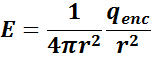
Electric Flux of a Point Charge over a Spherical Gaussian Surface arrow_upward

Solving for  we get
| Charge
| Density
|
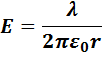
| Linear
| 
|
| Plane
| 
|
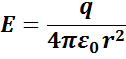
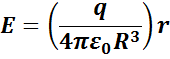
| Spherical
| 
|