Chapter 1 : Introduction to Electronics
Topics covered in this snack-sized chapter:
The term “electronics” stands for “electron mechanics”.
It is the branch of science and technology that deals with electrical circuits involving electrical components and electronic instruments.
An image below is showing electronic components:
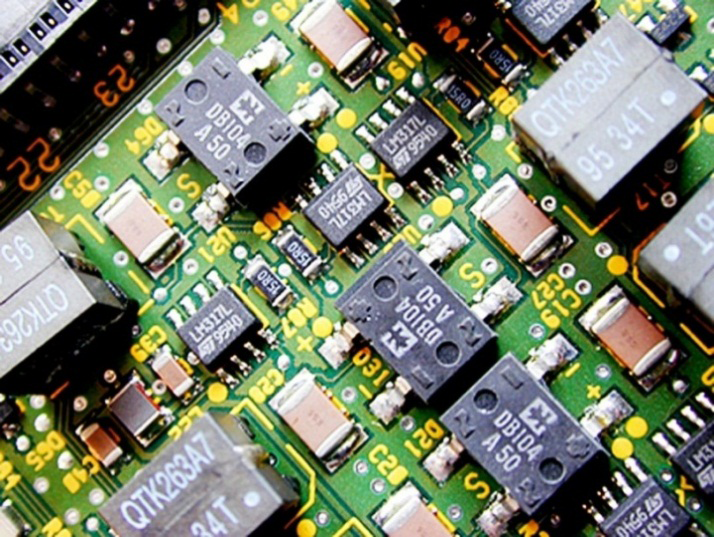
Electronics influences our everyday lives.
Some of the daily gadgets that leverage electronics are:
Understanding electronics can help us appreciate the impact of gadgets on our daily life.
Electronics is used in various fields:
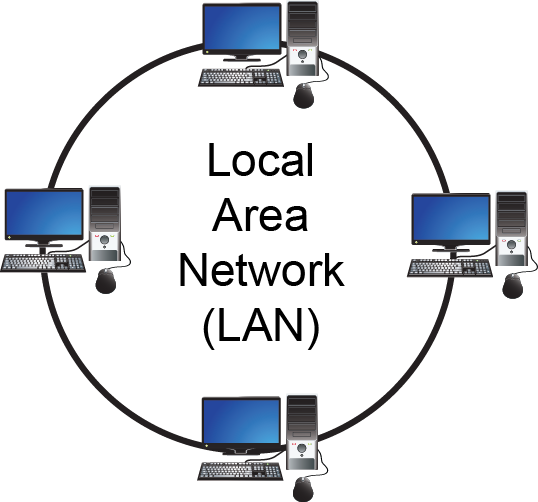
- Data Communications: Data can be transmitted through LANs (Local Area Networks), WANs (Wide Area Networks) and various other transmission line systems.
- An image below is showing LAN.
Electromagnetic wave propagation: Includes radio communications, radar, television, microwave and satellite communication, x-rays, and more.
Data Processing: Includes computing power applied to office management, banking, animation, word processing, and mathematical computation.
Process Control: Applied to robotics, automotive and aerospace vehicle control, and industrial plant control.
Research Analysis: It can be used in particle physics research.
To understand electronics it is important to understand some basic terms:
There are two types of electric circuit:
- Analog: Circuit that uses a continuous range of voltage.
- Example: Vacuum tube, transistor amplifiers, operational amplifiers and oscillators.
- Digital: Circuit that uses discrete levels of voltage.
- Example: Computers, electronic clocks.
There are two types of components:
- Passive Components: The components which store energy in the form of current or voltage.
- Example: Resistors, capacitors, inductors.
- Active Components: The components which produce energy in the form of current or voltage.
- Example: Transistor and Thyristors
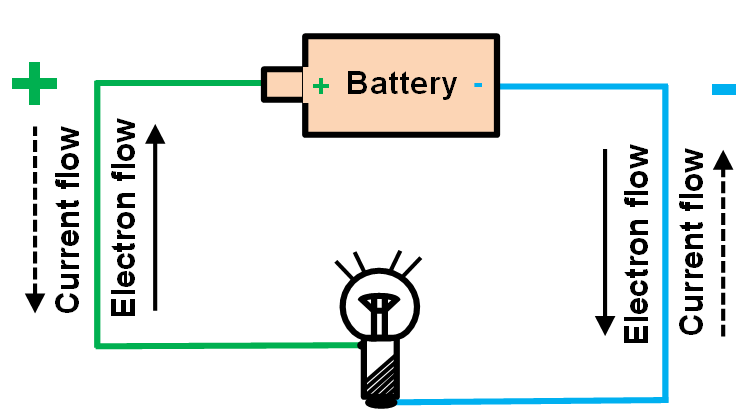
Electron Current: The flow of free electrons under the influence of applied voltage out of the negative terminal to the positive terminal.
Conventional Current: Conventional current flows in the direction of positive charge.
However, it is actually the negative charge that flows.
Voltage is a representation of the electric potential energy per unit charge.
It is a measurement of the energy contained within an electric field, or an electric circuit, at a given point.
The SI Unit of Voltage is Volts (V).
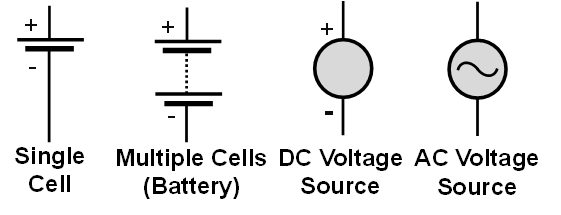
In Alternating Current (AC) the current periodically reverses its direction.
Household utility current in most countries is AC with a frequency of 60Hz (60 complete cycles per second).
The radio-frequency (RF) current in antennas and transmission lines is another example of AC.
AC current is popular for power generation.
AC current involves decreasing of the voltage for use in homes and other applications with the help of transformer.
Direct current (DC) is the unidirectional flow of electric charge.
Direct current is produced by sources as batteries, thermocouples, solar cells.
Direct current may flow in a conductor such as a wire, but can also be through semiconductors.
A term formerly used for direct current was galvanic current.
Direct current may be obtained from an alternating current supply by use of a current-switching arrangement called a rectifier that allows current to flow only in one direction.
Direct current may be made into alternating current with an inverter or a motor-generator set.
Direct current is used to charge batteries, and is the power supply in nearly all electronic systems.
Very large quantities of direct-current power are used in the production of aluminum and other electrochemical processes.
High voltage direct current is used to transmit large amounts of power from remote generation sites.
The voltage of AC can easily be stepped up or down. This is more difficult with DC.
AC has less copper loss (more heating effect) than DC.
It's easier and cheaper to produce AC.
A Waveform is a representation of how alternating current (AC) varies with time.
The most familiar AC waveform is the sine wave in which the current or voltage varies with the sine of the elapsed time.
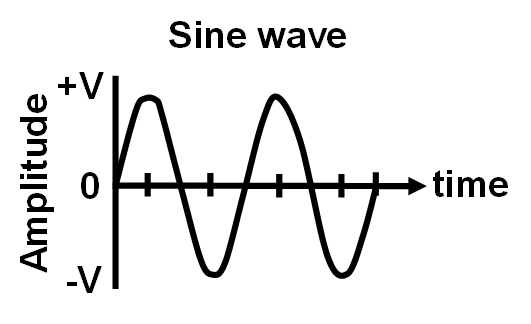
The AC in our home is a sine wave and one which constantly alternates between a maximum value and a minimum value over time.
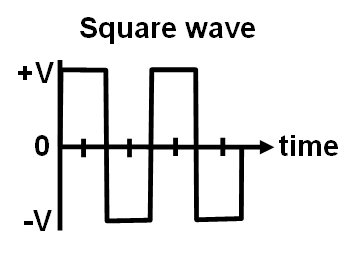
Square-waves are used extensively in electronic and micro -electronic circuits for clock and timing control signals.
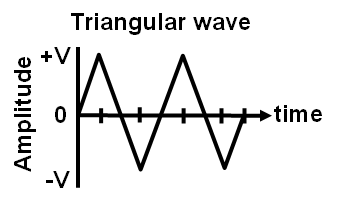
Other common AC waveforms are the ramp, the saw tooth wave, and the triangular wave.
Irregular AC waves are produced by audio amplifiers that deal with analog voice signals and/or music.
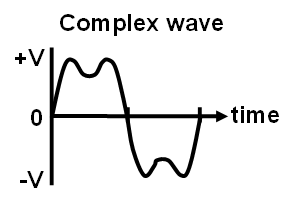
Other waveforms are often called Complex or Composite waveforms, a combination of a number of sinusoidal waves or other basic functions added together.