Chapter 1 : Complex Numbers
Topics covered in this snack-sized chapter:
A complex number is a number consisting of a real and imaginary part.
It can be written in the form a+bi.
a+bi.
- Where a and b are real numbers
i (called as Iota) is the standard imaginary unit with the property i2
=-1.
Imaginary number is the number which has imaginary part.
We can split the negative numbers into positive number and –1.
We are defining √(-1)=i
This is known as imaginary number.
Find the imaginary number of the following √(-5)
We know -5=-1×5
So
√(-5)=√(-1×5)=√(-1)×√5
=2.23i
So the imaginary number is 2.23i
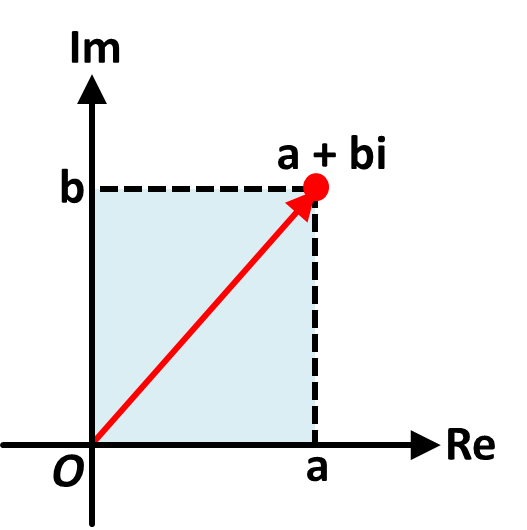
The graphical representation of the complex number field is called an Argand diagram.
Any complex number z = a + ib can be represented by an ordered pair (a, b) and hence plotted on xy - axis with the real part measured along the x - axis and the imaginary part along the y -axis.
In mathematics, complex conjugates are a pair of complex numbers, both having the same real part, but with imaginary parts of equal magnitude and opposite signs.
The conjugate of the complex number z = a + ib, where a and b are real numbers, is  .
.
Add or subtract two complex numbers
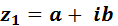 and
and 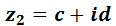
= a + ib + c + id
= a + c + i(b + d)
z1
- z2
= a + ib – c - id
= a – c + i(b - d)
(1+i)+(3+i)
=1+3+i(1+ 1)
=4+2i
(2+5i)-(1-4i)
=2+5i-1+4i
=1+9i
We multiply two complex numbers just as we multiply expressions of the form (x + y) together.
(a + ib)(c + id)
= ac + a(id) + (ib)c + (ib)(id)
= ac + iad + ibc - bd
= ac – bd + i(ad + bc)
(2 + 3i)(3 + 2i)
=2 × 3 + 2 × 2i + 3i × 3 + 3i × 2i (By substituting i2
=-1)
= 6 + 4i + 9i – 6 = 13i
For dividing two complex numbers multiply top and bottom by the complex conjugate of the denominator.
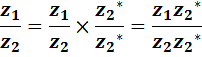
The denominator is now a real number.


The complex plane or z-plane is a geometric representation of the complex numbers.
It can be modified as a Cartesian plane.
The real part of a complex number represented by a displacement along the x- axis and the imaginary part by a displacement along the y- axis.
The multiplication of two complex numbers can be expressed easily in polar coordinates.
The magnitude or modulus of the product is the product of the two absolute value, or moduli.
The angle or argument of the product is the sum of the two angles, or arguments.
In particular, multiplication by a complex number of modulus 1 acts as a rotation.
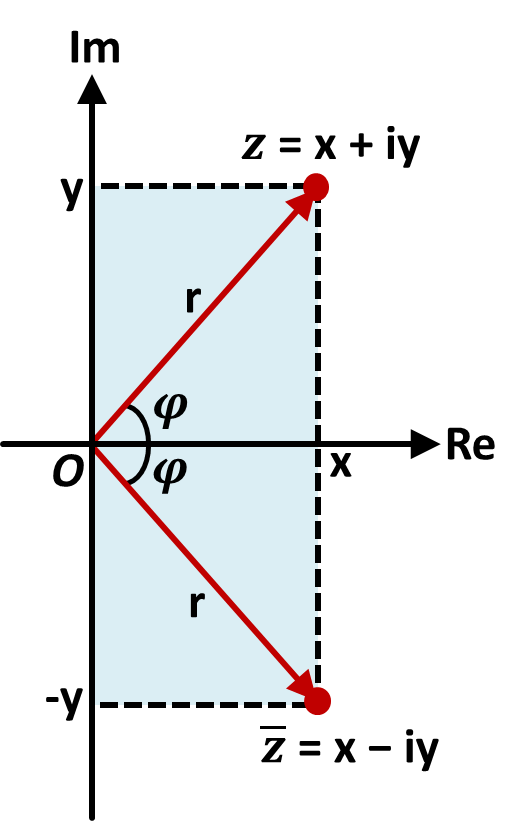
Geometric representation of  and its conjugate
  in the complex plane
The distance along the red line from the origin to the point z is the modulus or absolute value of z.
The angle  is the argument of z.
The polar form of a complex number is another way to represent a complex number.
The form z
= a
+ bi
is called the rectangular coordinate form of a complex number.
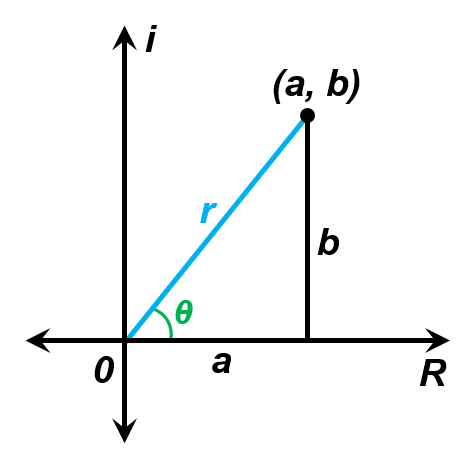
The horizontal axis is the real axis and the vertical axis is the imaginary axis.
The real and complex components in terms of r
and  where r
is the length of the vector and is the angle made with the real axis.
where r
is the length of the vector and is the angle made with the real axis.
From Pythagorean Theorem:
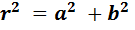
By using the basic trigonometric ratios:
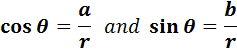
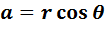
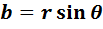
Multiplying each side by r
:

The rectangular form of a complex number is given by

Substitute the values of a
and b
.


In the case of a complex number, r
represents the absolute value or modulus and the angle  is called the argument of the complex number.
The polar form of a complex number
is

Where,
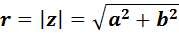
and
and
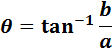
For

Or
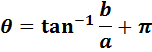
Or
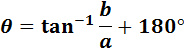
For

Express the complex number in polar form.

The polar form of a complex number  is
is .
.
So, first find the absolute value of r
.
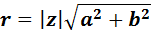
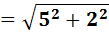
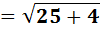
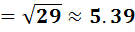
Now find the argument .
Since a
> 0, use the formula 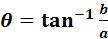
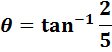

That here is measured in radians.
Therefore, the polar form of  is about
 .
.
Euler’s formula establishes the relationship between the trigonometric functions and complex exponential function.
It states that for any real number x:
eix
= cos x + i sin x
where i is the imaginary unit.
For real values of x:

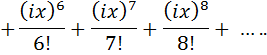

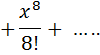
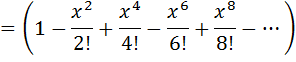
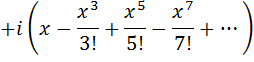

It can also be demonstrated using a complex integral.
Let 



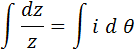
ln 
So


In polar form, if  and
and  then the product
  is easity obtained:

In particular, if 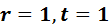 and
and  (i.e.
(i.e.  ),
),

Multiplying each side by  gives
gives


On adding the arguments of the terms in the product.
Similarly

After completing n
such products we have:

where n is a positive integer.
This result can be shown to be true for those cases in which n is a negative integer and when n is a rational number e.g. 
If  is a rational number:

- This result is known as De Moivre’s Theorem.
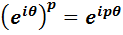
In exponential form De Moivre’s theorem, in the case when p
is a positive integer, is simply a statement of the laws of indices:
Use De Moivre’s theorem to obtain an expression for  in terms of powers of
  alone.
From De Moivre’s theorem we have

However, expanding the left hand side (using: )
)


And then, equating the real parts of both sides, gives the relation:

Replacing  by
by 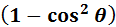 ;
;

Finally:

is the required relation.
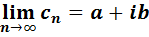
Definition: If  is a sequence of complex numbers such that the limits
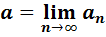
and
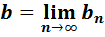
Exist, then we say that 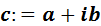 is the limit
of
is the limit
of  and is written as:
Theorem 2:
If  then
then
- If
 then
then 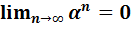 .
.
- If
 then
then 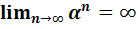 .
.
- If
 then
then  exists if and only if
 .
.
Corollary:
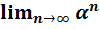 exists if only
  or
or  .
.
- If
 then the powers
  spiral in to
  .
.
- If
 then the powers spiral out to
  .
.
- If
 and
and  then the powers
  run around on the unit circle.

and