Chapter 2 : Matrix


Matrix arrow_upward


  • A Matrix is a rectangular array of numbers enclosed by a pair of bracket.
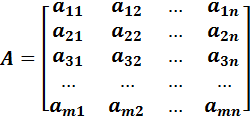
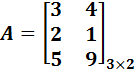
  • A set of mn numbers arranged in the form of an ordered set of m rows and n columns is called m×n matrix (to be read as m by n matrix).
  • m × n matrix A is written as:
  • A=  
    • i = 1, 2,…m
    • j = 1, 2,…n
  • Where  represents the element at the intersection of th row and th column.

  • Types of Matrices arrow_upward


    Square Matrix

  • A matrix in which the number of rows is equal to the number of columns is called a square matrix.
    • Thus m×n matrix A will be a square matrix if m=n

    Diagonal Elements

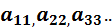
  • In a square matrix all those elements  for which  i.e. all those elements which occur in the same row and same column namely  are called the Diagonal Elements.
  • Diagonal Matrix

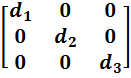
  • A square matrix A is said to be a diagonal matrix if all its non-diagonal elements be zero.
  • Example:


    Scalar Matrix

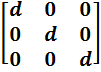
  • A diagonal matrix whose all the diagonal elements are equal is called a Scalar Matrix.
  • Example:


    Unit or Identity Matrix

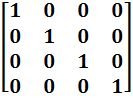
  • A square matrix  all of whose non-diagonal elements are zero and each of the diagonal element is unity.
  • Example:


    and


  • In general for a unit matrix, for and for

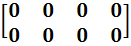
  • Zero Matrix or Null Matrix

  • Any m×n matrix in which all the elements are zero is called a Zero matrix or Null matrix of the type m×n and is denoted by
  • ,

    ,


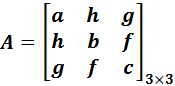
    Symmetric Matrix

  • A square matrix  will be called Symmetric if for all values of  and,
  • A is a symmetric matrix in which ,

  • Properties of Matrix Addition arrow_upward


  • Matrix addition is commutative:
  •     A + B = B + A

  • Matrix addition is associative:
  •     A + (B + C) = (A + B) + C


    Properties of Matrix Multiplication arrow_upward


  • Multiplication of Matrices is distributive with respect to addition of matrices.
    • A(B+C)=AB+AC
  • Matrix Multiplication is associative if conformability is assured.
    • A(BC) =(AB)C
  • The multiplication of Matrices is not always commutative.
    • AB is not always equal to BA
  • Multiplication of a Matrix A by a null matrix conformable with A for multiplication is a null matrix.
    • A0 = 0
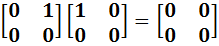
  • If AB = 0 then it does not necessarily mean that A=0 or B=0 or both are 0.
  • Example:

  • Multiplication of Matrix A by a Unit Matrix
    • Let A be a m×n matrix and I be a square unit matrix of order n, so that A and I are conformable for multiplication then

    The Transpose of a Matrix arrow_upward


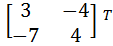
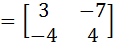
  • If  be a given matrix of the type m×n then the matrix obtained by changing the rows of A into columns and columns of A into rows is called Transpose of matrix A and is denoted by
  • As there are m rows in A therefore there will be m columns in  and similarly as there are n columns in A there will be n rows in
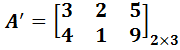
  • Example:

    Then

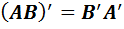
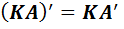
    Properties of Transpose:

    Determinant of a Matrix arrow_upward


  • A Determinant is a real number associated with every square matrix.
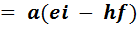
  • The determinant of a square matrix  is denoted by  or

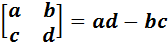
  • Determinant of a  matrices

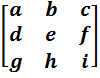
    Determinant of a  matrices


    Minors of a Matrix arrow_upward


  • A Minor for any element is the determinant that results when the row and column of that element are deleted.
  • For the matrix shown below (Note that  is row  and  is column)

  • C1

    C2

    C3

    R1

    1

    4

    3

    R2

    0

    5

    2

    R3

    3

    6

    1


  • Minor for (,, deleted) is:

  • C2

    C3

    R1

    4

    3

    R3

    6

    1


    Co-factor of a Matrix arrow_upward


  • Co-factor for any element is either the minor or the opposite of the minor, based on the element's position in the original Determinant.

  • Adjoint of a Matrix arrow_upward


  • The matrix formed by taking the transpose of the cofactor matrix of a given matrix.
  • The Adjoint of matrix is often written as adj A.

  • Example:

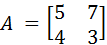
  • Find the adjoint for the matrix  

  • Solution:

  • First determine the cofactor matrix
  • Cofactor matrix =  
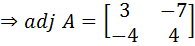
  • Adj A = Transpose of cofactor matrix

  • Inverse of a Matrix arrow_upward


  • For a square matrix A, the inverse is written as . When A is multiplied by  the result is the identity matrix I.
  • Non-square matrices do not have inverses.
  •  


    Ways to find the Inverse of Matrix arrow_upward


    Adjoint method:

     or


    Example:

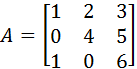
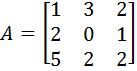
  • Consider the matrix
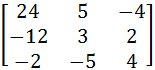
  • The cofactor matrix for A is  
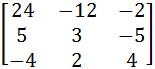
  • So the adjoint is
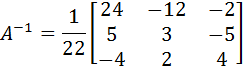
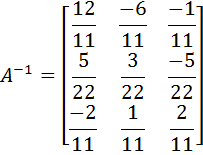
  • Since det A = 22, we get
  • Augmented Matrix Method:

  • An Augmented Matrix is a matrix obtained by appending the columns of two given matrices, usually for the purpose of performing the same elementary row operations on each of the given matrices.

  • Example:

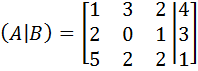
  • Given the matrices A and B, where:
  • , B =

  • Then, the augmented matrix  is written as:


  • Thank You from Kimavi arrow_upward


  • Please email us at admin@kimavi.com and help us improve this tutorial.