Chapter 1 : Introduction to Finance
Topics covered in this snack-sized chapter:

Finance is about the top line (revenue) and bottom line (profit) of business activities. It deals with the:
- Concepts of time, money, risk and how they are interrelated.
- How money is spent and budgeted.
- Application of a set of techniques used by organizations in managing their financial affairs.
Finance is the practical application of economics.
The financial system is the means by which an economy allocates money to its highest valued use.
The goal of any financial system is to make sure that people with good ideas get the money necessary to implement their ideas.
A function of a financial system provides an efficient payment system for the exchange of goods and services.
It provides mechanism that allows for the transfer of economic resources:
- Life-cycle allocations (consumption vs. saving).
- Efficient allocation (specialization).
Pool funds to undertake large-scale projects.
Manages uncertainty (allocates risk-bearing).
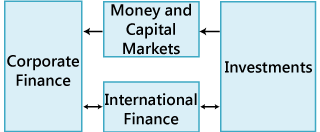
Corporate Finance
- Decisions specific to operations of a business.
Investments
- Decisions specific to investment decisions (Stocks, Securities).
Money and Capital Markets
- Workings of the financial system.
International Finance
- Decisions specific to international flow of money.
Addresses the following three questions:
- What long-term investments should the firm engage in?
- How can the firm raise the money for the required investments?
- How much short-term cash flow does a company need to pay its bills?
Focus is on taking decision related to money investments. Goal is to get a gain on the investments.
Most of the investment decision involves some form of risk.
Micro level
- Study of financial planning, asset management and fund raising for businesses and financial institutions.
Macro level
- Study of financial institutions and financial markets and how they operate within the financial system in both the domestic and global economies.
The finance manager owns the responsibility of managing the finance of the company and managing the risk, capital and the funds available with the company for its smooth working.
Management comprises of strategic thinking, job performance and profitability.
Finance manager is also known by credit manager, finance officer or finance controller.
Job of financial manager involves:
- Make investment decisions.
- Make financing decisions.
- Provide accurate information to the public, stakeholders and people related to the finance of business.
- Checks budgeting decisions of various departments present in the company.
- Identify potential resources for financial generation.
The managers of the corporation are obliged to make efforts to maximize wealth of shareholders.
The goal of the financial manager is to maximize the current value per share of the existing stock
Financial markets are divided into two categories:
Primary Market:
- When a corporation issue securities, cash flows from investors to the firm.
Secondary Markets
- Involve the sale of “used” securities from one investor to another.
- Securities may be exchange traded or trade over-the-counter in a dealer market.
The Sole Proprietorship: this is an unincorporated business with one owner who pays personal income tax on profits from the business.
The Partnership: A business organization in which two or more individuals manage and operate the business.
There are two types of Partnership:
The Corporation: A legal entity that is separate and distinct from its owners. Corporations enjoy most of the rights and responsibilities that an individual possesses; that is, a corporation has the right to enter into contracts, loan and borrow money, sue and be sued, hire employees, own assets and pay taxes.