Chapter 2 : Gene Therapy
Topics covered in this snack-sized chapter:
- A normal gene may be inserted into a nonspecific location within the genome to replace a nonfunctional gene; this approach is most common
- An abnormal gene could be swapped for a normal gene through homologous recombination
- The abnormal gene could be repaired through selective reverse mutation, which returns the gene to its normal function
- The regulation of a particular gene could be altered
- The therapeutic genes are transferred into the somatic cells of a patient
- Any modifications and effects will be restricted to the individual patient only, and will not be inherited by the patient's offspring or later generations
- Germ cells, that is sperms or eggs, are modified by the introduction of functional genes, which are ordinarily integrated into their genomes
- Therefore, the change due to therapy is heritable and passed onto the later generations
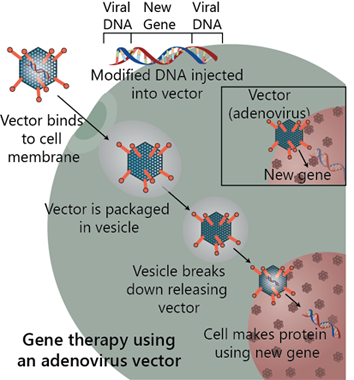
- They remove the original disease causing genes from the viruses
- Replace them with the genes needed to stop disease
- Insert the altered viruses into a person's diseased cells to deliver their genetic material
- A class of viruses that can create double-stranded DNA copies of their RNA genomes
- These copies of its genome can be integrated into the chromosomes of host cells
- Human immunodeficiency virus (HIV) is a retrovirus
- A class of viruses with double-stranded DNA genomes that cause respiratory, intestinal, and eye infections in humans
- The virus that causes the common cold is an “adenovirus”
- A class of small, single-stranded DNA viruses that can insert their genetic material at a specific site on chromosome 19
- A class of double-stranded DNA viruses that infect a particular cell type, neurons
- Herpes simplex virus type 1 is a common human pathogen that causes cold sores