Chapter 2 : Mendel's Work on Pea Plant
Topics covered in this snack-sized chapter:
Mendel has selected garden pea (pisum sativum) as the plant material for his experiment because:
- The flowers of the pea plant are bisexual and naturally self-pollinated
- Is an annual plant; its short life cycle made it possible to study several generations within short duration of time
- Easy to cross because pollens from one plant can be introduced to the stigma of another plant by removing anthers
- Easy to cultivate and large number of offspring are produced in each progeny
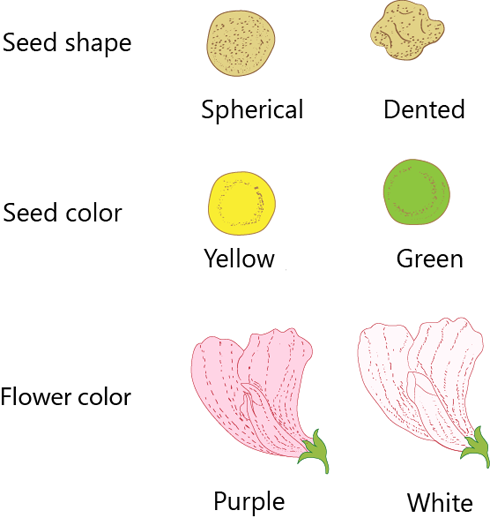
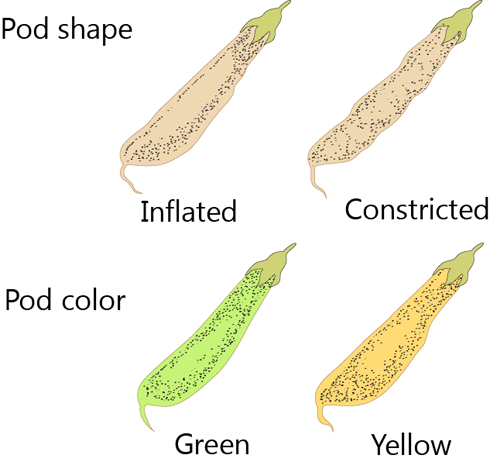
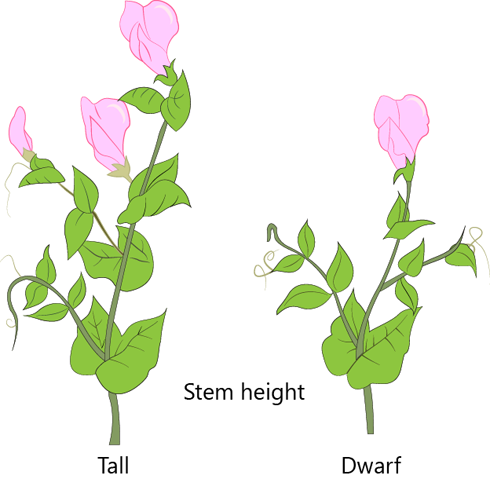
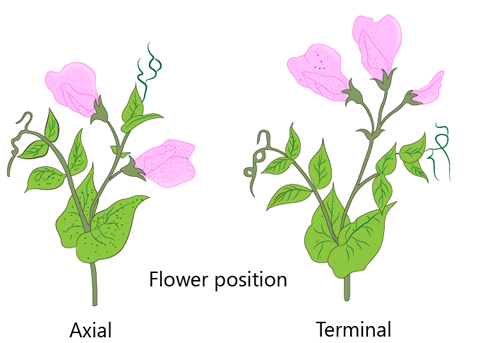
Mendel observed seven pea plant traits that are easily recognized in one of two forms:
- Seed shape is spherical or dented
- Seeds color is yellow or green
- Flower color is purple or white
- Pod shape is inflated or constricted
- Pod color is yellow or green
- Stem height is tall or dwarf
- Flower position is axial or terminal
Each parent contributes one factor of each trait shown in offspring.
The two members of each pair of factors segregate from each other during gamete formation.
The blending theory of inheritance was discounted.
Males and females contribute equally to the traits in their offspring.
Acquired traits are not inherited.
A cross involving only one trait
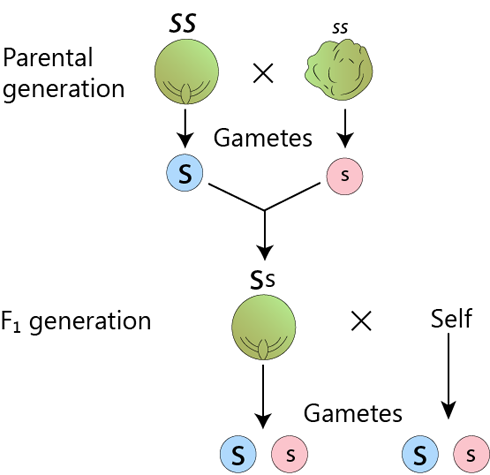
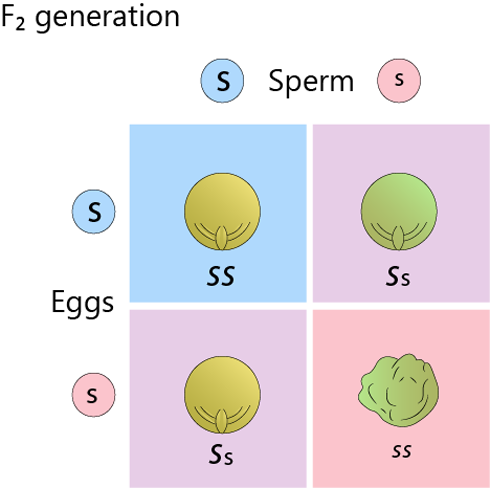
Mendel crossed pure-breeding smooth-seeded plants with a variety that had always produced wrinkled seeds. All resulting seeds were smooth.
The parental generation is denoted as the P1 generation.
The offspring of the P1 generation are the F1 generation (first filial). The self-fertilizing F1 generation produced the F2 generation (second filial).
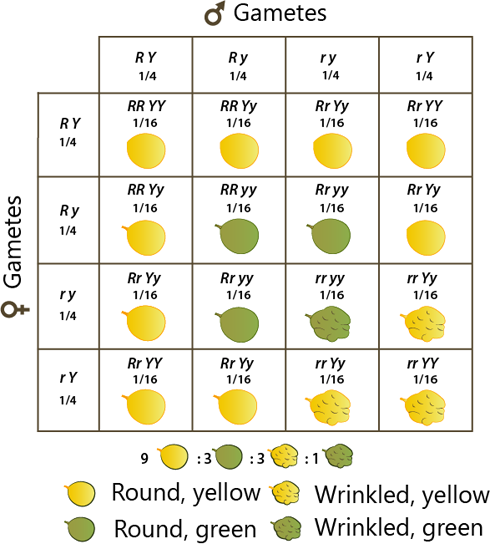
A cross concerning two traits
Dihybrid crosses have as many as 16 possible genotypes.
Crosses with two traits:
- Round seeds (R) are dominant over wrinkled (r) seeds
- Yellow seed color (Y) is dominant over green (y)