Topics covered in this snack-sized chapter:
An Angle is a figure formed by two rays with the same initial point.
- The initial point is called the Vertex.
- The two rays are called the Arms of the angle.

It is generally represented by a symbol  .
.
An angle that measures between  and
and  is called an Acute angle.
For example:  is an Acute Angle.

An angle that measures between and  is called an Obtuse angle.
For example: is an Obtuse Angle.

An angle that measures between and  is called a Reflex angle.
For example:  is a reflex angle.

An angle that measures exactly is called a Straight Angle.

Straight (or Flat) angles are formed when the legs are pointing in exactly opposite directions.
- The two legs then form a single straight line through the vertex of the angle.
- The measure of a flat angle is thus always 180°.
An angle that measures exactly is called a Complete angle.

An angle that measures exactly is called a Right angle.
For example: is a right angle.

| Angle Pair
| Property
|
| Adjacent Angles
| Angles that have a common vertex and a common arm but no common interior.
 is adjacent to is adjacent to  . .

|
| Vertically Opposite Angles
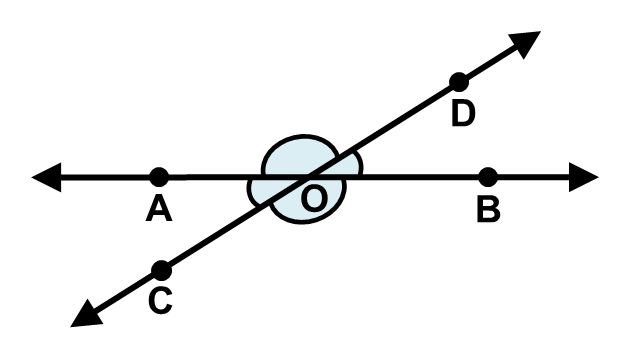
| A pair of non-adjacent angles formed by the intersection of two straight lines.
Each opposite pair are called vertically opposite angles and are always congruent.
For example:
∠AOC and ∠BOD are vertically opposite angles.
|
| Complementary Angles
| Two angles that add up to 90°. For example, the sum of ∠a and ∠b is 90°.

|
| Supplementary
Angles
| Two angles that add up to 180°. For example, the sum of ∠a and ∠b is 180°.

|
It is represented by symbol of “  .
.
- 1 Right Angle = 90°= 90 Degree
A transversal is a line that crosses at least two other lines.
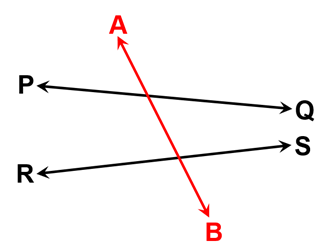
Transversal Intersecting Non Parallel Lines
Here AB is a transversal which intersects two non parallel lines PQ and RS.
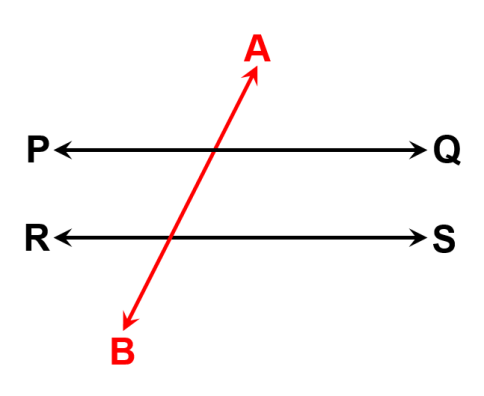
Transversal Intersecting Parallel Lines
Here AB is a transversal which intersects two parallel lines PQ and RS.
Vertical Opposite Angles are the angles opposite to each other when two lines cross.
They are called “Vertical” because they share the same vertex.
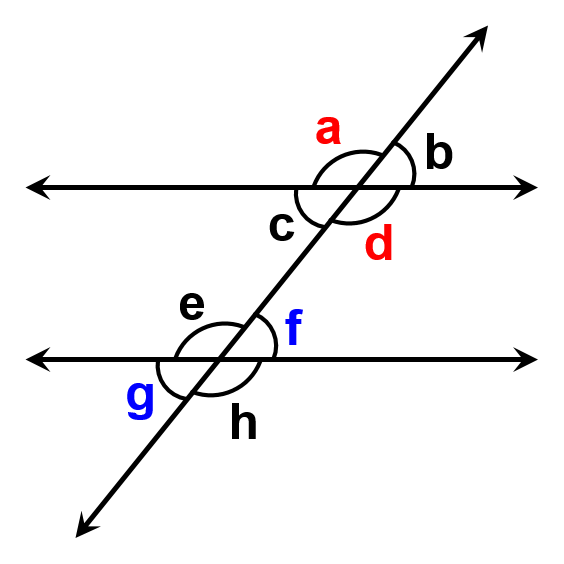
Here  are vertical opposite angles.
For example, if  a and d are vertical angles, the measure of both a and d will be same.
Angles that are formed on the inside of the two lines are known as Interior angles.
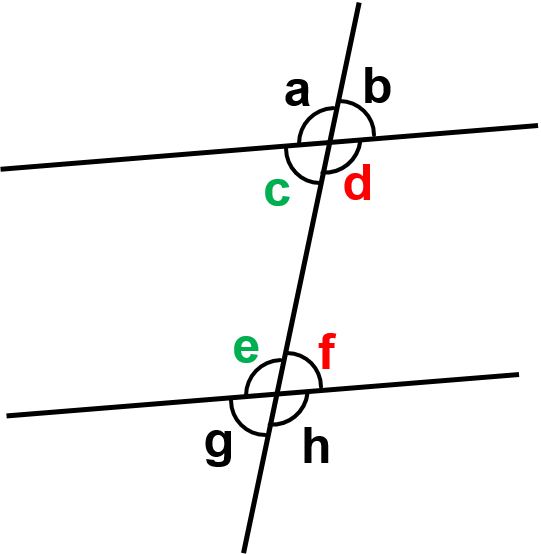
Here 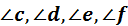 are interior angles.
Angles that are formed on the outside of the two lines are known as Exterior angles.
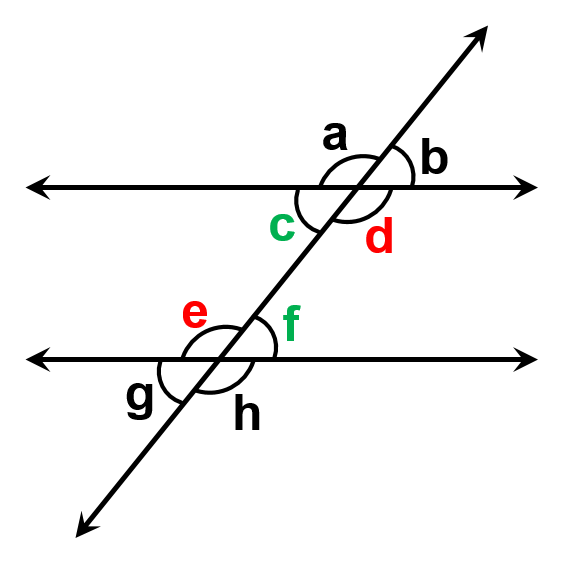
Here  are exterior angles.
If two lines are parallel, the pairs of angles on the same side of the transversal if both lie either above the two lines or below the two lines.
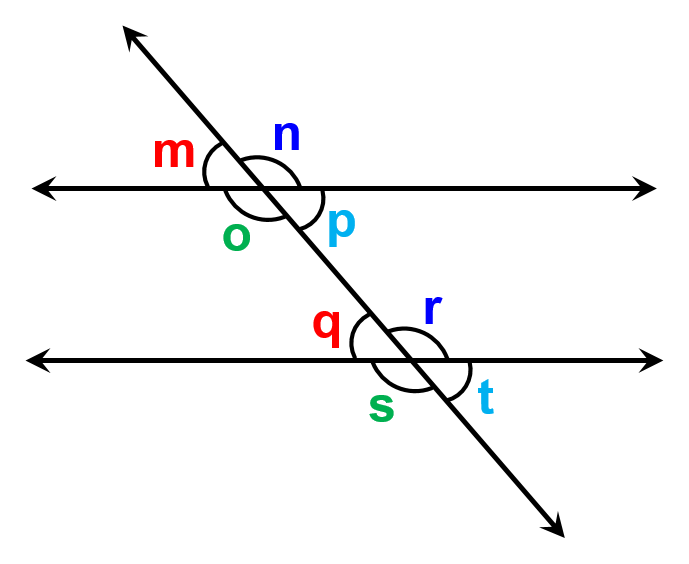
Two line are intersected by a transversal such that  .
.
Alternate Interior Angles are created where a transversal crosses two (usually parallel) lines.
- Each pair of these angles are inside the parallel lines, and on opposite sides of the transversal.
In the diagram below  are Alternate Interior Angles.
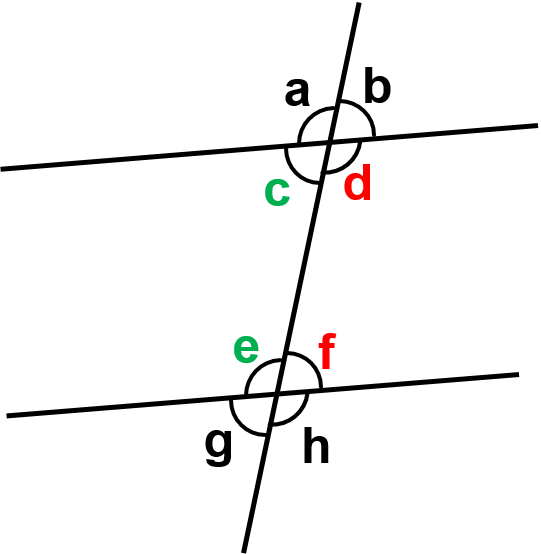
Alternate Exterior Angles are created where a transversal crosses two (usually parallel) lines.
- Each pair of these angles are outside the parallel lines, and on opposite sides of the transversal.
And  are Alternate Exterior Angles.
For parallel lines, Pairs of alternate (interior or exterior) angles are equal.
For parallel lines, Pairs of corresponding angles are equal.
The sum of the interior (or exterior) angles on the same side of the transversal is .
.
A ray that divides an angle into two equal and adjacent angles is called as an Angle Bisector.
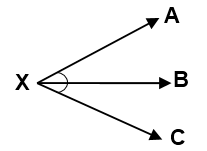
Angle bisector divides the angle AXC into two equal parts such that
∠AXB = ∠BXC.