Chapter 1 : Introduction to Geometry
Topics covered in this snack-sized chapter:
Geometry is the study of the size, shape and position of 2 and 3 dimensional shapes and figures.
It is a branch of mathematics that is concerned with the properties of configurations of geometric objects.
Geometry is used in art, architecture, engineering, land surveys, astronomy, sports, machines, etc.
A point is an exact position or location on a plane surface. It does not have any size, length, width or height.
We indicate the position of a point by placing a pointed dot.
The point is usually represented by any letter like "A", “B”, “C”…..

A line is a geometrical object that is straight, infinitely long and thin.
A line has no endpoints.
It is absolutely straight and can extend indefinitely in both the directions.

A line with a start point but no end point is called a Ray.
It can be extended only in one direction infinitely.
AB is a ray, beginning with the initial point and is denoted as  .
.

A straight line which links two points without extending beyond them.
If A and B are two points in a plane, the part AB of the line through A and B is called a Line Segment AB.
The points A and B are called the End Points of this segment and denoted as  or
or  .
.

A flat surface that is infinitely large and with zero thickness.
Two lines in a plane either intersect at exactly one point or are parallel.
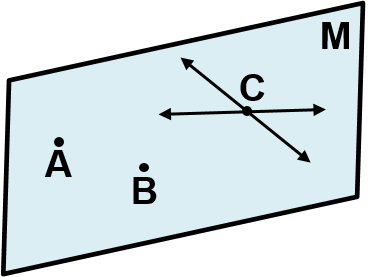
A plane is named by a single letter, for example (plane M) or by three non-collinear points (plane ABC).
Intersecting Lines:
Two or more lines that meet at a point.
The common point where all the intersecting lines meet is called the Point of Intersection.

Parallel Lines: Two or more lines that do not have a point of intersection and are equidistant from each other at all times.

Three or more points in a plane are said to be Collinear if they are on the same line.
This line is called the Line of Collinearity.
Points A, B, C are collinear in the figure:

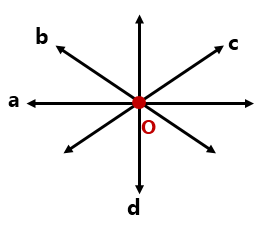
Three or more lines in a plane are concurrent if all of them pass through the same point.
The point O is called the "point of concurrency".
Lines a, b, c, d in the figure below are concurrent as they pass through the same point “O”.
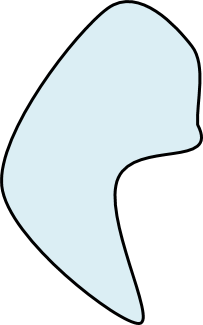
A line or surface that bends in a smooth, continuous way without sharp angles is called a curve.
A curve which does not cut itself is called an Open curve.

A curve which cuts itself is called a Closed curve.
A Polygon is defined as a number of coplanar line segments, each connected end to end to form a closed shape.
- No two line segments intersect except at their end points.
- No two line segments with a common end point are coincident.