Topics covered in this snack-sized chapter:
It is one of the great expressions of sovereignty.
It expresses the power and authority of the state against “anti-social” behavior.
Law embodies the values of the people of that country that, in turn, determine what is right and wrong.
We have tried to establish certain “Basic Human Rights” globally too.
Most Important
The law expresses the values of the majority of the people, in a democracy, in a country.
So, laws can and do vary from country to country.
Everyone is a citizen of someplace, and they are bound by the laws of their country, or whatever country they are in at the time - you don’t question the legitimacy of the law.
So, if you commit a crime against the laws of a country, you may fairly expect to be punished for that act. The state has real enforceable sanctions.
The law represents the rules of that society (state) and sanctions are reserved for those who willfully disregard that law. We all understand that.
The laws are made by the people of that country and so, in theory, express the values of that society. The peoples’ representatives are called Legislators.
International Law
consists of the rules and principles of general application dealing with the conduct of States and of international organizations in their international relations with one another and with private individuals, minority groups and transnational companies.
Black’s Law Dictionary defines International Law as “The legal system governing the relationship between nations, more modernly, the laws of international relations, embracing not only nations but also participants as international organizations and individuals (such as those who invoke their human rights or commit war crime).”
It is a combination of treaties and customs which regulates the conduct of States amongst themselves, and persons who trade or have legal relationships which involve the jurisdiction of more than one state.
"By international law is meant the rules acknowledged by the general body of civilized independent States to be binding upon them in their mutual relations."
It is the body of law that governs the legal relations between or among states or nations.

International law is the set of rules generally regarded and accepted as binding in relations between states and nations.
It serves as the indispensable framework for the practice of stable and organized international relations.
International law differs from national legal systems in that it primarily concerns nations rather than private citizens.
National law may become international law when treaties delegate national jurisdiction to supranational tribunals such as the European Court of Human Rights or the International Criminal Court.
Treaties such as the Geneva Conventions may require national law to conform.
International law is consent-based governance.
This means that a state member of the international community is not obliged to abide by international law unless it has expressly consented to a particular course of conduct.
This is an issue of state sovereignty.
The term "international law" can refer to three distinct legal disciplines:
- Private International Law
Three distinct legal disciplines of International Law arrow_upward
Public international law:
- Which governs the relationship between provinces and international entities
- It includes these legal fields: treaty law, law of sea, international criminal law, the laws of war or international humanitarian law and international human rights law.
Private International Law:
- Which governs civil and commercial law transactions and dispute that contain international element
- Its section serves as National Organ to Hague Conference on Private International Law.
Supranational law or the law of supranational organizations:
- Which concerns regional agreements where the laws of nation States may be held inapplicable when conflicting with a supranational legal system when that nation has a treaty obligation to a supranational collective
International legal personality refers to the entities or legal persons that can have rights and obligations under international law.
States: A State has the following characteristics:
- The capacity to enter into relations with other States
- The international legal system is a horizontal system dominated by States which are, in principle, considered sovereign and equal.
- International law is predominately made and implemented by States.
- Only States can have sovereignty over territory.
- Only States can become members of the United Nations and other international organizations.
- Only States have access to the International Court of Justice.
International Organizations
- International Organizations are established by States through international agreements and their powers are limited to those conferred on them in their constituent document.
- The main UN judicial organ is International Court of Justice (ICJ), which has the power to make binding decisions on questions of international law that have been referred to it by States or give advisory opinions to the U.N.
Nationality of individuals, companies, etc.
- Individuals are generally not regarded as legal persons under international law.
- Their link to State is through the concept of nationality, which may or may not require citizenship.
- Nationality is the status of being treated as a national of a State for particular purposes.
- The most common methods of acquiring nationality at birth are through one or both parents and/or by the place of birth.
- Nationality can also be acquired by adoption and naturalization.
- Companies, ships, aircraft and space craft are usually considered as having the nationality of the State in whose territory they are registered.
- Under the principle of nationality of claims, if a national of State A is injured by State B through internationally unlawful conduct, State A may make a claim against State B on behalf of its injured national. This is known as the doctrine of diplomatic protection.
Acquisition of territory, state immunity and legal responsibility
of states in their conduct with one another
Group rights, treatment of aliens, rights of refugees, international crimes, nationality problems, human rights, international peace and security, arms control, treatment of prisoners, global environment, global communities, and world trade.
International law includes both the customary rules and usages to which states have given express or tacit assent and the provisions of ratified treaties and conventions.
International law is directly and strongly influenced, although not made, by the writings of jurists and publicists, by instructions to diplomatic agents, by important conventions even when they are not ratified, and by arbitral awards.
Human rights
Diplomacy & state recognition
Use of force
Immigration & borders
Economics & trade
Arms control
International crime
Environmental issues
Areas held in common (oceans, outer space)
Ethical principles about how actors should behave.
Mutual expectations about how actors will behave in certain situations.
Social identities, indicating which actors are considered to be legitimate.
Four Paths by which Norms Spread
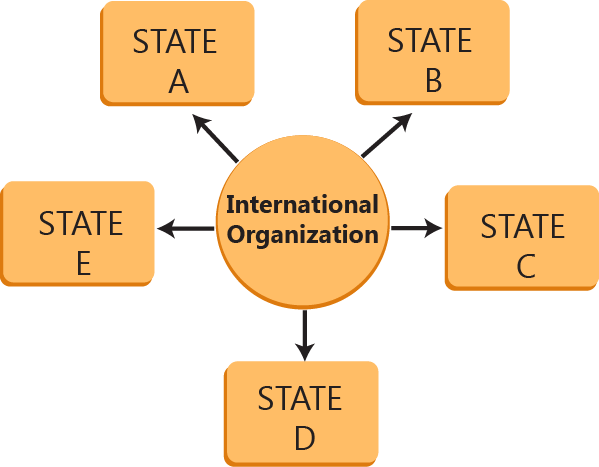
An International Organization spread a new norm.
States Spread a new norm to other states

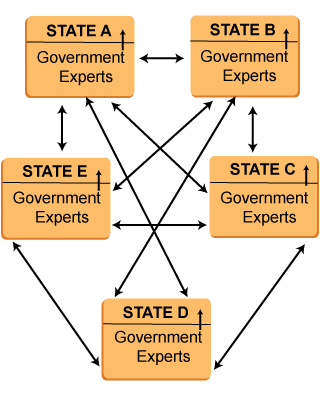
Norms spread among government experts across countries who promote the norm within their government
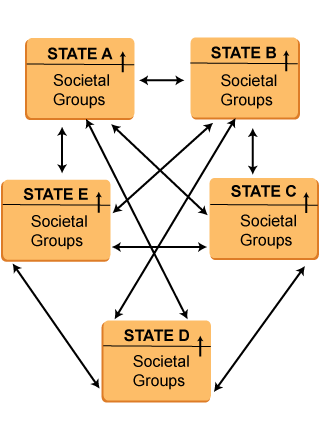
Norms spread among societal groups across countries (transnational activists) who then promote norms to their societies and governments