Chapter 1 : Introduction


What is Investment? arrow_upward


  • Do you want to grow your money?
    • How about doubling your $100 to $200?
    • If you invest wisely, then over a period of time you can “grow” your money
  • Investment:
    • Keeping an amount of money aside and investing it in financial instruments in the present, with the expectation of a positive rate of return in the future
  • In financial terms:
    • The purchase of a financial product or other item of value with an expectation of favorable future returns
  • In business terms:
    • The purchase or expenditure by a business, such as equipment, inventory or the hiring of independent contractors, with a hope of improving future business

    What is Investment Management? arrow_upward


    The art of managing money in the present, with the expectation and pursuit of a positive rate of return in the future

  • The collection of all financial instruments of an investor makes up his portfolio.
    • Instruments are any valuable asset or resource, including cash, product, or property

    Where Does the Money Come From? arrow_upward


    A person does a job and earns an income

    A business earns money by selling goods or services


    Where Does the Money Go? arrow_upward


    A person can spend his income in the following ways:

    • Consumption: current living expenses
    • Savings: money that can be immediately accessed, but isn’t being used on a regular basis
    • Investment: employed in pursuit of positive financial returns in the future
    • Luxury: non-essential expenditures, usually in the arena of leisure (for example: an expensive videogame system, a second home or a European vacation)

    Why Invest? arrow_upward


  • Mainly to increase the rate of financial return
  • To create additional sources of income (or to obtain funds for some future expenses)

  • What to Invest? arrow_upward


    Money

    Time and effort (to decide where to invest)


    Where to Invest? arrow_upward


    There are many financial investment avenues available today to the investor:

    • Bank deposits
    • Bonds
    • Stocks
    • Currencies
    • Commodities
    • Real estate

    When to Invest? arrow_upward


    It’s a personal decision taking into account current income, savings and expenses

    • In general, it’s a good idea to build a habit of saving and investing on a monthly basis
    • It can be as simple as setting $100 aside a month and investing it
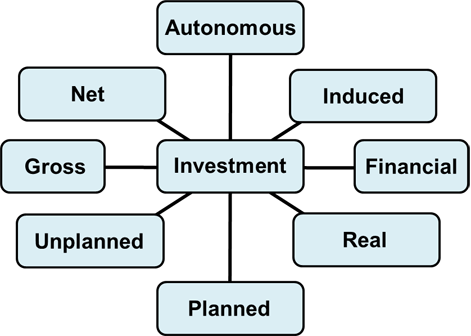
    Different Types of Investment arrow_upward


  • There are basically eight types of investment:


  • Autonomous Investment

  • Does not change with changes in the income level
  • Refers to the investment made on houses, roads, public buildings, and other parts of infrastructure
  • The government often makes such investments.

  • Induced Investment

  • Changes with changes in the income level
  • Induced investment is positively related to income level.
  • At high levels of income, individual share is induced to invest more.

  • Financial Investment

  • Made in buying financial instruments such as new shares, bonds, securities

  • Real Investment

  • Made in new plants and equipment or construction of public utilities like schools, roads
  • Real investment increases employment, production and economic growth of the nation.
  • Thus, real investment has a direct impact on employment generation, economic growth, etc.

  • Planned Investment

  • Made with a plan in several sectors of the economy with specific objectives

  • Unplanned Investment

  • Done without any planning
  • Investor makes investments randomly without making any concrete plan.
  • Oftentimes, for example, in a case where a business purchases additional inventory for whatever reason, this is not intentionally done to invest, and the investment is incidental (this is why it is also called unintended investment).

  • Gross Investment

  • The total amount of money spent for creation of new capital assets like plants or machinery
  • The total expenditure made on new capital assets in a given period

  • Net Investment

    • Gross investment minus capital consumption (depreciation and investment expenses) during a period of time (usually a year, sometimes a quarter)

    Process of Investment Management arrow_upward


  • There are six steps:
    • Specification of investment objectives and constraints
    • Choice of asset mix
    • Formulation of portfolio strategy
    • Selection of securities
    • Portfolio revision
    • Performance evaluation

    Specification of investment objectives and constraints

  • The first step before making an investment is to set an objective.
  • The main objectives taken into consideration by investors are:
    • Capital appreciation goal
    • Current income
    • Safety of principal
    • Identification of liquidity constraints and limitations
    • Time horizon
    • Tax

    Choice of asset mix

  • One of the most important aspects of investment management
  • The ratio of the number of stocks versus bonds depends upon the risk tolerance capacity of the investor.
  • This step also involves:
    • Which classes of asset investments will be placed?
    • Which securities should be purchased in a particular class?

    Formulation of portfolio strategy

  • The next step after the choice of asset mix
  • There are two types of strategies:
    • Active portfolio strategy: aims to earn greater risk adjusted returns depending on the market timing, sector rotation, security selection, or a combination thereof
    • Passive strategy: involves holding a well-diversified portfolio and maintaining a pre-decided level risk

    Selection of securities

  • Implementation of the formulated portfolio strategy by buying or selling certain securities in specified amounts

  • Portfolio revision

  • Fluctuation in the prices of stocks and bonds lead to changes in the value of the portfolio.
  • Calls for a rebalancing of the portfolio from time to time
  • Involves shifting from bonds to stocks or vice-versa

  • Performance evaluation

  • Assessment of the performance of the portfolio should be performed from time to time.
  • It is also necessary to have a benchmark for comparison with other portfolios that have a similar risk exposure.


  • Thank You from Kimavi arrow_upward


  • Please email us at admin@kimavi.com and help us improve this tutorial.