Topics covered in this snack-sized chapter:
MIS stands for Management Information System.
MIS refers broadly to a computer-based system that provides managers with the tools for organizing, evaluating and efficiently running their departments.
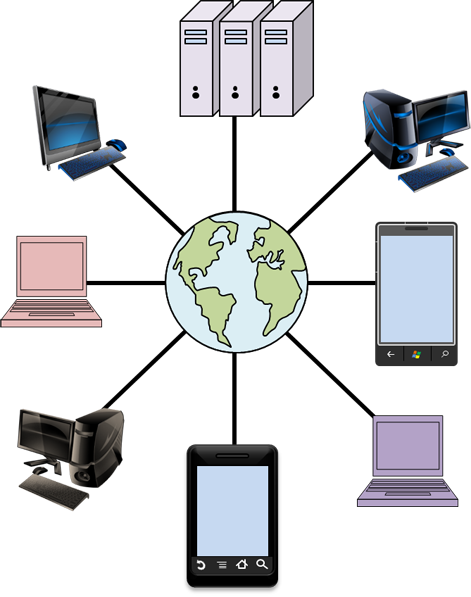
MIS is an important instrument to support the decision-making process in corporate houses, financial institutions, and large organizations.
MIS can be helpful to management personnel in making management decisions smoothly and effectively.
MIS is defined as a system based on the database of an organization, developed for the purposes of providing information to the people in that organization.
An information system (IS) is a set of interrelated components including but not limited to people, management, business processes, and an organizational culture that collects, processes, stores, analyzes, and distributes information in order to support decision making, coordination, and control.
Business firms invest heavily in information systems to achieve the following six strategic business objectives:
If a business can achieve improved levels of efficiency, it can establish higher profitability.
Information systems and their associated technologies provide managers with some of the most important tools and techniques to improve efficiency and productivity levels.
New products and services require an entire life cycle supported by IS.
- Ideas can be developed online.
- Products can be designed using computer aided design (CAD) tools.
It is important for IS to be used to create a real intimacy between the business and its customers.
Such an intimacy will allow the business not only to anticipate customer wants and desires, but also to communicate with them in a manner that suits the customer.
It is crucial for business managers to have good information on which to base decisions; this can most easily be achieved using good information systems.
Many companies now provide their managers with web-based real-time information on customer orders, complaints, and the production cycles of their businesses.
A “competitive advantage” simply means having a method or a product that allows the organization to do things better, faster, or more efficiently than their competitors.
The basic components of most Information Systems are:
- Computer Hardware (set of devices).
- Computer Software (set of programs).
- Databases (collection of interrelated data).
- Telecommunication Systems.
- Human Resources and procedures.
Information processing (or data processing) activities that occur in an information system include the following:
- Output of information products.
- Storage of data resources.
- Control of system performance.
Data about business transactions and other events must be captured and prepared for processing by the input activity.
Data is typically subjected to processing activities such as calculating, comparing, sorting, classifying, and summarizing.
Output of Information Products
Information in various forms is transmitted to end-users and made available to them in the output activity.
Storage of Data Resources
Storage is the information system activity in which data and information are retained in an organized manner for later use.
Control of System Performance
An important information system activity is the control of its own performance.
An information system should produce feedback, which must be monitored and evaluated to make adjustments to system activities in order to correct deficiencies.
Information systems (IS) differ according to business needs.
Information systems generally are classified into five categories:
- Office Information Systems.
- Transaction Processing Systems.
- Management Information Systems.
- Decision Support Systems.
An office information system (OIS) is an information system that uses hardware, software and networks to enhance work flow and facilitate communications among employees.
An office information system supports a wide range of office activities.
Office information systems use communications technology such as:
- Electronic data interchange (EDI) for the electronic exchange of text, graphics, audio, and video.
A Transaction Processing System (TPS) is an information system that captures and processes data generated during an organization’s day-to-day transactions.
A transaction is a business activity such as a deposit, payment, order or reservation.
Transaction processing systems can be programmed to follow the routine functions of an organization with greater speed and accuracy than any manual alternative.
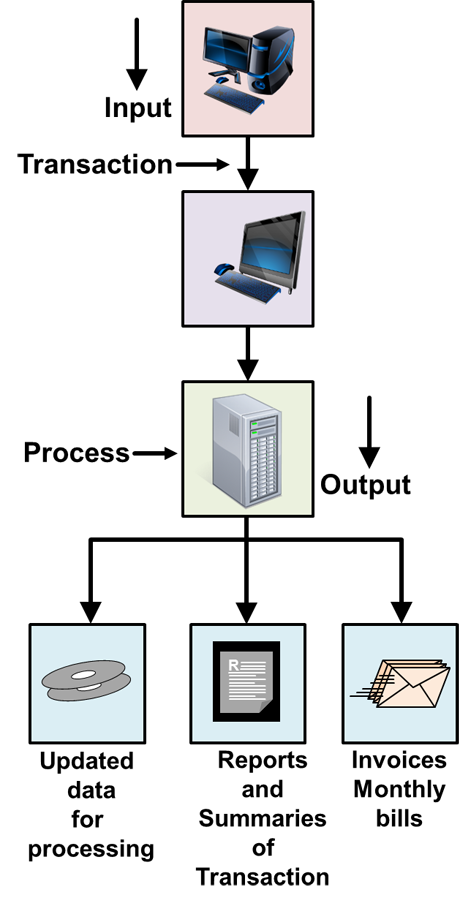
A Management Information System (MIS) extracts data from a database to compile reports, such as sales analyses, to help managers make routine decisions.
MIS is concerned chiefly with internal sources of information.
A Decision Support System (DSS) is an information system designed to help users reach a decision when a decision-making situation arises.
A special type of DSS, called an Executive Information System (EIS), is designed to support the information needs of executive management personnel.
To store all the necessary decision-making data, DSSs or EISs often use extremely large databases, which are known as data warehouses.
An Expert System is an information system that captures and stores the knowledge of human experts and then imitates human reasoning and decision-making processes for those who have less expertise.
Expert systems are composed of two main components:
- A knowledge base is the combined subject knowledge and experiences of the human experts.
- The inference rules are a set of logical judgments applied to the knowledge base each time a user describes a situation to the expert system.