Chapter 2 : Strategic and Competitive Opportunities
Topics covered in this snack-sized chapter:
Managers and executives understand the value of integrating business strategy and IT strategy in pursuit of competitive advantage.
Organizations possess competitive advantage when they are able to provide better and/or cheaper service than their competitors.
Information systems provide new options to:
- The way companies interact.
- The way organizations are structured.
- The way workplaces are designed.
Strategic Information Technology provides managers with an understanding and appreciation for the development of business and information technology strategies to yield competitive advantage.
The Internet increases the accessibility, storage, and distribution of information and knowledge for organizations.
Various models have been proposed for developing a strategy for competitive advantage:
- Porter’s Five Forces Model.
- The Three Generic Strategies.
Michael Porter's famous Five Forces of Competitive Position model provides a simple perspective for assessing and analyzing the competitive strength and position of a corporation or business organization.
Porter’s model of competitive forces assumes that there are five competitive forces that identify the competitive power in a business situation.
These five competitive forces identified by Michael Porter are:
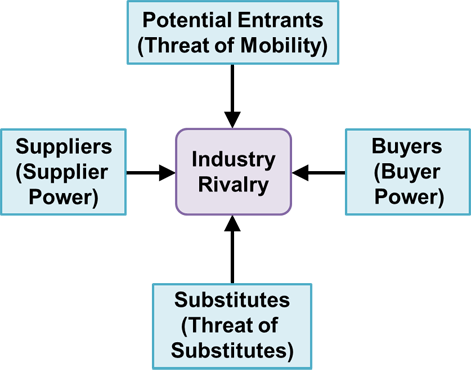
- Threat of substitute products.
- Intense rivalry among existing players.
- Bargaining power of suppliers.
- Bargaining power of buyers.
Threat of Substitute Products
The presence of substitute products can lower industry attractiveness and profitability because they limit price levels.
The threat of substitute products depends on:
- Buyers' willingness to substitute.
- The relative price and performance of substitutes.
- The costs of switching to substitutes.
In substitute industries, if competition rises or superior technology emerges then prices and profits decline.
The entry of a competitor into the market may also weaken power.
Threat of new entry depends upon entry and exit barriers.
Threat of new entry is high when:
- Capital requirements to start the business are less.
- Customers can easily switch (low switching cost).
- Key technology is not hard to acquire or isn’t protected well.
- Product is not differentiated.
Intense Rivalry among Existing Players
Industry rivalry refers to the intensity of competition among the existing competitors in the market.
Intensity of rivalry depends on the number of competitors and their capabilities.
Industry rivalry is higher when:
- There are a number of small or equal competitors, but lower when there’s a clear market leader.
- Customers have low switching costs.
- Exit barriers are high and rivals stay and compete.
- The fixed cost is high resulting huge production and a reduction in prices.
These situations create advertising wars, price wars, modifications, and ultimately costs increase. These factors can make it difficult to compete.
Bargaining Power of Suppliers
Bargaining power of a supplier refers to the strength of the seller or supplier’s position.
Supplier bargaining power is likely to be high when:
- Suppliers are concentrated and well organized.
- Few alternatives are available.
- Their product is most effective or unique.
- Switching cost, from one supplier to another, is high.
Bargaining Power of Buyers
The bargaining power of buyers determines how much pressure customers can create.
Buyers have more bargaining power when:
- There are few buyers chasing too many goods.
- Buyer(s) purchases in bulk quantities.
- Product is not differentiated.
- Buyer’s cost of switching to a competitors’ product is low.
- Buyers are price sensitive.
Analysis of the five forces can provide valuable information for three aspects of corporate planning:
It provides insights on profitability.
The model can be used to compare the impact of competitive forces on one’s own organization with their impact on competitors.
It can reveal insights about the potential future of the industry.
With knowledge of the intensity and power of competitive forces, organizations can develop options that improve their own competitive position.
For an organization to obtain a sustainable competitive advantage, Michael Porter suggests that they should follow either one of three generic strategies:
The low cost leader in any market gains competitive advantage from being able to produce at the lowest cost.
The organization aims to drive cost down through all the elements of the production of the product, from sourcing to labor costs.
Differentiated goods and services satisfy the needs of customers through a sustainable competitive advantage.
With a differentiation strategy, the organization aims to focus its effort on particular segments and charge for the added differentiated value.
This strategy is aimed at a specific target consumer group.
The focus strategy is also known as a 'niche' strategy.
- With a “cost focus,” a firm aims at being the lowest cost producer in that niche or segment.
- With a “differentiation focus,” a firm creates competitive advantage through differentiation within the niche or segment.
“The value chain” is a way of viewing the organization as a chain or series of processes, each of which adds value to the product or service for the customer.
A firm can create a cost advantage either by reducing the cost of individual value chain activities or by reconfiguring the value chain.