Chapter 2 : Fundamental Definitions
Topics covered in this snack-sized chapter:
Body
Rigid Body
Deformable Body
Particle
Space
Time
Matter
Mass
Force
- A change in speed,
- A change in direction, or
- A change in shape
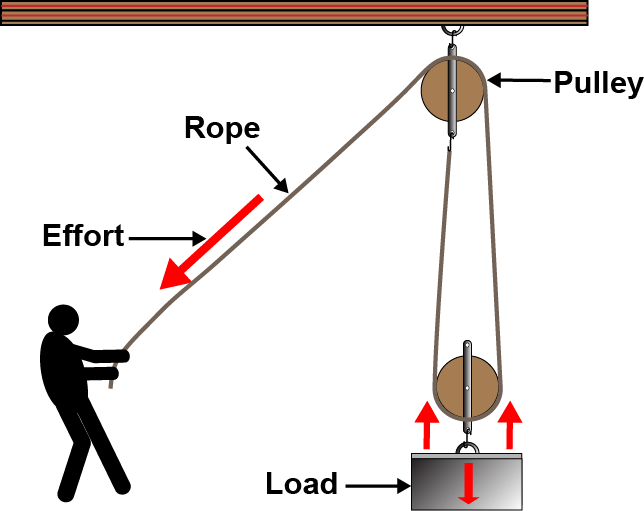
Push or Pull on an object
Vector Quantity
- Examples: Acceleration, velocity, force, displacement, etc.
Scalar Quantity
- Examples: Speed, time and distance.
- They describe the relationship between the forces acting on a body and its motion due to those forces.
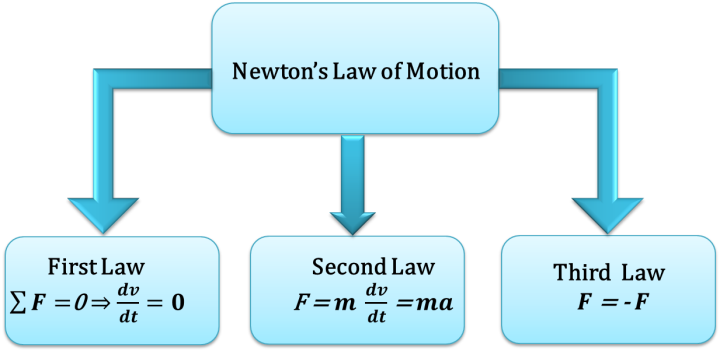
Newton’s First Law
Newton’s Second Law
then magnitude of the acceleration will be directly proportional to the force and inversely proportional to the mass of the particle.
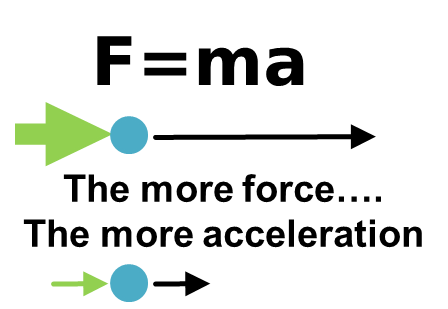
Where
-
 is the external force acting on the body
-
 is the mass of the body
-
 is the acceleration of the particle in the direction of the force
Newton’s Third Law
 and reaction
  between contacting bodies are equal in magnitude and opposite in direction.
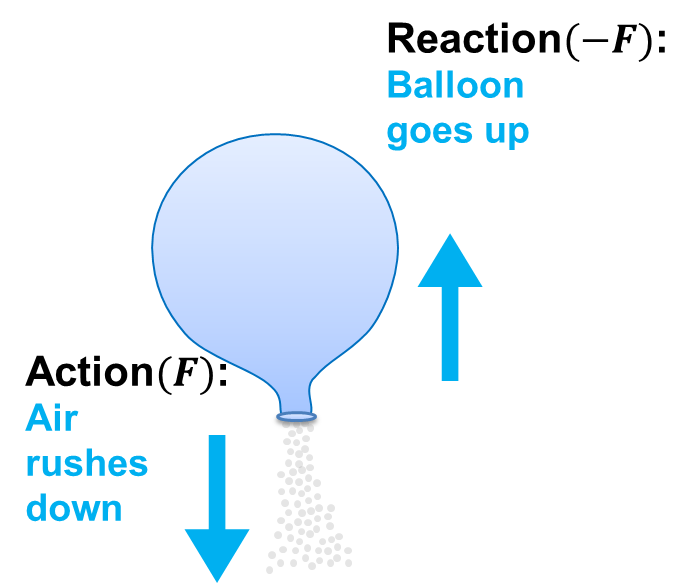
Example:
- In the above figure enclosed air particles push balloon wall outwards and balloon wall pushes enclosed air particle inwards.
Mass & Weight
- For example, our mass does not change when we go to the Moon, but our weight does.
- Mass shows the quantity, and weight shows the size of gravity.

Where
-
 is weight in Newton
-
 is mass in
-
 is the acceleration of gravity in
Example:


| Quantity | Unit |
| Length | Meter |
| Mass | Kilogram |
| Time | Second |
| Acceleration | Meter/second2 |
| Force | Newton |
| Velocity | Meter/second |
| Pressure/Stress | Pascal |
| Density | Kilogram/meter3 |
| Work, Energy | Joule |
| Spring constant | Newton/meter |
| Moment of force | Newton-meter |
| Moment of inertia, mass | Kilogram-meter2 |
| Area | Meter2 |
| Frequency | Hertz |
| Unit | SI symbol |
| Meter | m |
| Kilogram | kg |
| Second | s |
| Meter/second2 | m/s2 |
| Newton | N |
| Meter/second | m/s |
| Pascal | pa |
| Kilogram/meter3 | kg/m3 |
| Joule | J |
| Newton/meter | N/m |
| Newton-meter | N-m |
| Kilogram-meter2 | kg – m2 |
| Meter2 | m2 |
| Hertz | Hz |