Topics covered in this snack-sized chapter:
Mechanics is a branch of the physical sciences concerned with the state of rest or motion of bodies that are subjected to the action of forces.
It includes the transmission of forces, how they are carried internally and the motion they produce.
Some examples of mechanical system include:
- The flow of liquid under pressure,
- The fracture of a solid from an applied force, or
- The vibration of an ear in response to sound.
Depending upon the nature of the body involved, it can be further divided into-
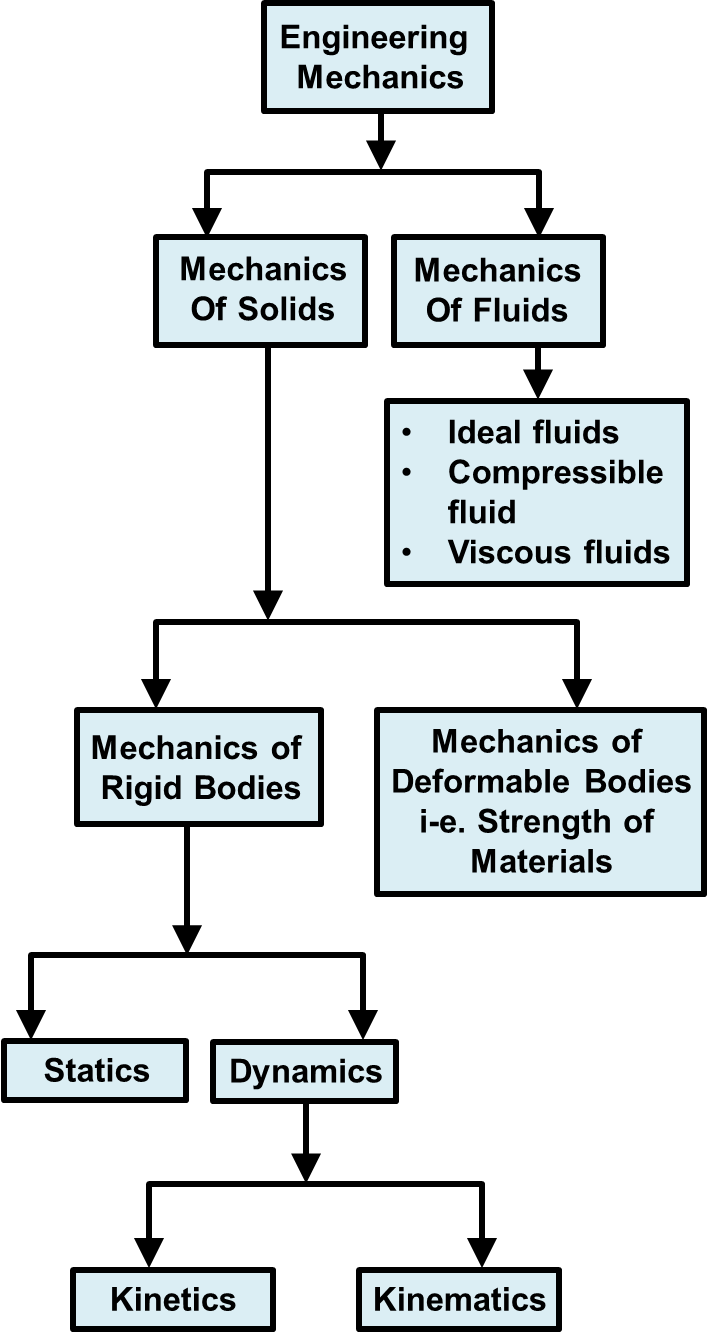
The Mechanics of Rigid Bodies is sub-divided into two branches:
Statics
Statics is the branch of mechanics under which we study the effect of forces on rigid bodies which are at rest and remain at rest or have uniform motion.
- Such bodies are said to be in equilibrium.
Statics is an important part in mechanics
because it provides method for the determination of support reaction.
Its center of mass moves at constant velocity.
Dynamics (body is in motion)
Dynamics is the branch of mechanics under which we study the effect of forces and motion of rigid bodies.
It may be classified as following:
- Kinetics - It is the study of relationship between the forces and the resulting motion.
- Kinematics - It is the study of motion of the body without any reference to the force causing motion or forces produced as a result of the motion.
Mechanics of Deformable Bodies (Strength of Materials) arrow_upward
It is the study which deals with internal force distribution and the deformation developed in actual engineering structures and machine elements.
It is popularly known as Mechanics of Materials or Strength of Materials.
Example:
Elasticity (or stretchiness) is the inherent property of a body which tries to regain its original shape after removal of its shape by applying any force on it.
Example:
- An eraser, spring coming back to its original shape after being pressed
Plasticity describes the deformation of a material undergoing non-reversible changes of shape in response to the applied forces.
We can bend plastic material but it will stay where it left off (like soldering wire).
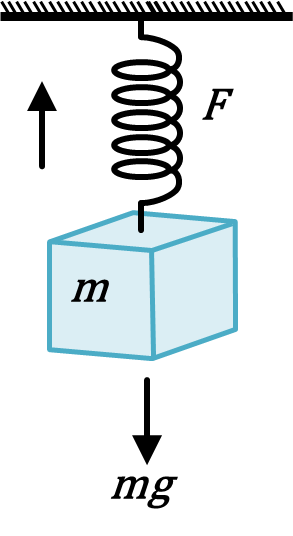
Hooke's Law in simple terms says that strain is directly proportional to stress.
Mathematically,
Where;
 is the displacement of the spring's end from its equilibrium position in meter
 is the applied force in newton
 is a constant called the Rate or Spring Constant in newton/meter
Stress
It is a measure of the average force per unit area of a surface within the body on which the internal forces act.
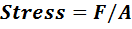
Where;
 Average force in newton
 Area in square meter
The unit of stress is Pascal or  .
.
Strain
It is expressed as the change in length  per unit of the original length
  of the line element or fiber.
The normal strain is positive if the material fibers are stretched or negative if they are compressed.
Thus, we have
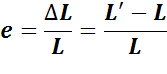
Where
 is the strain,
-
 is the original length of the fiber
 is the final length of the fiber
It is unit less.
Young's modulus is the ratio of stress, which has units of pressure, to strain, which is dimensionless; therefore, Young's modulus has units of pressure.
The SI unit of modulus of elasticity (E, or less commonly Y) is the Pascal (Pa or N/m² or m−1
kgs−2
).
Young's modulus  can be calculated by dividing the tensile stress by the tensile strain in the elastic (initial, linear) portion of the stress-strain curve:
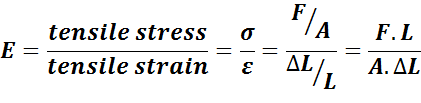
Where;
 is the Young's modulus
 is the force
 is the original cross-sectional area
 is the amount by which the length of the object changes (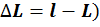
 is the original length of the object.
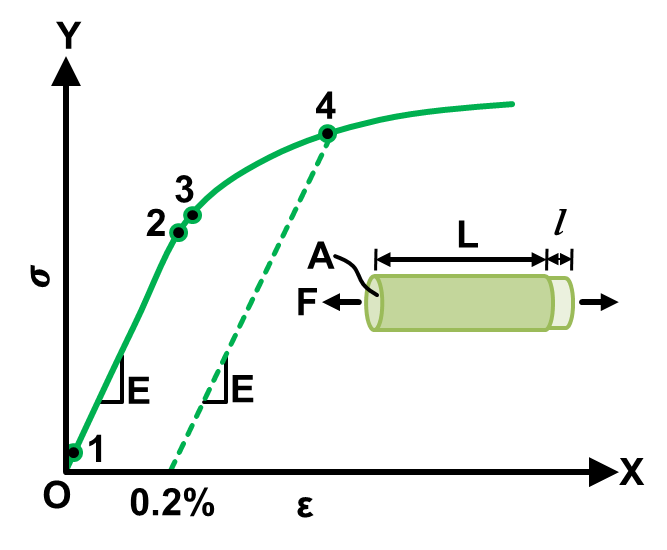
The numbers in the graph represents following:
 - True elastic limit
 - Proportionality limit
 - Elastic limit
 - Offset yield strength
It is the study of liquids and gases that is; fluids at rest or in motion.
Fluids can be classified as compressible or incompressible.
If the density of the fluid varies with temperature and pressure, fluid is said to be compressible.
If the volume of the fluid remains constant during a change in pressure, fluid is said to be incompressible.
Mechanics, as its name suggests, bridges the gap between physical theory and its application to technology.
As such, applied mechanics is used in many fields of engineering, especially mechanical engineering.
In this context, it is commonly referred to as engineering mechanics.
Much of modern engineering mechanics is based on Newton's laws of motion.
The research in applied Mechanics has wide application in many departments of engineering. Like
- Material Science and engineering
