Topics covered in this snack-sized chapter:
A computer network is a system where computer and peripheral devices are interconnected electronically.
- Example: It connects computers, printers, scanners, cameras, etc.
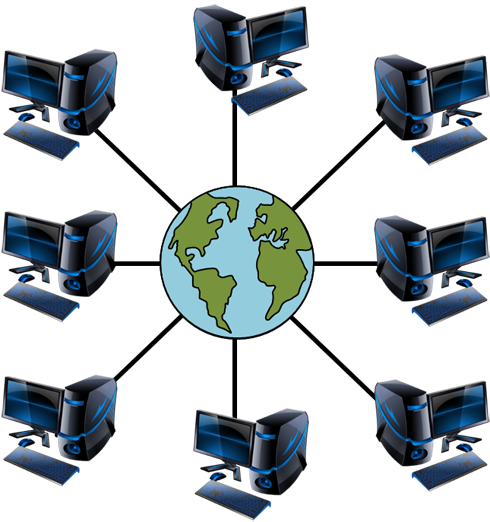
Computer network
These connected computers can "communicate” to each other.
- That is, they can share and send information to one another.
Computer networks are able to carry different types of data (Video, audio, doc files etc.) and support wide and ever growing applications.
The old model of a single computer serving computational needs of an organization has been replaced.
- Now, a large number of separate but interconnected computers do the job.
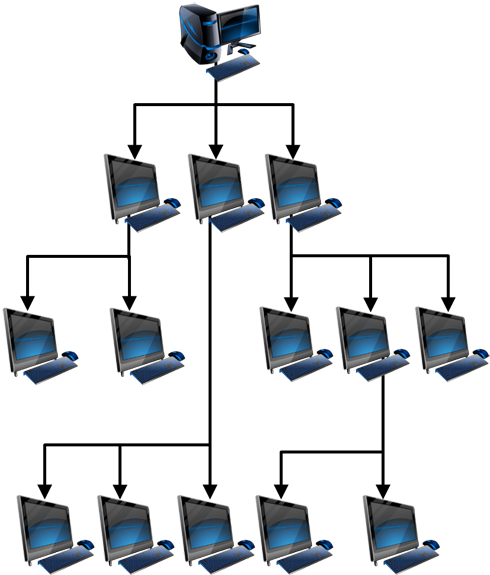
Interconnected computers
Computers are interconnected by communication channels that allow sharing of resources and information.
The interconnection of computers is done via copper wire, fiber optics, microwave, communication satellites, etc.
A computer network is a linked set of computer systems capable of sharing computer resources such as printers, large disk drives, CD-ROM and other databases.
Transferring of data using these devices is tedious especially if the files need to be transmitted very often.
- Using computer network to transfer the data from one computer to another without using movable disks is very easy.
Computer networks can be classified on the basis of:
Computer networks can be classified according to the geographical area they occupy or their behavior when data is shared or accessed between the computers.
The computer networks are of three types:
- Metropolitan Area Network (MAN)
Local Area Network:
- It is a computer network across one building or site.
Metropolitan Area Network
- It can occupy the whole city or state.
Wide Area Network:
- WAN occupies the whole world or group of countries.
A transmission media is a material substance (solid, liquid or gas) that can propagate energy waves.
Two main categories:
- Guided -wires, cables, etc.
- Unguided -wireless transmission, e.g.: radio, microwaves, infrared, sound, sonar, etc.
Wired transmission takes place via
Wireless transmission takes place via radio waves, microwaves, infrared waves, etc.
Two kinds of network management methods are used:
Peer-to-Peer Method:
Peer-to-peer computing or networking is a distributed application architecture that allocates tasks or workloads among peers.
Peer-to-peer network is also called workgroup with no hierarchy among computers. All are equal.
Peers are equally privileged, equipotent participants in the application.
Client/Server Method:
Network Clients (Workstation)
- They request for network resources or services.
Network Servers:
- They manage and provide network resources and services to clients.
- Usually have more processing power, memory and hard disk space than clients.
- They run network operating system that can manage not only data, but also users, groups, security and applications on the network.
- Servers often have a more powerful requirement on its performance and reliability.
Network topology is the layout pattern of interconnections of the various elements of computers.
Topology can be understood as the shape or structure of a network.
In communication networks, a topology is a usually schematic description of the arrangement of a network including its nodes and connecting lines.
Different types of network topologies are:
Advantages of computer networks are as follows:
- Internet connection sharing
- Internet telephone service
- Increased cost efficiency
- Increased storage capacity