Chapter 2 : Network Technology
Topics covered in this snack-sized chapter:
A computer network is an interconnection of various computer systems located at different places.
They are interconnected for the purpose of data sharing with each other.
There are various ways to interconnect computer networks and various communication channels for data sharing.
To interconnect computers, technologies used are LAN, MAN, WAN.
Modes of communication through which data travels are copper cable, fiber optic cable and microwaves.
Data transmission, digital transmission or digital communications is the physical transfer of data (a digital bit stream) over a point-to-point or point-to-multipoint communication channel.
Data transmission technology is increasingly used for the transmission of digital data.
Types of data transmission are:
- Parallel data transmission
Serial data transmission implies that one bit is sent after another (bit-serial) on a single transmission line.
- A large number of up-to-date communication networks apply serial transmission
Parallel transmission is the simultaneous transmission of the signal elements of a character or other entity of data.
- Parallel transmission is simultaneous transmission of related signal elements over two or more separate path.
- Multiple electrical wires are used which can transmit multiple bits simultaneously, which allows for higher data transfer rates compared to serial transmission.
Transmission systems differ as per the direction and timing of the data flow transmission.
There are three transmission modes:
In simplex mode, the communication takes place in one direction. The receiver receives the signal from the transmitting device.

Since the flow of information is in one direction, hence it is rarely used for data communication.
- Example: Radio relay system
In half-duplex mode, the communication channel is used in both the directions, but only in one direction at a time.

Thus, a half-duplex line can alternately send and receive data.
- Example: Telex and field networks
In full-duplex mode, the communication channel is used in both directions at the same time.

Use of full-duplex line improves the efficiency as compared to half-duplex mode.
A medium is required for data communication to take place.
- Data transmission takes place either through Wired Technology or Wireless Technology.
In wired technology, a physical medium is required for communication.
Data communication takes place with the help of twisted pair, co-axial cable and optical fiber.
Twisted pair:
Twisted pair cable consists of copper wires that are twisted into pairs.
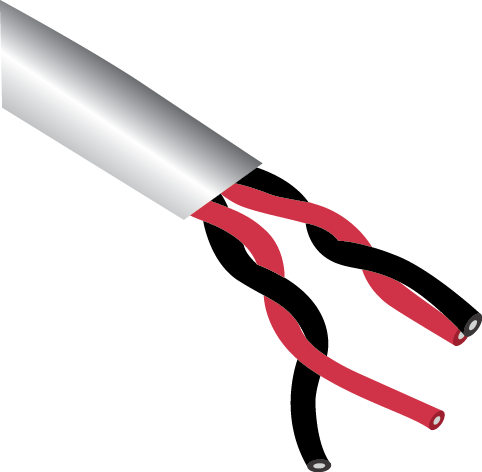
Twisted pair cable consists of 4 pairs of copper cable that can be utilized for both voice and data transmission.
- Twisted pair cables are of two types:
Unshielded Twisted Pair (UTP) cable
Shielded Twisted Pair (STP) cable
Unshielded Twisted Pair (UTP) Cable:
The quality of UTP may vary from telephone-grade wire to extremely high-speed cable.
The cable has four pairs of wires inside the jacket.
- Each pair is twisted with a different number of twists per inch to eliminate interference from adjacent pairs and other electrical devices.
Shielded Twisted Pair (STP) Cable:
Each pair of wires is individually shielded with foil.
- There is a shield around each individual pair as well as around the entire group of wires (referred to as double shield twisted pair).
Co-axial Cable
The cable consists of copper or aluminum wire wrapped with insulating layer typically a flexible material.
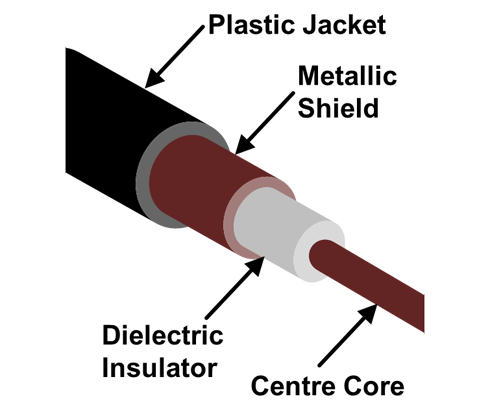
Co-axial cable
There are two types of coaxial cable: Thin coaxial and Thick coaxial.
Thin coaxial cable is also referred to as thin-net. 10Base2 refers to the specification for thin coaxial cable carrying Ethernet signals.
- The 2 refers to the approximate maximum segment length being 200 meters.
- Thin coaxial cable is popularly used for linear bus networks.
Thick coaxial cable is also referred to as thick-net. 10Base5 refers to the specifications for thick coaxial cable carrying Ethernet signals.
- The 5 refers to the maximum segment length being 500 meters.
- Thick coaxial cable has an extra protective plastic cover that helps keep moisture away from the conductor at the center.
- This makes thick coaxial a great choice when running longer lengths in a linear bus network.
- One disadvantage of thick coaxial is that it does not bend easily and is difficult to install.
Optical Fiber
Fiber optic cable consists of a central glass core surrounded by several layers of protective materials.
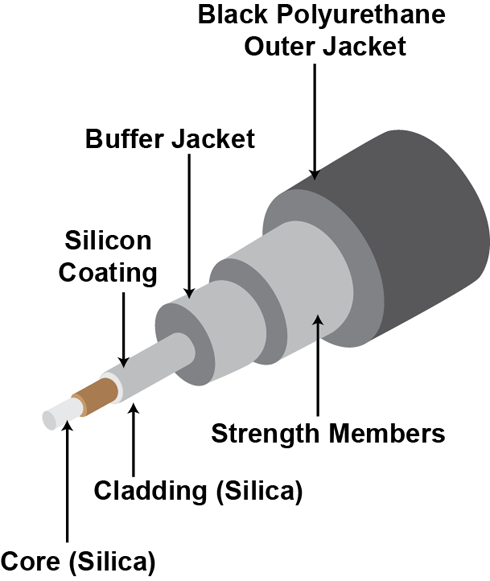
It transmits light rather than electronic signals eliminating the problem of electrical interference.
The transmission speed of fiber optics is hundred times faster than coaxial cables and a thousand times faster than a twisted-pair wire.
Optical fiber is a flexible, transparent fiber made of pure glass (silica) which is not much wider than a human hair.
It functions as a wave-guide to transmit light between the two ends of the fiber.
Data communication takes place without any wire in wireless technology.
Wireless signals are electromagnetic waves that can travel through the vacuum of outer space and through a medium such as air.
- Therefore, no physical medium is necessary for wireless signals, making them a very versatile way to build a network.