Chapter 1 : What is Fracture?
Topics covered in this snack-sized chapter:
A fracture is defined as a disruption in bone continuity.
The degree of disruption can vary from a crack in the cortex to multifragmentation.
Fractures are often associated with local tissue trauma.
Again, the severity can vary; from mild oedema to vascular compromise.
Fractures are common, and most people will sustain one across a lifetime.
There is a typical 3 peak incidence, childhood, young adulthood and in the elderly.
Bone is a relatively brittle material; it maintains sufficient strength to withstand regular day to day activities.
Fractures are a result of trauma to bone, when applied force exceeds bone strength.
The degree of force typically relates to the outcome, greater force results in greater severity of injury, conversely less severe injuries result from lower applied force.
When fractures occur at abnormally low impact they are termed ‘pathological’.
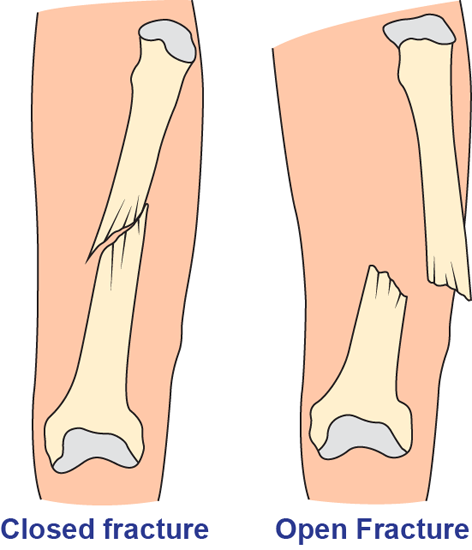
Open and Closed
- Open (Compound): Skin surface or body cavities are breached as a result of the fracture. They are associated with greater local tissue trauma and risk of bone infection.
- Closed (Simple): No breach of skin or body cavities. Variable degrees of local tissue trauma.
Complete and Incomplete
- Complete- Two or more bone fragments
- Incomplete- Periosteal continuity is maintained
The following are the most common symptoms of a fracture.
Symptoms may include:
- Swelling in the injured area
- Obvious deformity in the injured area
- Difficulty using or moving the injured area in a normal manner
- Warmth, bruising, or redness in the injured area
The symptoms of a broken bone may resemble other conditions.
The physician makes the diagnosis with physical examination and diagnostic tests.
Diagnostic procedures may include:
- Magnetic resonance imaging (MRI)
- Computed tomography scan (Also called a CT or CAT scan)
A diagnostic test which uses invisible electromagnetic energy beams to produce images of internal tissues, bones, and organs onto film.
Magnetic resonance imaging (MRI)
A diagnostic procedure that uses a combination of large magnets, radiofrequencies, and a computer to produce detailed images of organs and structures within the body.
This test is done to rule out any associated abnormalities of the spinal cord and nerves.
Computed tomography scan (Also called a CT or CAT scan)
A diagnostic imaging procedure that uses a combination of x-rays and computer technology to produce cross-sectional images (often called slices), both horizontally and vertically, of the body.
A CT scan shows detailed images of any part of the body, including the bones, muscles, fat, and organs.
CT scans are more detailed than general x-rays.
The type of treatment will depend on the kind of fracture and the specific bones involved.
After the broken bones have been manipulated back into their proper positions, a plaster or fiberglass cast is applied to keep the bones from moving while they heal.
Pins or wires are set into the bone through the skin above and below the fracture.
These are connected to a ring or a bar outside the skin that holds the pins in place.
After the bones have healed, the pins are removed.
In a surgical procedure, metal rods, wires, or screws are inserted in the bone fragments to keep them together.