Topics covered in this snack-sized chapter:
Matter refers to any object that has mass and volume.
Examples include particles, atoms, rocks, cars etc.
Properties:
All matter must have Mass and Volume.
All matter exists one of four states:
Examples of the states of matter:
The mass of an object is a fundamental property of that object.
Mass has a symbol M and is measured in Kilograms (Kg) (In S.I. units).
Volume is a measure of an object’s capacity.
Volume is represented by the symbol V and is measured in units of meters cubed (m3
).
Ratio of mass to volume indicates the density of an object.

Here,
- M is mass, measured in kilograms (kg),
- V is volume, measured in meters cubed (m3
),
- D is density, measured in kilograms per cubic meter (kg/m3
).
All matter is made up of small particles called atoms.
Atoms are the smallest particles of matter that still retain the same properties of that type of matter, even when alone.
- That is even when matter has been decomposed into atoms; it still retains the same properties.
It is the basis for measuring the masses of all other atoms.
It is 1/12th
of the mass of a Carbon-12 atom.

Three main types of charged particles:
- Electrons have a negative charge.
- Protons have a positive charge.
The characteristics of three charged particles are:
Electron:
- Electric Charge
 Coulombs
- Mass

Proton:
- Electric Charge
 Coulombs
- Mass

Neutron:
- Electric Charge

- Mass
All matter that conducts electricity can be divided into:
All types of matter that don’t conduct electricity are called non-conductors or insulators.
Newton proposed that all matter consists of particles.
John Dalton’s experiment pointed out that all matter is made up of atoms.
J.J. Thomson’s experiment pointed out that atoms can be decomposed into smaller charged particles.
All matter is made up of atoms.
Atoms are the smallest elements of matter that:
- Cannot be divided by chemical reaction and,
- Continue to have the properties of the matter.
All atoms have a nucleus made up of protons and neutrons located in the center of the atom.
Electrons orbit the nucleus of the atom.
The total number of electrons orbiting the nucleus must be equal to the number of protons in the nucleus.
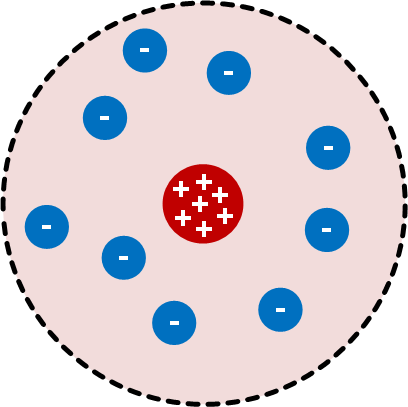
Figure:
Rutherford atomic model: electrons (blue) and nucleus (red)
The Atomic Number indicates:
- Number of electrons in an orbit or,
- The number of protons in the nucleus.
Only electrons in the outermost orbit can participate in any chemical reaction.
Niels Bohr was able to explain the stability of atoms as well as the emission spectrum of hydrogen.
The Bohr model consists of a few main principles:
- Electrons assume only certain orbits around the nucleus.
- These orbits are stable and are called stationary orbits.
- Each orbit has an energy associated with it.
- For example, the orbit closest to the nucleus has energy E1 (energy level; n=1), the next closest E2 (energy level; n=2) and so on.
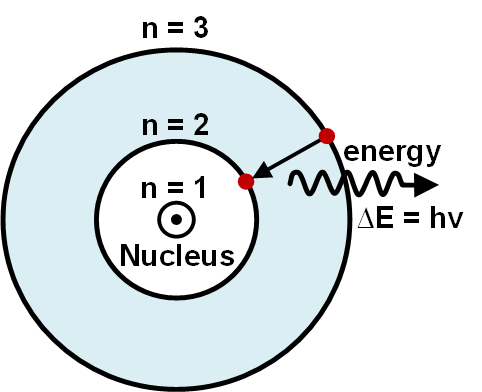
Figure: The Bohr’s model of the hydrogen like atom (Z = 1)
Light is emitted when an electron jumps from a higher orbit to a lower orbit and,
- When light is absorbed, an electron jumps from a lower to a higher orbit.
The energy and frequency of light emitted or absorbed is given by the difference between the energies of the two orbits,
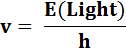
Where,
- “f” and “i” represent final and initial orbits respectively.
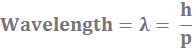
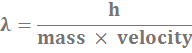
Matter exhibits the De Broglie wavelength given by:
Where,
 = Momentum,
 = Planck’s Constant.
Energy:
Momentum:
Matter wave's wavelength:

Where,
h = Planck’s constant
f = frequency of the photon.
Since the energy of a photon is:

The wavelength of the photon given off is given by:
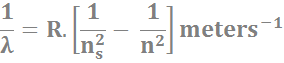
- This is known as the Rydberg formula.
Where,
- R = Rydberg’s Constant =

- ns
= series integer (2 = Balmer)