Topics covered in this snack-sized chapter:
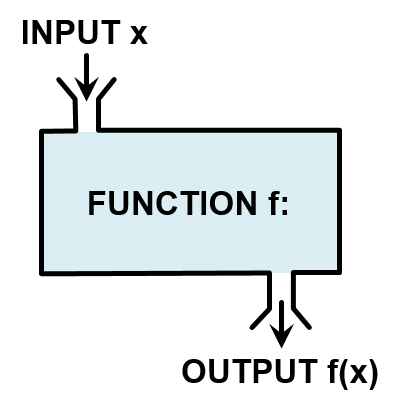
A function is a relation between a set of inputs and a set of permissible outputs with the property that each input is related to exactly one output.
The output of a function f corresponding to an input x is denoted by f(x) (read "
f
of x").
Let X and Y be two nonempty sets of real numbers.
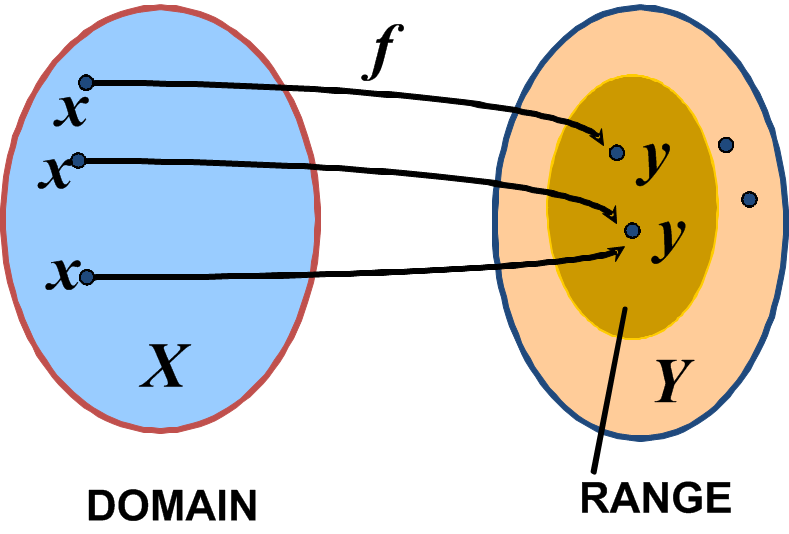
A function from X into Y is a relation that associates with each element of X a unique element of Y.
Domain:
The set of all possible input values. For function f(x), x is called the Domain of the function.
Range:
The set of all images of the elements of the domain is called the Range of the function.
For each element x in X, the corresponding element y in Y is called the image of
x.
Example of Function:
Any sequence can be considered as a function defined on a set of integers.
Example: Sequence 2, 5, 8, 11, 14,… can be defined as a function as follows:
f : n → 3n - 1
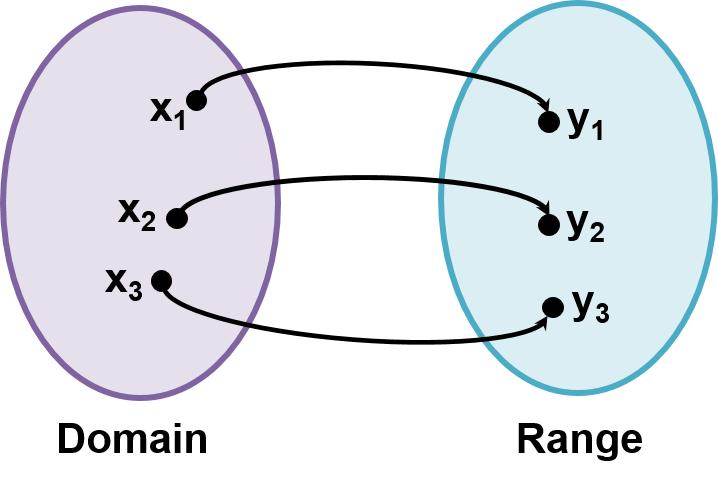
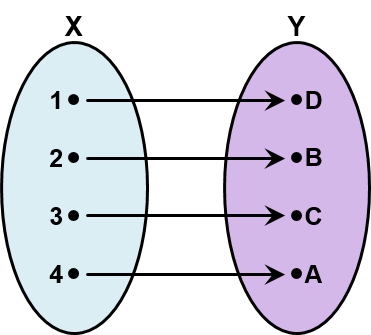
A one-to-one or injective function f from set X to set Y is a function such that each x in X is related to a different y in Y.
F is one-to-one or injective if for all elements  . If
. If  then
then  . No
. No  in the range is the image of more than one
  in the domain.
As shown in figure that, for every element of there is exactly one value of .
.
Example: f: R→R is defined by f(n) = 2n + 3, g: R → R is defined by f(x) = x2
, then f is one-to-one function, and g is not.
A function f : X Y is said to be onto or surjective if for every y in Y, there is an x in X, such that f(x) = y. All the elements in the Y are used.
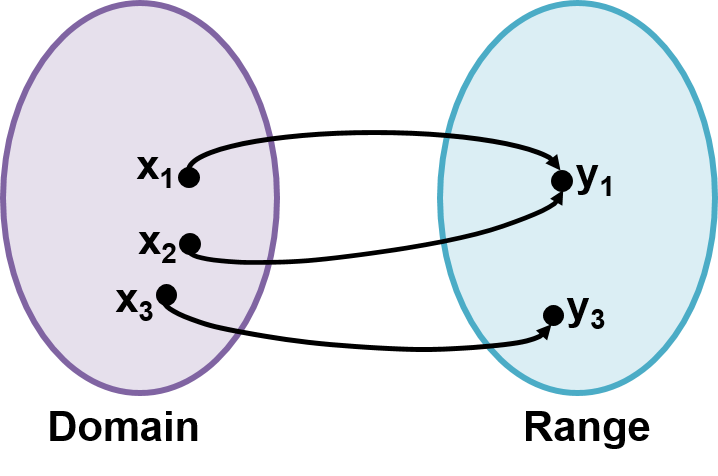
A function is onto if two or more different elements in the domain corresponds to the same element in the range.
Examples:
- We define f: R → R by f(n) = n2
- 2
- g: R → R by f(n) = 3 n - 4
- Then, f is onto, and g is not.
A One-to-One correspondence or bijection from a set X to a set Y is a function  that is both one-to-one and onto.
For a function y = f(x), the variable x is called the Independent Variable.
- Because it can be assigned any of the permissible numbers from the domain.
The independent variable is also called the Argument of the function.
The variable y is called the Dependent Variable, because its value depends on x.
This is a function that returns a true (for 1) or false (for 0) value instead of a numeric value. It uses principal logical relations “and”, “or”, “not”, “if…then” etc.
In Boolean function both range and domain consists of true and false.
Example: 
The function for which the domain and range are the subsets of the set of real number R is called a Real valued Function.
Uniform definition
- If a function is defined as
 , we say that it is uniformly defined.
Piecewise Definition
- If a function
 assumes different forms in different subsets of
 , we say that it is piecewise defined.
Functions with values that are obtained by adding, subtracting, multiplying or dividing constants and independent variable or raising a variable to a power are known as Algebraic Functions.
Algebraic functions are of three types.
Polynomial Function:
If a function y = f(x) is given by:

Where,  are real numbers (sometimes called the coefficients of the polynomial) and n is any non – negative integer, then f(x) is called a Polynomial Function in x.
The degree of a polynomial is the highest power of x in its expression. The function f(x) = 0 is also a polynomial but we say that its degree is “undefined”.
Example: f(x) = 4x3
– 3x2
+ 2 is a polynomial function with degree 3.
Rational Functions:
If a function  is given by
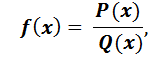
Where  and
and  are polynomial functions, then f(x) is called a Rational Function in x.
Irrational Functions
The algebraic functions containing one or more terms having non – integral rational powers of x are called Irrational Functions.
Signum function is denoted by  ,
,
thus, f (x) = sgn (x)
Where,
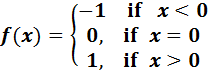
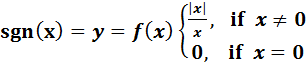
Domain of sgn (x) = R
Range of sgn (x) = {-1, 0, 1}
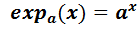
If a is any number such that a > 0 and a ≠ 1 then an exponential function is a function in the form,
  , where a is called the base and x can be any real number.
The Exponential Function with base  is the following function from R to
  .
.

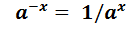
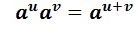
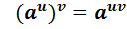
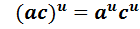
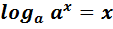
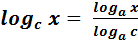
If a is any number such that a > 0 and a ≠ 1 and x > 0 then, 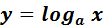 .
.
Symbolically,

Properties
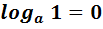
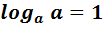


Suppose  is a one-to-one correspondence.
Then, there is a function 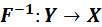 defined as follows:
- Given any element in Y.
 is the unique element x in X such that
F(x) = y.
The function  is called the Inverse Function for F.
Example:
- The logarithmic function with base
 is the inverse of the exponential function with base b.That is logarithmic function y = logb
x is the inverse function of exponential function that is by
= x.
is the inverse of the exponential function with base b.That is logarithmic function y = logb
x is the inverse function of exponential function that is by
= x.