Chapter 2 : Evolution of Management
Topics covered in this snack-sized chapter:
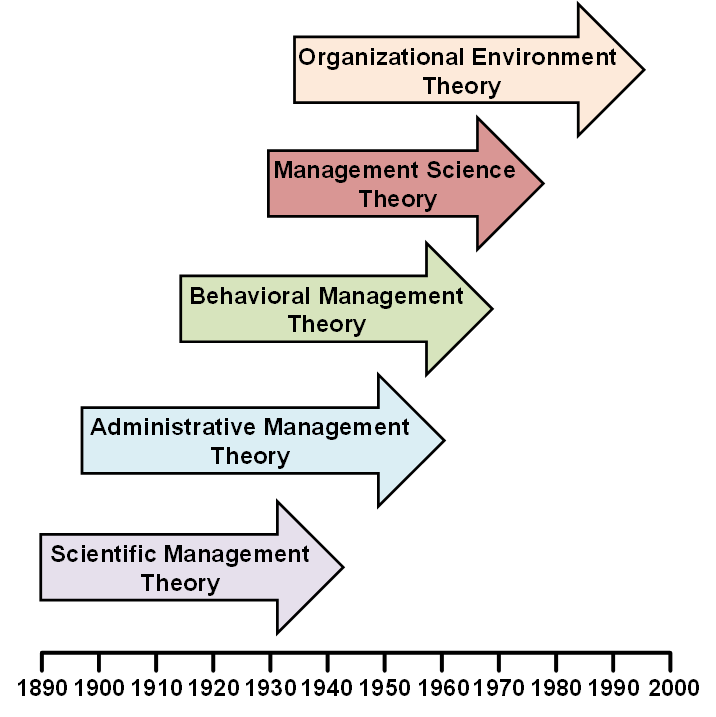
Management has developed from a nearly insignificant topic in the previous centuries, to one of the integral ones of our age and economy.
In recent times, management has become a more scientific discipline having certain standardized principles and practices.
A general body of assumptions and principles used to describe a particular set of facts or some observed phenomenon
It is the systematic study of the relationships between people and tasks for the purpose of redesigning the work process of higher efficiency.
It was defined by Frederick Taylor in the Late 1800’s.
He wanted to replace the “Rule of Thumb”.
Scientific management theory is called Taylorism; it analyzed and synthesized workflows. Its main objective was:
- Improving economic efficiency especially labor productivity
Scientific management theory was characterized by a worker-task relationship, with efficiency as its primary goal.
Elements of the Scientific Management:
Separating planning and actual doing of work.
Functional foremanship based on specialization of functions.
Job analysis is to find out the best way of doing the things.
Standardization of things shall be fixed in advance on the basis of job analysis.
Workers should be selected on the scientific basis and should be trained.
Financial incentive programs are designed to motivate workers.
Apart from considering the Scientific and Technical aspects, adequate consideration should be given to economy and profits.
Create a suitable environment for mutual co-operation between management and workers.
Principle 1: Study the way workers perform their tasks, gather all the informal job knowledge that workers possess, and experiment with ways of improving the way tasks are performed.
Principle 2: Codify the new methods of performing tasks into written rules and standard operating procedures.
Principle 3: Carefully select workers so that they possess skills and abilities that match the needs of the task, and train them to perform the task according to the established rules and procedures.
Principle 4: Establish a fair or acceptable level of performance for a task, and then develop a pay system that provides a reward for performance above the acceptable level.
The Administrative Theory "emphasized management functions and attempted to generate broad administrative principles that would serve as guidelines for the rationalization of organizational activities.”
It deals with how to create an organizational structure that leads to high efficiency and effectiveness.
Fayol is known as the Father of Management or the Founder of the Classical Management.
Not because he was first to investigate managerial behavior, but because he was the first to systematize it.
Henri Fayol was one of the most influential contributors to modern concepts of management, having proposed that there are five primary functions of management:
14 General Principles of Management
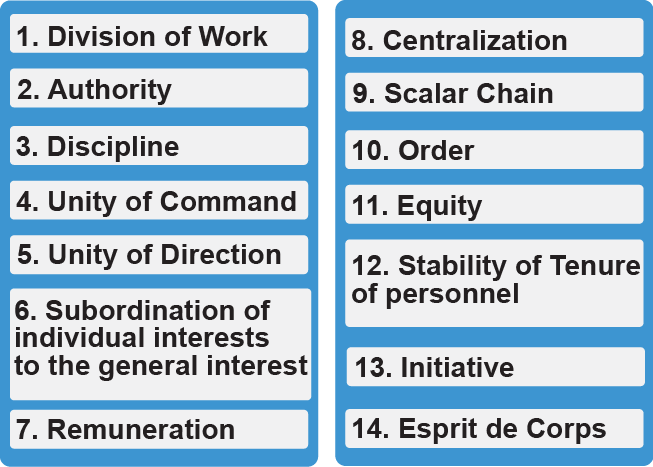
According to Fayol, a manager requires the following qualities and skills:
The study of how managers should behave to motivate employees and encourage them to perform at high levels and be committed to the achievement of organizational goals.
Focusses on the way a manager should personally manage to motivate employees.
Behavioral management theory emerged when employee behavior and motivation was ignored at the time of classical theory.
In any organization, relationship is termed as an important set of areas that should be handled with care in order to make every single organization an effective one.
Expectations, conflicts, motivations, level of productivity and group behavior are important areas that should be handled carefully.
An approach to management that uses rigorous quantitative techniques to maximize the use of organizational
resources.
Quantitative management: Utilizes linear programming, modeling, simulation systems and chaos theory.
Operations management: Techniques used to analyze all aspects of the production system.
Total Quality Management (TQM): Focuses on analyzing input, conversion, and output activities to increase product quality.
Management Information Systems (MIS): Provides information vital for effective decision making.
The set of forces and conditions that operate beyond an organization’s boundaries but affect a manager’s ability to acquire and utilize resources.
Open System
- A system that takes resources for its external environment and converts them into goods and services that are then sent back to that environment for purchase by customers.
Closed System
- System that operates as though it is self-contained.
- Likely to experience entropy and disintegrate.
The idea that the organizational structures and control systems are contingent on characteristics of the external environment.
“There is no one best way to organize.”
The idea that the organizational structures and control systems managers choose depend on characteristics of the external environment in which the organization operates.
Mechanistic Structure
- Authority is centralized at the top (Theory X).
- Employees are closely monitored and managed.
- Can be very efficient in a stable environment.
Organic Structure
- Authority is decentralized throughout the organization (Theory Y).
- Reliance on shared norms is greater.
- Works best when environment is unstable and rapidly changing.