Topics covered in this snack-sized chapter:
Probability is a branch of mathematics that deals with calculating the likelihood of a given event's occurrence.
Probabilities are given values between 0 (0% chance or will not happen) and 1 (100% chance or will happen).
If E is an event, then P(E) stands for the probability that event E occurs.
It is read as “the probability of E”.
Suppose an event E can happen in r ways out of a total of n possible equal likely ways.
- Then the probability of occurrence of the event (called its success) is denoted by:
The probability of non – occurrence of the event (called its failure) is denoted by:
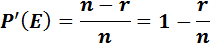
- Here P'(E) indicates that the event does not occur.
Thus,

This means that the sum of all probabilities in any experiment is 1.
Probability Experiment
Random Experiment
Sample Space
- Finite and Infinite Sample Space.
- Discrete and Continuous Sample Space.
Sample Point
Probability Experiment is a process leading to well defined results called outcomes.
Examples:
Random Experiment is an experiment in which the outcome varies in an unpredictable fashion when the experiment is repeated under the same conditions.
Example:
| Experiment
| Outcomes
|
| Flip a coin
| Heads, Tails
|
Sample Space S of a random experiment is defined as the set of all possible outcomes.
- Note: When we perform a random experiment, one and only one outcome occurs.
Example: In tossing a coin, there are two possible outcomes.
- Sample Space S = {heads, tails}
Or S = {H, T}
Sample Space for rolling a die once is:
- Sample Space S = {1, 2, 3, 4, 5, 6}

Example: Experiment E1:
- Toss a coin three times and note the sequence of heads and tails.
- S = {HHH, HHT, HTH, THH, TTT, THT,
TTH, HTT}
Example: Experiment E2:
- Toss a coin three times and note the number of heads.
S = {HHH, HHT, HTH, THH, THT, TTH, HTT}
Finite and Infinite Sample Space
Finite Sample Space:
If the number of sample points is finite, it is called a finite sample space.
Example: If there are 4 red, 2 white balls in a bag then for the random experiment, “draw two balls at random”, the sample space may be described as:

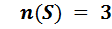
Infinite Sample Space:
If the number of sample points is infinite it is called an infinite sample space.
Example: Tossing a coin endlessly.

Discrete and Continuous Sample Space
Discrete Sample Space:
A sample space is called Discrete if it contains countable number of sample points.
Example: When a coin and die is thrown simultaneously, the sample space given below is discrete.

Continuous Sample Space:
A sample space is said to be Continuous if it contains uncountable number of sample points.
Example: All the points in the straight line.
Each possible outcome given in the sample space is called an Element or Sample Point.
Example: In case of tossing a coin the sample points are H
andT.
Suppose an experiment has N possible outcomes.
Then the probability that a specified event occurs will be equal to the number of ways that the event can occur to the total number of possible outcomes.
In symbols

Example: What is the probability of getting head in a single throw of a coin?

Solution: When we toss a coin there are two possible outcomes  head or tail
- Number of favorable cases for head m = 1.
- Therefore, probability of getting head:

There are three types of probability:
Classical probability of an event is the number of ways that the event can occur, divided by the total number of outcomes.
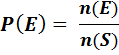

- P(E) = Probability that an event E, will occur.
- n(E) = Number of equally likely outcomes of E.
- n(S)
= Number of equally likely outcomes of sample space S.
Example: If we roll a six-sided die. Find the probability of the following:
Solution: When rolling a six-sided die, the sample space consists of six outcomes {1, 2, 3, 4, 5, 6}.
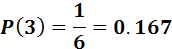
Event A: Rolling a 3
There is one outcome in event A = {3}.
So,
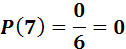
Event B: Rolling a 7
Because 7 is not in the sample space, there are no outcomes in eventB.
So,
Empirical probability of an event is an "estimate" that the event will happen based on how often the event occurs after collecting data or running an experiment (in a large number of trials).
It is based specifically on direct observations or experiences.

Subjective concept of probability is a calculation based on the individual's estimates of likelihood, rather than on objective statistical computations.
The probability is determined between 0 and 1, where 0 = impossible and 1= surety.