Chapter 2 : Types of Events
Topics covered in this snack-sized chapter:
An event is a subset of a sample space when the outcome satisfies certain conditions.
A subset of the sample space S is called an event.
Note:
- Sample space S plays the same role as the universal set for all problems related to the particular experiment.
-
 is also a subset of S which is called an impossible event.
Types of events:
- Mutually Exclusive Events
- Collectively Exhaustive Events
An event having only a single element of the sample space is called a Simple Event.
Example: When a coin is tossed, and we denote,
E1
= {H} = The event of occurrence of head.
E2
= {T} = The event of occurrence of tail.
- Then, E1
and E2
are simple events in the sample space S = {H, T}.
A subset of the sample space S which contains more than one element is called a Mixed Event.
Example: When a coin is tossed, we denote E = {H, T} = The event of occurrence of a head or a tail.
- Then, E is a mixed event in the sample space S = {H, T}.
Two or more events are said to be equally likely if each one of them has an equal chance of occurrence.
Example: When a fair coin is tossed, then occurrences of head or tail are equally likely events and there is no reason to expect a ‘head’ or a ‘tail’ in preference to the other.
Events are said to be Exhaustive when their totality includes all the possible outcomes of a random experiment.
Example: If a die is thrown, then the events A1
= {1, 2} and A2
= {2, 3, 4} are not exhaustive as we can get 5 as outcome of the experiment which is not the member of any of the events A1
and A2.
- But if we consider the events E1
= {1, 2, 3} and E2
= {2, 4, 5, 6}, then the set of events E1
, E2
is exhaustive.
Two events are 'mutually exclusive' if they cannot occur at the same time, that is if one event occurs, the other doesn't occur.
Example: Throwing a die once can yield a 5 or 6, but not both, in the same throw.
- The probability that either a 5 or 6 occurs is the sum of their individual probabilities.
p = p1
+ p2


Two events are said to be Independent, if the occurrence of one does not depend on the occurrence of the other.
Example: When a coin is tossed twice, the event of occurrence of head in the first throw and the event of occurrence of head in the second throw are independent events.
Note:
If two events A and B are mutually exclusive, they would be strongly dependent as the occurrence of one precludes the occurrence of other.
The Complement of an event E, denoted by  or
or  is the set of all sample points of the space other than the sample points in E.
Example: When a die is thrown, we get the sample space,
S = {1, 2, 3, 4, 5, 6}
- If E = {1, 2, 3, 4}; then

In the probability theory, a set of events is jointly or collectively exhaustive if at least one of the events must occur.
Example: For the die-rolling experiment, the set of events consists of 1, 2, 3, 4, 5, and 6.
- The set is collectively exhaustive because it includes all possible outcomes.
- Thus, all sample spaces are collectively exhaustive.
Let
S be a sample space.
Then the probability of occurrence of an event A is denoted by P (A) and is defined as:


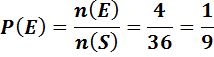
Example: Two dice are thrown simultaneously. Find the probability that the product of number is 6.
Solution: Here n(S) = 6 × 6 = 36
- Favorable condition for probability that the product of numbers on both dices is 6, is:
= {(1, 6), (2, 3), (3, 2), (6, 1)}
n (E) = 4
- Therefore, desired probability:
If either event A or event B or both occur on a single performance of an experiment, this is called the Union of the events A and B, and is denoted by (A B).
B).

The union of A and B is the whole blue colored area.
If two events are mutually exclusive then
the probability of either occurring is:

If the events are not mutually exclusive, then,

If both events happen simultaneously it is written as A  B and it is read as A intersection B.
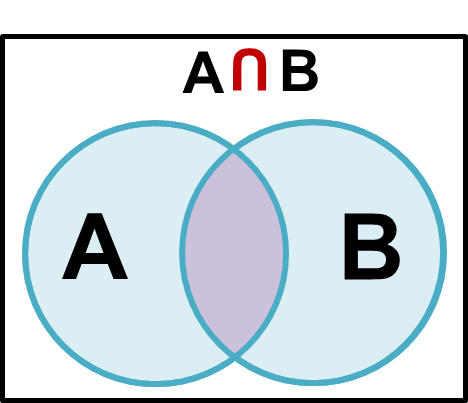
The intersection of A and B is shown by
the purple overlapping area in the above figure.
If two events, A andB are independent, the joint probability is:

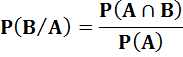
If A and B are two events associated with a random experiment, then

Or

Therefore,
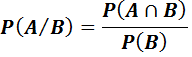
and
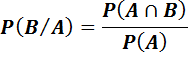
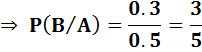
Example: If A and B are two events such that P(A) = 0.5, P(B) = 0.6 and
P(AB) = 0.8, find P(A/B) and P(B/A)?
Solution: We have,


 = 0.5 + 0.6 - 0.8 = 0.3
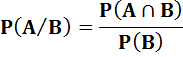
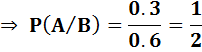
and