Chapter 1 : Introduction to Robotics
Topics covered in this snack-sized chapter:
Robotics is the branch of technology that deals with the design, construction, operation, manufacture and application of robots.
It came out in 1941 and was first adopted by Isaac Asimov, a scientist and writer.
A robot is a machine capable of carrying out complex series of actions automatically.
- Essentially, robots are man-made versions of animal life.
It is a machine resembling a human being and able to replicate certain human movements and functions.
The Robot Institute of America defines a robot as follows:
- “A reprogrammable, multifunctional manipulator designed to function in place of a living agent that is to move materials, parts, tools or specialized devices through various programmed motions for the performance of a variety of tasks.”
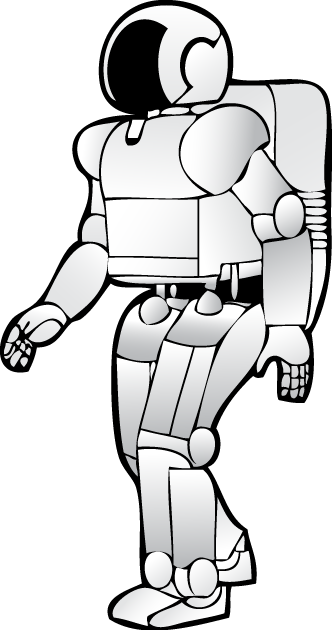
The Webster defines a Robot as:
- An automatic apparatus or device that performs functions ordinarily ascribed to humans or operates with what appears to be almost human intelligence.
A robot is a machine that gathers information about its environment by its sensors and uses that information for processing to follow instructions to do work.
- The “sensing” part provides input to the robot through switches, light sensors.
- The “thinking” part is the microcontroller brain.
- The “acting” part could be through lights, motors, actuators, sounds, etc.
Definition of a Robot revisited:
The robot is a computer-controlled device that combines the technology of digital computers with the technology of servo-control of articulated chains.
- It should be easily reprogrammed to perform a variety of tasks, and must have sensors that enable it to react and adapt to changing conditions. Most industrial robots satisfy this definition.
What is hard for humans is easy for Robots:
- Do complicated calculations,
- Refer to huge data bases.
What is easy for a human is hard for Robots:
- Adapting to new situations,
- Flexible to changing requirements,
- Integrating multiple sensors,
- Resolving conflicting data,
- Synthesizing unrelated information,
The word "robot" comes from robota, Czech for “hard work."
The term 'robot' was first used by Czech writer Karel Capek in a 1921 play called R.U.R (Rossum's Universal Robots).
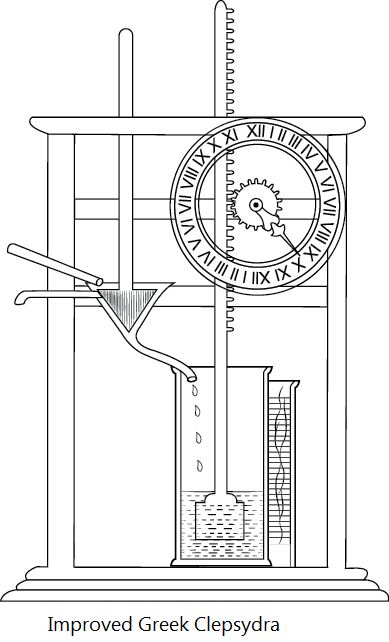
Babylonians developed the clepsydra, a clock that measures time using the flow of water.
It is considered as one of the first "robotic" devices in history. For centuries, inventors would refine the design.
1961:
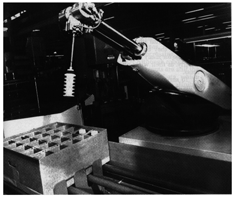
- George C. Devol obtained the first US robot patent, No. 2,998,237. Joe Engelberger formed Unimation (Universal Automation) and was the first to market robots.
- Unimate was the first industrial robot, which worked on a General Motors assembly line at the Inland Fisher Guide Plant in Ewing Township, New Jersey, in 1961.
- The first industrial robot saw service in 1961 in a car factory run by General Motors in Trenton.
1962:
- Unimation, Inc. was formed (Unimation stood for "Universal Automation").
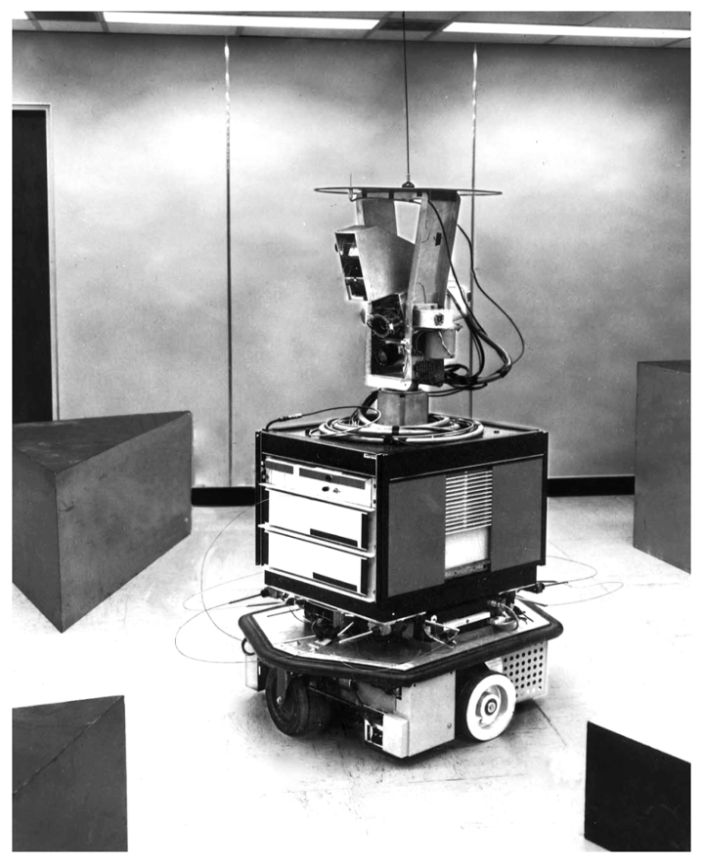
Shakey the robot was the first general-purpose mobile robot to be able to reason about its own actions.
While other robots would have to be instructed on each individual step of completing a larger task, Shakey could analyze the command and break it down into basic chunks by itself.
Shakey was developed at the Artificial Intelligence Center of Stanford Research Institute (now called SRI International).
It was endowed with a limited ability to see and model its environment and was controlled by a computer that filled an entire room.
Ctesibius, a Greek physicist and inventor makes organs and water clocks with movable figures. (270 BC)
The anthrobot, a mechanical man, is designed by Leonardo da Vinci. (1495)
Joseph Jacquard invents a textile machine called a programmable loom. It is operated by punch cards. (1801)
American Christopher Spencer designs a cam-operated lathe. (1830)
Science fiction writer Isaac Asimov first uses the word "robotics" to describe the technology of robots and predicts the rise of a powerful robot industry. (1940)
A teleoperator-equipped articulated arm is designed by Raymond Goertz for the Atomic Energy Commission. (1951)
The first industrial robot was online in a General Motors automobile factory in New Jersey. It was Devol and Engelberger's UNIMATE. It performed spot welding and extracted die castings. (1962)
Ralph Moser’s Walking Machine. (1967)
Robot vision, for mobile robot guidance, demonstrated at the Stanford Research Institute. (1969)
The Stanford Arm was the first electrically powered, computer-controlled robot arm. (1969)
Unimate robots assembled Chevrolet Vega automobile bodies for General Motors (1969)
General Motors became the first company to use machine vision in an industrial application. The Consight System was installed at a foundry in St. Catherines, Ontario, Canada. (1970)
Puma (Programmable Universal Machine for Assembly). (1978)
SCARA (Selective Compliant Articulated Robot Arm). (1979)
Adaptive Suspension Vehicle. (1985)
Demeter: It navigates with GPS and uses camera vision to differentiate cut and uncut crops. (1993)
LEGO launched its first Robotics Inventions System. (1998)
Sony released the first version of AIBO, a robotic dog with the ability to learn, entertain and communicate with its owner. More advanced versions followed. (1999)
Honda debuted ASIMO, the next generation in its series of humanoid robots. (2000)
Epsom released the smallest known robot, standing 7cm high and weighing just 10 grams. The robot helicopter was intended to be used as a “flying camera” during natural disasters. (2004)
Researchers at Cornell University built the first self-replicating robot. Each ‘robot’ was made up of a small tower of computerized cubes which linked together through the use of magnets. (2005)
After being first introduced in 2002, the popular Roomba robotic vacuum cleaner had sold over 2.5 million units, proving that there was a strong demand for this type of domestic robotic technology. (2008)
Automotive markets in the US are “saturated.”
- Expansion in Asian automotive markets.
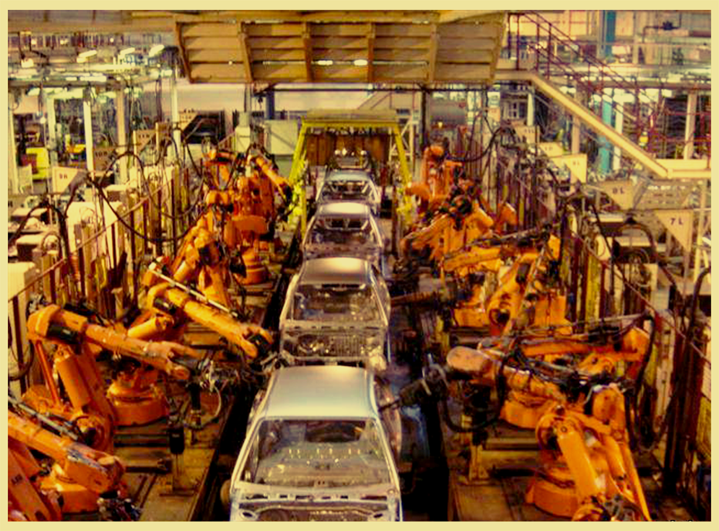
Robots are extensively used in the manufacturing of automobiles, electronic goods and semiconductors.
90% of all robots used today are found in factories. These robots are referred to as industrial robots.
The automotive industry employs robots for their various tasks.
Robots not only save labour costs, but also allow shorter production lines, which mean a lower cost per capita on product and more flexibility, which in turn allows customization of products.
Robots are also used for small volume flexible manufacturing systems for cameras, walkman and personal computers.
Ten years ago, 9 out of 10 robots were being bought by auto companies - now, only 50% of robots made today are bought by car manufacturers.
Robots are slowly finding their way into warehouses, laboratories, research and exploration sites, energy plants, hospitals, even outer space.
Japan is the largest Robot-user country. The U.S. is the second largest robot user after Japan.
The major reasons for growth in this industry are Japanese labor shortage and strong investment by industry and the government.
Electronic goods and semiconductors:
- Lower capital cost per unit product
Virtual Reality:
- Robot technology allows the user/operator to feel the virtual environment and exert forces on it.
Highways:
- Cars are being equipped with increasingly sophisticated sensors, navigation systems and controllers.
Medical Robotics:
- The surgeon directs the robot to make controlled, high-precision incisions.
- Laparoscopic surgery involves inserting a micro-robot through a small incision.
Military Applications:
Unmanned vehicles
Unreachable Areas
Asimov also proposed three "Laws of Robotics"
Law One:
- A robot may not injure a human being or, through inaction, allow a human being to come to harm.
Law Two:
- A robot must obey the orders given to it by human beings except where such orders would conflict with the First Law.
Law Three:
- A robot must protect its own existence as long as such protection does not conflict with the First or Second Law.