Chapter 1 : Introduction to Sales
Topics covered in this snack-sized chapter:

Sale means selling of the product and services to the customers according to their needs and requirements.
Sales are one of the most crucial functions of an organization.
It is the principle revenue generating function of the organization.
Marketing and sales have a close relationship.
- Marketing is the method of bringing customers to your business as well as making others aware of your business, product, and brand.
Sales can be achieved via phone interaction, web, or in-person (salesman).
A series of small, logical and explicit commitments that the buyer makes as he/she advances toward ultimately committing to purchase.
The sales process is a systematic approach to selling a product or service that involves:
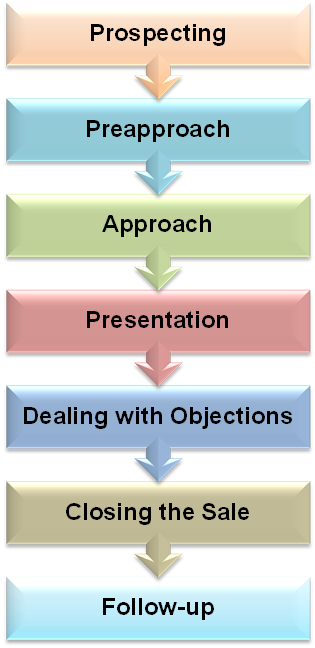
Develop sales plan.
Work closely with marketing functions to establish channel and partner program.
Achieving sales target in terms of value and units.
Develop relationships with customers, suppliers, and distributors.
Negotiate with customers to sell the company’s products (profitably).
Sales training builds confidence in the sales force and enables sales people to make superior presentations.
Salespeople are most comfortable in selling if they understand more about product.
A set of concepts and techniques which are well learned and consistently practiced, increase sales and customer satisfaction.
Selling is about uncovering a prospect’s needs and then positioning the product or service as the best selection to fulfill that need.
Selling keeps products, services and ideas flowing:
| Sales people are solution providers
| Understand your customer’s problems.
Help your customer in solving the problem.
|
| Businesses rely on sales people to perform many functions
| Identify customer needs.
Help in determining the price of the products that their company sells.
Give information to customers about new products.
Follow up with the customer once the sale is made.
|
- Seeking out people who have a particular need.
- Assisting them in recognizing the existence of their need.
- Demonstrating how the sales person’s offering fills that need.
- Persuading qualified prospects that your product will fill their needs.
Be trustworthy.
Understand your customer’s needs.
Deeply understand your product.
Understand your competitor’s strength and weaknesses.
Build excellent communication skills.
Listen, learn and respond.
Be persistent (never give up)
Be persistent
- Persistence is power when it comes to increasing your sales and profit.
- Far too many businesses fail because they don't follow-up leads repeatedly.
- Most sales are made after the seventh or eighth contact - the sale is rarely made after just one - so be persistent.
Focus on helping instead of selling
- Don’t try to force people into purchasing your product or service.
- Find people who may want your product or service.
- And then focus on offering helpful information so that they can make an informed decision.
Focus on benefits instead of features
- Spend time focusing on how your potential customers will benefit if they purchase your product or service.
Target the right people
- If you try to market to everybody then you end up targeting nobody.
- Decide who might be interested in your product or service and target them.
Networking
- Networking is a great way to get your message out to a large number of people, for free.
Focus on the lifetime value of your customers
- Don't focus on generating one-off customers.
- Build a relationship so that your customers become repeat, lifelong customers.