Chapter 1 : Introduction to Statistics
Topics covered in this snack-sized chapter:
Statistics is a branch of mathematics that deals with the collection, organization, and interpretation of data.
It is a method of analyzing data.
- A collection of methods for planning experimenting, obtaining data and summarizing it.
- Drawing conclusions based on the data.
Statistics is a numerical measurement describing some characteristics of a sample.
Almost all the fields of study gets benefit from the application of statistical methods. This can include:
- Marketing (Consumer preferences).
- Management (Quality improvement).
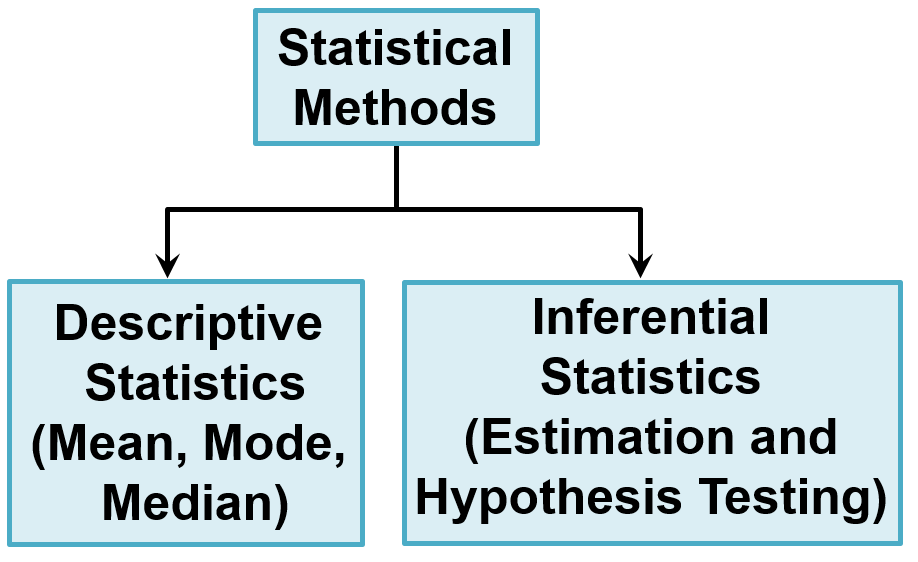
There are two types of statistical methods:
- Inferential (or “analytical”) Statistics.
Descriptive statistics includes statistical procedures that we use to describe the population we are studying.
The list of techniques used to summarize data in the form of following:
Inferential statistics is concerned with making predictions or inferences about a population from observations and analyses of a sample.
The methods of inferential statistics are:
- Estimation of parameters.
The list of techniques used to summarize data in the form of following:
Probability is a numerical measure of the likelihood that an event will occur.
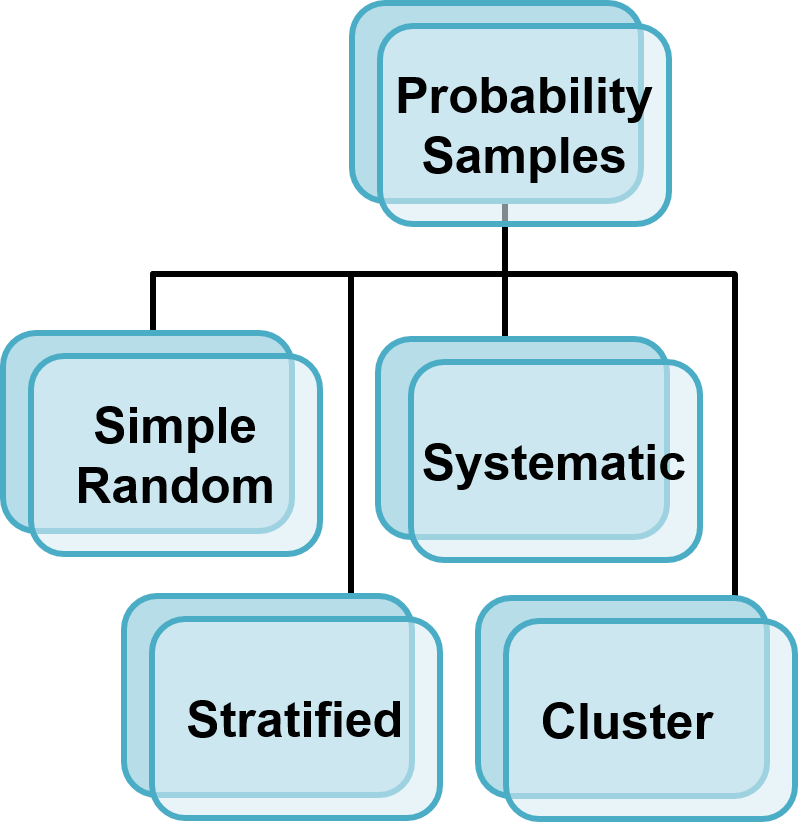
Probability sampling is a sampling technique where the samples are gathered in a process that gives all the individuals in the population equal chances of being selected.
Types of Probability Sampling are as shown in the figure:
Every individual or item from the frame has an equal chance of being selected.
Selection may be with replacement or without replacement.
- With replacement: Measured items are returned to the frame.
- Without replacement: Measured items are not returned to the frame.
Advantages of Simple Random Sampling:
Estimates are easy to calculate.
The sample will be free from bias.
Disadvantages of Simple Random Sampling:
If sampling frame is large, then this method is impracticable.
Due to its very randomness, “freak” results can sometimes be obtained that are not representative of the population.
A statistical method involving the selection of elements from an ordered sampling frame.
Advantages of Systematic Sampling:
It is very simple to use.
It also saves time and cost.
It checks bias in subsequent selections of samples.
Disadvantages of Systematic Sampling:
There is the possibility of losing vital information from the population.
It may not be good for periodic data.
Stratified sampling involves dividing the population into groups and then sampling from those different groups depending on a certain set criteria.
Advantages of Stratified Sampling:
Yields more accurate results than Simple Random Sampling.
Disadvantages of Stratified Sampling:
It is more complex to organize and analyze the results compared to simple random sampling.
Cluster sampling is a sampling technique where the entire population is divided into groups, or clusters, and a random sample of these clusters are selected. All observations in the selected clusters are included in the sample.
Advantages of Cluster Sampling:
This sampling technique is cheap, quick and easy.
Disadvantages of Cluster Sampling:
Less efficient (need a larger sample to acquire the same level of precision).