Chapter 2 : Algebra of Vectors
Topics covered in this snack-sized chapter:
Two or more vectors may be added together to produce their addition.
If two vectors have the same direction, their resultant has a magnitude equal to the sum of their magnitudes and will also have the same direction.
Similarly orientated vectors can be subtracted in the same manner.

In general, since vectors may have any direction, we must use one of two methods for adding vectors.
If two vectors  and
and  are represented in magnitude and direction by the two adjacent sides of a parallelogram then their sum
  is represented by the diagonal of the parallelogram which is co-initial with the given vectors.
In the parallelogram method for vector addition, the vectors are translated, (that is, moved) to a common origin and the parallelogram constructed as follows:
Step 1:

Step 2:

Step 3:

Symbolically, we have
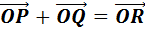 or
or 
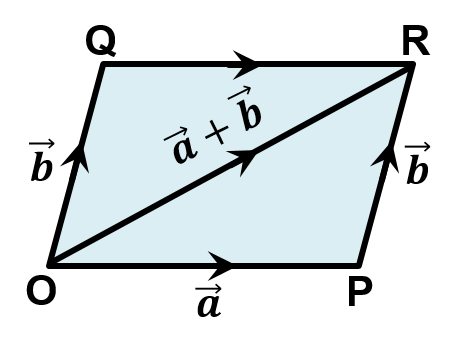
We have
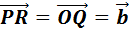
Therefore, in triangle OPR,

Thus, it follows that if two vectors are represented in magnitude and direction by the two sides of a triangle taken in the same order, then their sum is represented by the third side taken in the reverse order.
This is called the triangle law of addition of vectors.
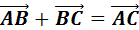
Using triangle law of addition of vectors in  we have:
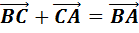
and 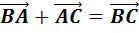
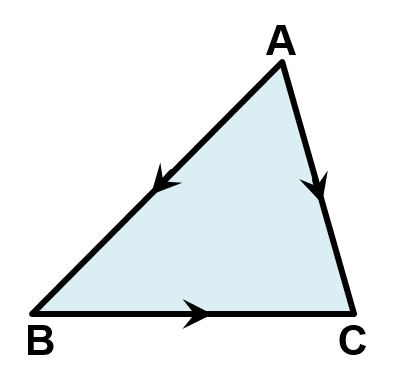
Example: Find the sum of vectors  and
and  ?
?
Solution: We have,






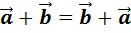
Commutative:
For any two vectors and , we have,
Associative:
For any three vectors,  we have,

Existence of additive identity:
For every vector , we have,
 ,
,
- Where,
 is the null vector.
Existence of additive inverse:
For every vector, there corresponds a vector  such that,

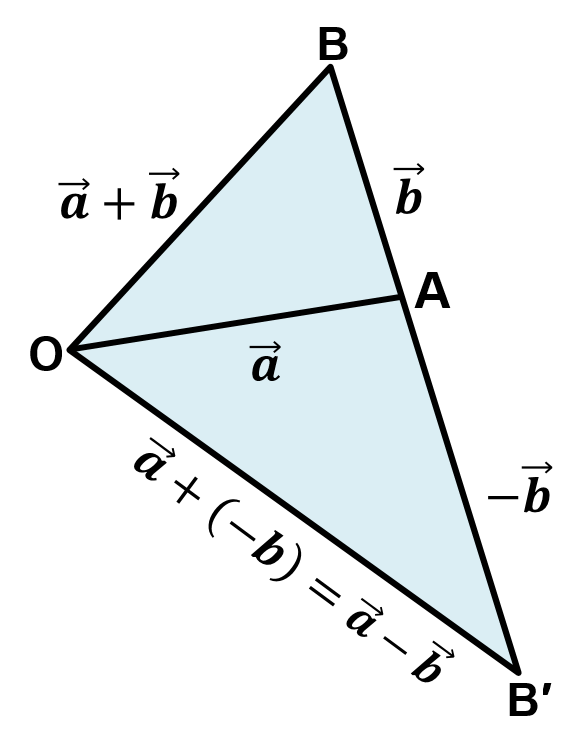
If and are two vectors, then the subtraction of from is defined as the vector sum of and  and it is denoted by
  i.e.
i.e.  .
.
Thus, to subtract vector from vector, we reverse the direction of vector and add it to vector as:
Example: If  and
and then find
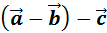 ?
?
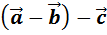
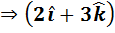
Solution: We have,