Chapter 1 : Introduction to Vectors
Topics covered in this snack-sized chapter:
Vector Algebra is the part of algebra that deals with the theory of vectors and vector spaces.
Vector Quantity:
A vector is defined to be a directed line segment.
A vector quantity has both magnitude and direction.
Examples include acceleration, velocity, force, displacement, etc.
Vectors can be depicted graphically in two or three dimensions.
Scalar Quantity:
A scalar quantity has only magnitude and no direction.
Examples include mass, temperature, time and distance etc.
Vectors are usually denoted in lowercase boldface, as a or lowercase italic boldface, as a.
Other conventions include  or a, especially in handwriting.
If the vector represents a directed distance or displacement from a point A to a point B (see figure), it can also be denoted as  .
.
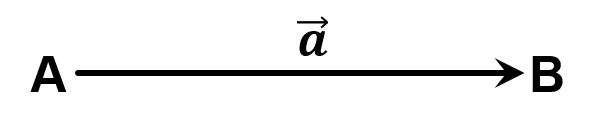
Meaning of magnitude is size or quantity.
The magnitude of the vector is the length of the line segment AB. It is denoted by  .
.
The magnitude of a vector is always a positive number or zero.
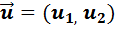
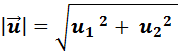
We can calculate the magnitude of a vector knowing the coordinates of the endpoints: A(x1,
y1
) and B (x2,
y2
)


Vectors can be classified as follows:
A vector whose initial and terminal points are coincident is called the zero or the null vector.
It is a vector whose magnitude is zero.
The null vector is denoted by  .
.
A vector, whose modulus is unity, is called a unit vector.
The unit vector in the direction of a vector is denoted by  , read ‘a cap’ thus,
  .
.
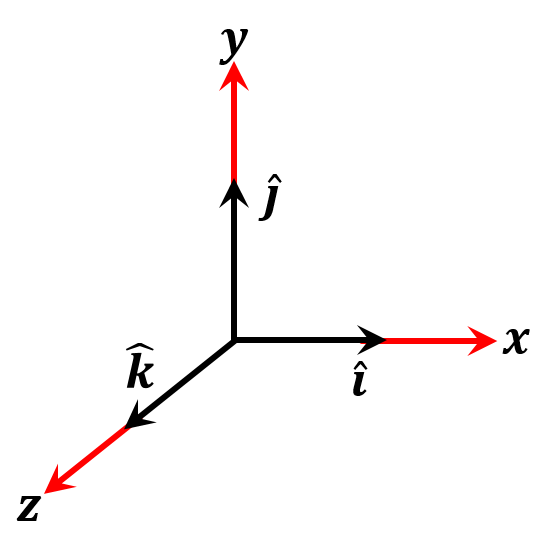
As shown, in the above figure  ,
,  ,
,  are the unit vectors in the direction of
  and
and  axis.
axis.
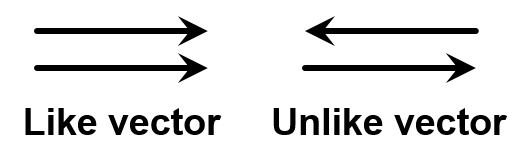
Vectors are said to be like when they have the same sense of direction and unlike when they have opposite directions.
Vector having the same initial point are called co –initial vectors.
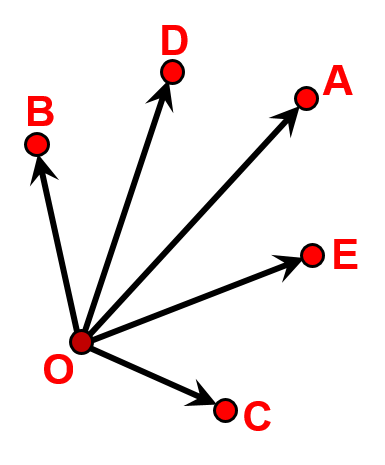
In the above figure,  are co-initial vectors, having the same initial point O.
The vectors which lie in the same plane are called co-planar vector.
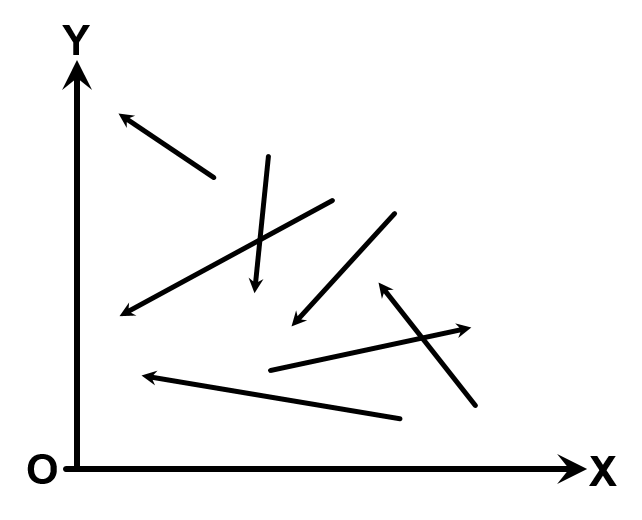
- All the vectors which lie in XY plane are coplanar with respect to one another.
If any vector possess components along all the three axes X, Y and Z such vectors are called space vectors.
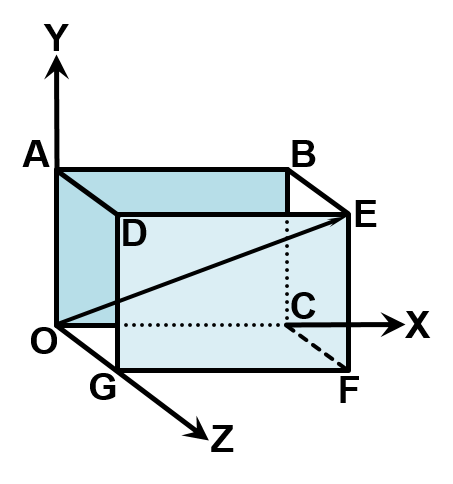
In the given figure  is a space vector, where OC = ax
, OA = ay
and OG = az
. Hence
is a space vector, where OC = ax
, OA = ay
and OG = az
. Hence  .
.
The vector which has the same magnitude as the vector but opposite direction, is called the negative of and is denoted by  .
.
Thus, if  , then
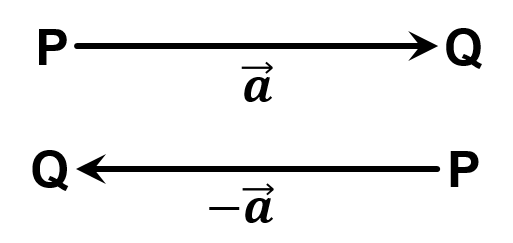
A vector having the same direction as that of a given vector but magnitude equal to the reciprocal of the given vector is known as the reciprocal of and is denoted by  .
.
Thus,

