Chapter 2 : Planning and Survival Kits
Topics covered in this snack-sized chapter:
A survival plan depends on three separate but intertwined parts to be successful.
Plans are based on Evasion and Recovery (E&R) considerations and the availability of resupply or emergency bundles.
The following things should be considered during Planning.
- The distance to friendly lines.
- The environment, including the terrain and weather and possible changes in the weather.
- The platform you will be operating with.
Preparation means preparing yourself and your survival kit for the contingencies.
Practice those things that you have planned with the items in your survival kit.
Checking ensures that items work and that you know how to use them.
Including survival considerations in mission planning will enhance your chances of survival.
One important aspect of prior planning is preventive medicine.
Properly preparing and carrying a survival kit is important.
Before making your survival kit, consider
- The operational environment.
- The equipment and vehicles assigned to your unit.
| Long term survival plan
| When a disaster is of long duration
|
| Determination
| To acquire the means of survival and follow through when a disaster or emergency occurs
|
| Staying healthy
| When an emergency does occur, to meet any challenges you may face
|
| Preparedness budget
| To kept up to date at all times
|
| Action Plans
| To move directly into action with a minimum of delay
|
| “Bug-out bag”
| To keep you alive when disaster strikes suddenly and unexpectedly
|
| Survival training
| Increasing training at every opportunity
|
| Practicing survival skills
| So that they are ready for use when the time comes
|
| Not advertising the fact that you are prepared to survive
| So that those with little or no disaster preparedness will not attempt to harm you or steal your preparations
|
The environment is the key to the types of items you will need in your survival kit.
In preparing a survival kit, select items that are
Keep the most important items on your body.
Functional items that will meet these needs:
- Water-repellent or waterproof.
- Easy to carry or attach to your body.
- Suitable to accept various-sized. Components.
Imagination may be the largest part of your kit.
Include a weapon only if the situation dictates.
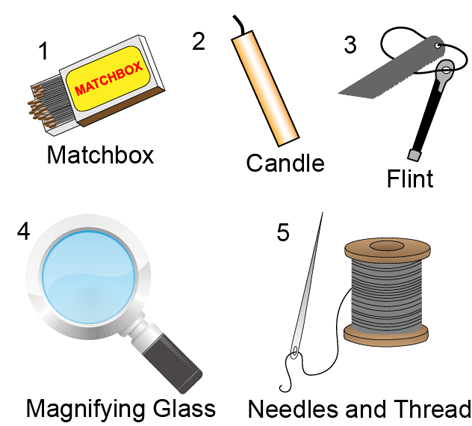
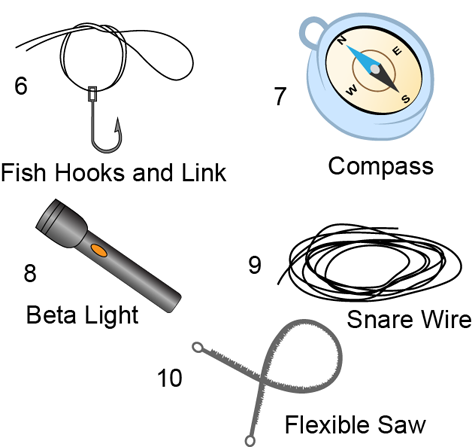
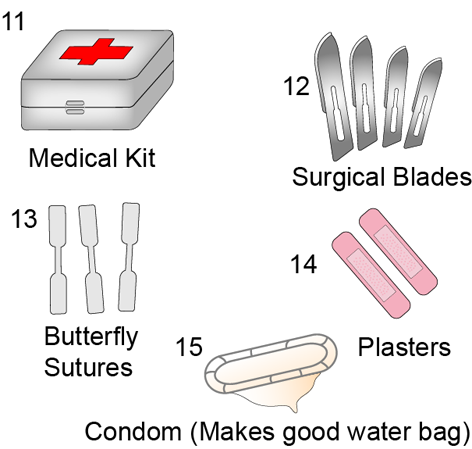
Survival kit should be broken down into the following categories
| Category
| Inclusions
|
| Water
| Purification tablets
Non-lubricated condoms for carrying water
Bleach
Cravats
Sponges
Small plastic or rubber tubing
Collapsible canteens or water bags
|
| Fire
| Lighter
Metal match
Waterproof matches
Magnesium bar
Candle
Magnifying lens
|
| Food
|
Knife
Snare wire
Fishhooks
Fish and snare line
Bouillon cubes or soup packets
High-energy food bars
Granola bars
Gill or yeti net
Aluminum foil
Freezer bags
|
| Signal
| Signaling mirror
Strobe
Pen flares
Whistle
Flag
Pilot scarf or other bright orange silk scarf
Glint tape
Flashlight
Laser pointer
Solar blanket
|
| Medical
| Ox tetracycline tablets
Surgical blades or surgical preparation knife
Butterfly sutures
Lip balm
Safety pins
Sutures
Anti-diarrheal medication
Antimalarial medication (Doxycycline)
Broad-spectrum antibiotics
(Rocephin and zithromax)
Broad spectrum topical Ophthalmic (eye) antibiotic
Antifungal, anti-inflammatory (Ibuprofen)
Petrolatum gauze
Soap
|
| Miscellaneous
| Wrist compass
Needle and thread
Extra eyeglasses
Knife sharpener
Cork
Camouflage stick
Survival manual
Money
|