Other Sellers on Amazon
& FREE Shipping
89% positive over last 12 months
Usually ships within 3 to 4 days.
+ $3.99 shipping
95% positive over last 12 months
+ $3.99 shipping
84% positive over last 12 months
Follow the Author
OK
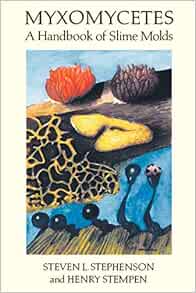
Myxomycetes Paperback – Illustrated, February 1, 2000
|
Steven L. Stephenson
(Author)
Find all the books, read about the author, and more.
See search results for this author
|
-
Print length200 pages
-
LanguageEnglish
-
PublisherTimber Press, Incorporated
-
Publication dateFebruary 1, 2000
-
Dimensions6.08 x 0.53 x 8.76 inches
-
ISBN-100881924393
-
ISBN-13978-0881924398
Enter your mobile number or email address below and we'll send you a link to download the free Kindle App. Then you can start reading Kindle books on your smartphone, tablet, or computer - no Kindle device required.
-
Apple
-
Android
-
Windows Phone
-
Android
|
Download to your computer
|
Kindle Cloud Reader
|
Frequently bought together
Customers who viewed this item also viewed
The Social Amoebae: The Biology of Cellular Slime MoldsHardcover$27.50$27.50FREE Shipping on orders over $25 shipped by AmazonGet it as soon as Monday, Sep 6Only 15 left in stock - order soon.

The Curious Observer's Guide to Slime Mold of UC Santa Cruz and BeyondCarrie NiblettPaperback$17.99$17.99FREE Shipping on orders over $25 shipped by AmazonGet it as soon as Monday, Sep 6
Lichens of North AmericaHardcover$130.00$130.00FREE Shipping on orders over $25 shipped by AmazonGet it as soon as Monday, Sep 6
On the Track of the Elusive Slime MoldSteve StephensonPaperback$27.95$27.95& Free ShippingOnly 1 left in stock - order soon.
Entangled Life: How Fungi Make Our Worlds, Change Our Minds & Shape Our FuturesPaperback$15.49$15.49FREE Shipping on orders over $25 shipped by AmazonGet it as soon as Friday, Sep 3
Secretive Slime Moulds: Myxomycetes of AustraliaSteven StephensonHardcoverFREE Shipping on orders over $25 shipped by AmazonIn stock soon.
What other items do customers buy after viewing this item?
The Curious Observer's Guide to Slime Mold of UC Santa Cruz and BeyondCarrie NiblettPaperback$17.99$17.99FREE Shipping on orders over $25 shipped by AmazonGet it as soon as Monday, Sep 6
The Social Amoebae: The Biology of Cellular Slime MoldsHardcover$27.50$27.50FREE Shipping on orders over $25 shipped by AmazonGet it as soon as Monday, Sep 6Only 15 left in stock - order soon.
Lichens of the North Woods (Naturalist Series)Joe WalewskiPaperback$18.95$18.95FREE Shipping on orders over $25 shipped by AmazonGet it as soon as Friday, Sep 3
The Fifth KingdomBryce KendrickPaperback$47.60$47.60FREE Shipping on orders over $25 shipped by AmazonGet it as soon as Friday, Sep 3
National Audubon Society Field Guide to North American Mushrooms (National Audubon Society Field Guides)Paperback$13.99$13.99FREE Shipping on orders over $25 shipped by AmazonGet it as soon as Friday, Sep 3
Editorial Reviews
Review
The aim of this book is to introduce slime moulds to the public and this it does admirably. -- A. Feest, New Phytol, Vol 132 1996
This handbook goes a long way toward revealing the otherworldly beauty of the myxomycetes. -- HortIdeas, March 2000
This handbook should certainly stimulate interest and study of the myxomycetes. -- Vernon Ahmadjian, The Bryologist, Vol 98 1995
Book Description
About the Author
Excerpt. © Reprinted by permission. All rights reserved.
Slime molds, or myxomycetes, as biologists call them, may not have a particularly attractive name, but members of the group produce fruiting bodies that exhibit incredibly diverse forms and colors and are often objects of considerable beauty. Most myxomycetes are quite small, reaching no more than a millimeter or two in height. Although large enough to be seen with the naked eye, the fruiting bodies of myxomycetes can best be observed with a hand lens or microscope. Only then can their intricate nature be fully appreciated. Fruiting bodies may take the shape of tiny goblets, globes, plumes, or other shapes more difficult to characterize. Some occur in tightly packed clusters, while others are scattered or even solitary. Many of the more intricate forms have a spore case held aloft on a delicate stalk, but others are attached directly to the substrate by their bases. Whatever form the fruiting body takes, its primary function is to produce the spores by which the myxomycete is propagated.
Myxomycetes have long intrigued and perplexed biologists because they possess characteristics of both animals and fungi. The fruiting bodies and spores they produce resemble those of many fungi, but some of their other attributes, including the capability for locomotion, are normally associated with animals.
For most of its life, a myxomycete exists as a thin, free-living mass of protoplasm. Sometimes this mass is several centimeters across and, as the name slime mold suggests, viscous and slimy to the touch. The mass of protoplasm, which is called a plasmodium (plural: plasmodia), can change form and creep slowly over the substrate upon which it occurs, much like a giant amoeba. As it moves, it feeds by engulfing bacteria and tiny bits of organic matter, another animal-like feature
Myxomycete plasmodia occur in cool, moist, shady places such as within crevices of decaying wood, beneath the partially decayed bark of logs and stumps, and in leaf litter. Consequently, they are not seen as frequently as are the fruiting bodies. Nonetheless, one can sometimes find plasmodia by stripping the bark from a decaying log or by carefully searching the moist underside of a piece of wood that has been lying on the forest floor. Plasmodia may be colorless or, as is more often the case, strikingly colored yellow, orange, or red.
After a period of feeding and growth, the plasmodium moves out of its normal habitat and into a drier, more exposed location. Here it gives rise to one or more fruiting bodies. This remarkable transformation from an animal-like to a funguslike form seems more like something from science fiction than like science fact. Each fruiting body contains numerous spores, which are dispersed by the wind and, under suitable conditions, germinate--the first stage in development of a new plasmodium.
Most people overlook myxomycetes because of their small size and because of where they occur . . . However, myxomycetes are among the most fascinating inhabitants of the woodlands of the world.
I'd like to read this book on Kindle
Don't have a Kindle? Get your Kindle here, or download a FREE Kindle Reading App.
Product details
- Publisher : Timber Press, Incorporated (February 1, 2000)
- Language : English
- Paperback : 200 pages
- ISBN-10 : 0881924393
- ISBN-13 : 978-0881924398
- Item Weight : 10.6 ounces
- Dimensions : 6.08 x 0.53 x 8.76 inches
-
Best Sellers Rank:
#509,607 in Books (See Top 100 in Books)
- #252 in Mushrooms in Biological Sciences
- #480 in Microbiology (Books)
- #483 in Gardening & Horticulture Reference (Books)
- Customer Reviews:
Customer reviews
Top reviews from the United States
There was a problem filtering reviews right now. Please try again later.
Stephenson and Stempen have written an excellent book on these strange critters in "Myxomycetes: A Handbook of Slime Molds." It fills a gap in the literature on natural history. It is my hope that more people will be able to appreciate these neat organisms through the descriptions, excellent line drawings and well-rendered color plates.
I will disagree with one reviewer's dislike of the describer's name after the scientific name, however. It is there for the convenience of other taxonomist as least as much as the vanity of the describer. If I know that Physarum nutans was described by Persoon it tells me something about where I should look for the original description and may also give me some idea of when the name probably originated. Also Physarum cinereum (Batsch) Persoon tells me that Batsch wrote the original description, but placed the species in a different genus, which was than changed to the present genus by Persoon. Thus such "vain" additions are often important to other workers in the field.
I do agree with the same reviewer that some further discussion of how slime molds are classified might have helped an otherwise excellent book. However, I am also fully aware that the classification is still in flux and no final answers may yet be possible until DNA studies are done (and maybe not even then!).
Read this book if you find the weirdness of the world fascinating! Better still, use it to find and identify slime molds. Good hunting.
All that said, the illustrations are wonderful and there is good information in the book. Information and species descriptions are presented in a straighforward, factual manner that more advanced students will appreciate. It is not a collection of interesting field anecdotes or stories, though with the peculiarities of this group I did expect that. There is plenty of basis for a creative science writer to expound on these, but alas, my romance with slime was not to be. I'm sure other readers with more patience to figure things out on their own will find the book useful, but I admit I don't have the patience to scan all 54 species descriptions to find what I'm looking for. A key is provided, but it is based on the microscopic fruiting bodies, so for the layman it is useless.
All I want to know is, what was that big neon orange blob I'd seen moving through the woods? I'm sorry to report that the answer escaped me in this book.
If you are interested, the Sam Mitchell Herbarium at the Denver Botanic Gardens in Denver, Colorado USA has what is probably the world's best collection of specimens down in some lockers in the basement.
Otherwise, I don't think there are a lot of us that are studying these things, although I get the impression there is somewhat more interest outside of the U.S.
Top reviews from other countries
It is also worth noting that pages 95 and 96 are bound into the book in the wrong order, merging and confusing the species descriptions of both Ceratomyxia fruticulosa and Clastoderma debaryanum.
Overall, the book provides useful information on the subject, and, with the caveat that this is a wholly black and white edition, the individual species descriptions and illustrations are excellent.